



AD
(4S)-4-Phenyl-1,3-thiazolidine-2-thione(CAS: 185137-29-5)
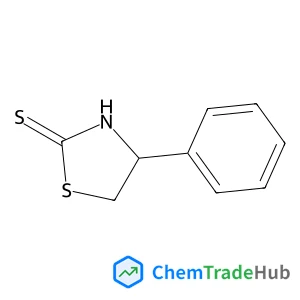
CAS Number
Related Products


methyl}benzamide](https://static.chemtradehub.com/structs/224/2247491-97-8-c197.webp)
![4-Amino-2-({[(2-methyl-2-propanyl)oxy]carbonyl}amino)butanoic acid](https://static.chemtradehub.com/structs/289/2899-79-8-863a.webp)
![2-Methyl-2-propanyl 7-(4,4,5,5-tetramethyl-1,3,2-dioxaborolan-2-yl)-2-azaspiro[4.4]nonane-2-carboxylate](https://static.chemtradehub.com/structs/230/2304631-27-2-21b7.webp)
![Methyl 3-(4-{3-[3-(trifluoromethyl)phenyl]-1H-pyrazol-5-yl}-1-piperidinyl)propanoate](https://static.chemtradehub.com/structs/103/1030386-15-2-7851.webp)
Other Suppliers for (4S)-4-Phenyl-1,3-thiazolidine-2-thione








Basic Information
Molecular Formula
C9H9NS2
Molecular Weight
195.31 g/mol
Physical Properties
Melting Point
127.0 to 131.0 deg-C
Boiling Point
322.2°C at 760 mmHg
Chemical Identifiers
SMILES
C1C(NC(=S)S1)C2=CC=CC=C2
InChIKey
IEXSISKCCADMLK-MRVPVSSYSA-N
Database References
MDL Number
MFCD06658214
FAQ
(4S)-4-Phenyl-1,3-thiazolidine-2-thione is a white crystalline solid with a molecular weight of 192.22 g/mol. It is soluble in organic solvents like DMSO and DMF. This compound is characterized by its low solubility in water. It exhibits good reactivity, particularly towards nucleophiles, making it suitable for various synthetic transformations. It is stable under normal conditions but should be protected from moisture and air to prevent hydrolysis.
(4S)-4-Phenyl-1,3-thiazolidine-2-thione can be synthesized by the condensation of 4-phenylthiazolidine-2-thione with appropriate reagents under basic conditions. Commonly, this involves the use of sodium hydride as a base in a suitable solvent such as dimethylformamide (DMF). The reaction is typically carried out at room temperature, yielding a high selectivity and good yield. The exact method may vary depending on the starting materials and desired purity of the product.
(4S)-4-Phenyl-1,3-thiazolidine-2-thione finds applications in pharmaceuticals, particularly in the development of bioactive compounds and drugs targeting specific biological pathways. It is also used in the synthesis of polymers, where it acts as a functional monomer. Additionally, it is employed in the manufacturing of sensors for detecting various gases and in the production of semiconductors for their specific chemical and electronic properties.
When handling (4S)-4-Phenyl-1,3-thiazolidine-2-thione, it is crucial to wear appropriate personal protective equipment (PPE) including gloves, safety glasses, and a lab coat. This compound should be used in a well-ventilated area or a fume hood to minimize exposure to airborne particles. It is important to follow standard laboratory safety protocols and keep an up-to-date safety data sheet (SDS) on hand. Spills should be cleaned up immediately using appropriate absorbents and disposed of according to local regulations.
Safety Notice
Please verify product specifications and safety data before use. Contact the supplier for detailed safety information.
Always follow proper handling procedures
Contact Information
Contact Person
Manager Gu
sales@gh-reagent.com
Mobile
18939883912
Telephone
021-34536277
Visit Website
https://www.gh-reagent.com/Address
No. 91, Building 2, Block 537, Sanada Road, Minhang District, Pujiang Town, Shanghai