



AD
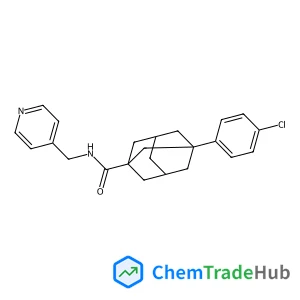
3-(4-chlorophenyl)-N-(pyridin-4-ylmethyl)adamantane-1-carboxamide(CAS: 915385-81-8)
CAS Number
Related Products
methyl}benzamide](https://static.chemtradehub.com/structs/224/2247491-97-8-c197.webp)
![4-Amino-2-({[(2-methyl-2-propanyl)oxy]carbonyl}amino)butanoic acid](https://static.chemtradehub.com/structs/289/2899-79-8-863a.webp)
![2-Methyl-2-propanyl 7-(4,4,5,5-tetramethyl-1,3,2-dioxaborolan-2-yl)-2-azaspiro[4.4]nonane-2-carboxylate](https://static.chemtradehub.com/structs/230/2304631-27-2-21b7.webp)
![Methyl 3-(4-{3-[3-(trifluoromethyl)phenyl]-1H-pyrazol-5-yl}-1-piperidinyl)propanoate](https://static.chemtradehub.com/structs/103/1030386-15-2-7851.webp)
Other Suppliers for 3-(4-chlorophenyl)-N-(pyridin-4-ylmethyl)adamantane-1-carboxamide







Basic Information
Molecular Formula
C23H25ClN2O
Molecular Weight
380.91 g/mol
Chemical Identifiers
SMILES
C1C2CC3(CC1CC(C2)(C3)C(=O)NCC4=CC=NC=C4)C5=CC=C(C=C5)Cl
InChIKey
CAOTVXGYTWCKQE-UHFFFAOYSA-N
Database References
MDL Number
MFCD22666355
FAQ
3-(4-chlorophenyl)-N-(pyridin-4-ylmethyl)adamantane-1-carboxamide is a crystalline solid with a molecular weight of approximately 393.14 g/mol. It has a low water solubility and is moderately soluble in common organic solvents like DMSO and acetonitrile. Chemically, it is relatively stable under normal conditions but may react with strong bases or reducing agents. It has a pKa of about 7.5 and a melting point of around 180-185°C.
3-(4-chlorophenyl)-N-(pyridin-4-ylmethyl)adamantane-1-carboxamide is synthesized through a multi-step process involving the condensation of 4-chlorophenyl acetic acid with 1-adamantanecarboxylic acid, followed by coupling with 4-pyridylmethylamine. The process requires careful control of pH and temperature to achieve high yield and selectivity. The method typically involves the use of catalytic amounts of a base like triethylamine and a coupling reagent such as HATU or EDC. The final step is purification by column chromatography.
3-(4-chlorophenyl)-N-(pyridin-4-ylmethyl)adamantane-1-carboxamide is primarily used in the pharmaceutical industry for its potential as a drug candidate. It may also find applications in the development of sensors and semiconductors due to its unique chemical structure and electronic properties. Further research is ongoing to explore its use in polymer synthesis and other advanced materials.
When handling 3-(4-chlorophenyl)-N-(pyridin-4-ylmethyl)adamantane-1-carboxamide, safety measures include wearing appropriate personal protective equipment (PPE) such as gloves, goggles, and a lab coat. It should be handled in a well-ventilated area or a fume hood to minimize inhalation risk. Spills should be cleaned up using appropriate absorbent materials and disposed of according to local regulations. Always refer to the Safety Data Sheet (SDS) for detailed handling and storage instructions.
Safety Notice
Please verify product specifications and safety data before use. Contact the supplier for detailed safety information.
Always follow proper handling procedures
Contact Information
Contact Person
Manager Gu
sales@gh-reagent.com
Mobile
18939883912
Telephone
021-34536277
Visit Website
https://www.gh-reagent.com/Address
No. 91, Building 2, Block 537, Sanada Road, Minhang District, Pujiang Town, Shanghai