



AD
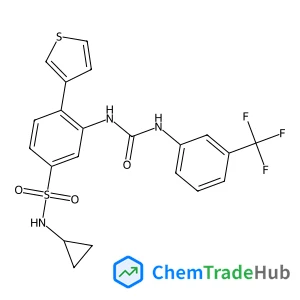
N-cyclopropyl-4-(thiophen-3-yl)-3-(3-(3-(trifluoromethyl)phenyl)ureido)benzenesulfonamide(CAS: 1432660-47-3)
CAS Number
Related Products

![Ethyl 4-(2-{4,5-bis[4-(ethoxycarbonyl)phenyl]-1,3-dithiol-2-ylidene}-5-[4-(ethoxycarbonyl)phenyl]-1,3-dithiol-4-yl)benzoate](https://static.chemtradehub.com/structs/135/1356336-61-2-b5d1.webp)
![1-[(3aS,8aS)-2,2-Dimethyl-4,4,8,8-tetraphenyltetrahydro[1,3]dioxolo[4,5-e][1,3,2]dioxaphosphepin-6-yl]piperidine](https://static.chemtradehub.com/structs/582/582300-11-6-7e49.webp)
![2-[(5-Phenyl-2-pyrimidinyl)amino]ethanol](https://static.chemtradehub.com/structs/298/298217-37-5-72d8.webp)





Other Suppliers for N-cyclopropyl-4-(thiophen-3-yl)-3-(3-(3-(trifluoromethyl)phenyl)ureido)benzenesulfonamide





Basic Information
Molecular Formula
C21H18F3N3O3S2
Molecular Weight
481.52 g/mol
Chemical Identifiers
SMILES
C1CC1NS(=O)(=O)C2=CC(=C(C=C2)C3=CSC=C3)NC(=O)NC4=CC=CC(=C4)C(F)(F)F
InChIKey
CCAWRGNYALGPQH-UHFFFAOYSA-N
Database References
MDL Number
MFCD26097285
FAQ
N-cyclopropyl-4-(thiophen-3-yl)-3-(3-(3-(trifluoromethyl)phenyl)ureido)benzenesulfonamide (CAS: 1432660-47-3) falls under various regulatory guidelines, including GHS classification for hazardous chemicals, REACH regulations for European manufacturers, and FDA/EPA requirements for safety and environmental protection. It is crucial to adhere to these guidelines to ensure the safe handling, transport, and disposal of the compound.
Several alternatives to N-cyclopropyl-4-(thiophen-3-yl)-3-(3-(3-(trifluoromethyl)phenyl)ureido)benzenesulfonamide (CAS: 1432660-47-3) exist in synthesis, including analogs such as related thiophene-based compounds and isomers. Common alternative reagents include trifluoromethylated phenylureas and thiophene derivatives. These alternatives can offer similar functional groups or improved properties for specific applications.
The market for N-cyclopropyl-4-(thiophen-3-yl)-3-(3-(3-(trifluoromethyl)phenyl)ureido)benzenesulfonamide (CAS: 1432660-47-3) is driven by its use in pharmaceutical applications, particularly in the development of new drug candidates. Research trends focus on its ability to modulate specific biological pathways and its potential in treating various diseases. Additionally, there is an increasing interest in its synthesis and chemical properties, which are being explored for diverse applications.
Waste containing N-cyclopropyl-4-(thiophen-3-yl)-3-(3-(3-(trifluoromethyl)phenyl)ureido)benzenesulfonamide (CAS: 1432660-47-3) should be collected and disposed of according to local and international regulations. Collection should be done in compatible containers to prevent contamination. For disposal, industrial incineration is a common method, while professional waste disposal services can also be utilized. It is essential to take appropriate environmental protection precautions to minimize the impact on the environment and public health.
Safety Notice
Please verify product specifications and safety data before use. Contact the supplier for detailed safety information.
Always follow proper handling procedures
Contact Information
shenlinxing@macklin.cn
Mobile
15221275939
Telephone
021-50706066
Fax
021-50706099
Visit Website
https://www.macklin.cn