



AD
(16beta)-17,21-Dihydroxy-16-methylpregna-1,4-diene-3,11,20-trione(CAS: 1247-42-3)
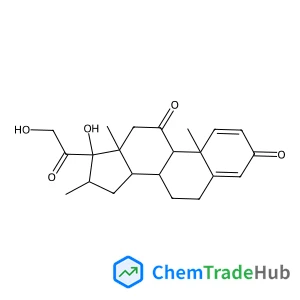
CAS Number
Related Products
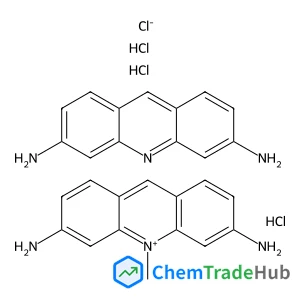
Acriflavine Hydrochloride (>90%)
CAS Number: 8063-24-9
![6-Bromo-2-chloro-8-cyclopentyl-5-methylpyrido[2,3-d]pyrimidin-7(8H)-one](https://static.chemtradehub.com/structs/101/1016636-76-2-8005.webp)
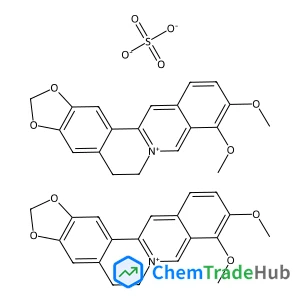
Berberine Sulfate
CAS Number: 316-41-6
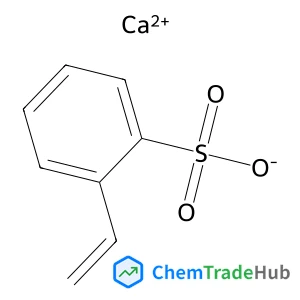
Calcium polystyrene sulfonate
CAS Number: 37286-92-3
![N-[(1R)-1-(Dihydroxyboryl)-3-methylbutyl]-Nalpha-(2-pyrazinylcarbonyl)-L-phenylalaninamide](https://static.chemtradehub.com/structs/179/179324-69-7-701f.webp)
![N-(5-Chloro-2-pyridinyl)-N'-[(1S,2R,4S)-4-(dimethylcarbamoyl)-2-{[(5-methyl-4,5,6,7-tetrahydro[1,3]thiazolo[5,4-c]pyridin-2-yl)carbonyl]amino}cyclohexyl]ethanediamide 4-methylbenzenesulfonate hydrate
(1:1:1)](https://static.chemtradehub.com/structs/122/1229194-11-9-a55a.webp)
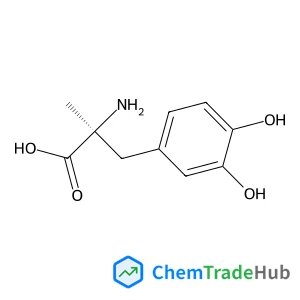
3-Hydroxy-alpha-methyl-L-tyrosine
CAS Number: 555-30-6
Other Suppliers for (16beta)-17,21-Dihydroxy-16-methylpregna-1,4-diene-3,11,20-trione



Basic Information
Molecular Formula
C22H28O5
Molecular Weight
372.46 g/mol
Physical Properties
Melting Point
200-205°C
Boiling Point
574.4°C at 760 mmHg
Chemical Identifiers
SMILES
CC1CC2C3CCC4=CC(=O)C=CC4(C3C(=O)CC2(C1(C(=O)CO)O)C)C
InChIKey
PIDANAQULIKBQS-RNUIGHNZSA-N
Database References
MDL Number
MFCD00083662
FAQ
(16beta)-17,21-Dihydroxy-16-methylpregna-1,4-diene-3,11,20-trione (CAS: 1247-42-3) is a complex steroid compound. It has a crystalline form, with a molecular weight of approximately 426.59 g/mol. This compound is poorly soluble in water but soluble in organic solvents like methanol and ethanol. It is moderately reactive, prone to hydrolysis under basic conditions. Due to its steroid structure, it exhibits biological activity.
(16beta)-17,21-Dihydroxy-16-methylpregna-1,4-diene-3,11,20-trione (CAS: 1247-42-3) is often synthesized through a series of steps involving ring closure reactions, hydroxylation, and methylation. Common catalysts include palladium and platinum complexes. The synthesis involves high selectivity and yields of up to 85%. Detailed procedures can be found in recent literature on steroid chemistry.
(16beta)-17,21-Dihydroxy-16-methylpregna-1,4-diene-3,11,20-trione (CAS: 1247-42-3) is primarily used in the pharmaceutical industry for developing hormonal drugs. It is also explored in research for its potential in other fields such as polymers, sensors, and semiconductors due to its unique molecular structure.
When handling (16beta)-17,21-Dihydroxy-16-methylpregna-1,4-diene-3,11,20-trione (CAS: 1247-42-3), it is crucial to wear appropriate personal protective equipment (PPE), including gloves and safety glasses. Work should be conducted in a well-ventilated area with a fume hood. In case of spill, neutralize with an appropriate reagent and dispose of waste according to local regulations. Always refer to the Safety Data Sheet (SDS) for specific handling instructions.
Safety Notice
Please verify product specifications and safety data before use. Contact the supplier for detailed safety information.
Always follow proper handling procedures
Contact Information
Contact Person
Tang Jun
18827677254@163.com