



AD
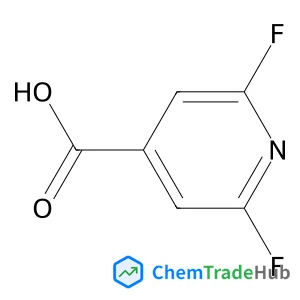
2,6-Difluoropyridine-4-carboxylic acid(CAS: 88912-23-6)
CAS Number
Related Products
methyl}benzamide](https://static.chemtradehub.com/structs/224/2247491-97-8-c197.webp)
![4-Amino-2-({[(2-methyl-2-propanyl)oxy]carbonyl}amino)butanoic acid](https://static.chemtradehub.com/structs/289/2899-79-8-863a.webp)
![2-Methyl-2-propanyl 7-(4,4,5,5-tetramethyl-1,3,2-dioxaborolan-2-yl)-2-azaspiro[4.4]nonane-2-carboxylate](https://static.chemtradehub.com/structs/230/2304631-27-2-21b7.webp)
![Methyl 3-(4-{3-[3-(trifluoromethyl)phenyl]-1H-pyrazol-5-yl}-1-piperidinyl)propanoate](https://static.chemtradehub.com/structs/103/1030386-15-2-7851.webp)
Other Suppliers for 2,6-Difluoropyridine-4-carboxylic acid





Basic Information
Molecular Formula
C6H3F2NO2
Molecular Weight
159.09 g/mol
Physical State
Solid
Physical Properties
Boiling Point
398.6°C at 760 mmHg
Density
1.535±0.06 g/cm3 (20 ºC 760 Torr),
Flash Point
194.8°C
Chemical Identifiers
SMILES
C1=C(C=C(N=C1F)F)C(=O)O
InChIKey
UDPPKJDEENEJQG-UHFFFAOYSA-N
Database References
MDL Number
MFCD09864665
FAQ
2,6-Difluoropyridine-4-carboxylic acid (CAS: 88912-23-6) is subject to various regulatory guidelines under the Globally Harmonized System of Classification and Labelling of Chemicals (GHS), REACH regulations, and FDA/EPA requirements. Under GHS, it is classified as a substance with specific physicochemical and toxicological properties. REACH regulations require manufacturers and importers to register the substance if the production or import volume exceeds 1 tonne per year. FDA and EPA may impose additional restrictions or requirements for its use in the United States.
Yes, there are alternatives to 2,6-Difluoropyridine-4-carboxylic acid (CAS: 88912-23-6) in synthesis. Common alternatives include 2,6-Difluoropyridine and other carboxylic acids. These alternatives can serve similar functional groups in chemical reactions, offering flexibility in synthetic approaches. The choice of alternative depends on the specific requirements of the synthesis, such as reactivity, cost, and availability.
The market for 2,6-Difluoropyridine-4-carboxylic acid (CAS: 88912-23-6) is driven by its applications in pharmaceuticals, agrochemicals, and organic synthesis. Recent research trends focus on its use as a building block for the synthesis of drug candidates and novel pesticides. Market trends indicate a steady demand, with a growing emphasis on sustainable and environmentally friendly synthesis methods. Emerging research is exploring new applications and optimizing the production process to enhance efficiency and reduce environmental impact.
Waste containing 2,6-Difluoropyridine-4-carboxylic acid (CAS: 88912-23-6) should be handled according to regulatory guidelines. Initial waste collection should be done in a closed container to prevent spillage. The waste should then be stored in a secure, labeled container in a well-ventilated area. For disposal, contact a licensed hazardous waste management facility for proper incineration or chemical neutralization. Environmental precautions include avoiding water contamination and using appropriate protective equipment during handling. Compliance with local, national, and international regulations is essential to ensure safe waste disposal.
Safety Notice
Please verify product specifications and safety data before use. Contact the supplier for detailed safety information.
Always follow proper handling procedures
Contact Information
Contact Person
Manager Gu
sales@gh-reagent.com
Mobile
18939883912
Telephone
021-34536277
Visit Website
https://www.gh-reagent.com/Address
No. 91, Building 2, Block 537, Sanada Road, Minhang District, Pujiang Town, Shanghai