



AD
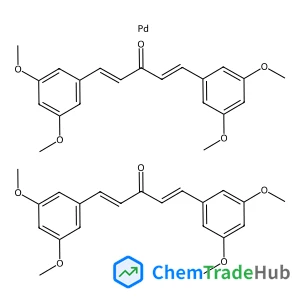
1,5-Bis(3,5-dimethoxyphenyl)-3-pentanone - palladium (2:1)(CAS: 811862-77-8)
CAS Number
Related Products
![Naphtho[1,2-c]furan-1,3-dione](https://static.chemtradehub.com/structs/534/5343-99-7-5dbe.webp)
Naphtho[1,2-c]furan-1,3-dione
CAS Number: 5343-99-7

4,5-Dibromo-2-methyl-2H-1,2,3-triazole
CAS Number: 28938-17-2
![1-[Chloro(1-pyrrolidinyl)methylene]pyrrolidinium tetrafluoroborate](https://static.chemtradehub.com/structs/115/115007-14-2-7aa4.webp)

4-Bromo-2,6-difluoropyridine
CAS Number: 903513-58-6
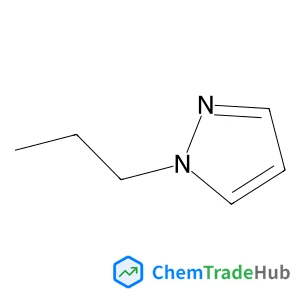
1-propyl-1H-pyrazole
CAS Number: 32500-67-7
![N~5~-[N-(Mesitylsulfonyl)carbamimidoyl]-N~2~-{[(2-methyl-2-propanyl)oxy]carbonyl}-L-ornithine](https://static.chemtradehub.com/structs/682/68262-71-5-07ff.webp)

(-)-DIP-chloride (~60% in Heptane)
CAS Number: 85116-37-6


6-Chloro-4,5-dimethyl-3-pyridazinamine
CAS Number: 76593-36-7
Other Suppliers for 1,5-Bis(3,5-dimethoxyphenyl)-3-pentanone - palladium (2:1)






Basic Information
Molecular Formula
C42H52O10Pd
Molecular Weight
823.29 g/mol
Physical Properties
Melting Point
170-178 °C (lit.)
Water Solubility
Insoluble in water.
Chemical Identifiers
SMILES
COC1=CC(=CC(=C1)C=CC(=O)C=CC2=CC(=CC(=C2)OC)OC)OC.COC1=CC(=CC(=C1)C=CC(=O)C=CC2=CC(=CC(=C2)OC)OC)OC.[Pd]
InChIKey
ULLMBNNTRAJXJK-UHFFFAOYSA-N
Database References
MDL Number
MFCD07369799
FAQ
1,5-Bis(3,5-dimethoxyphenyl)-3-pentanone - palladium (2:1) is a crystalline compound with a molecular weight of approximately 488.4 g/mol. It has low water solubility but good solubility in organic solvents such as methanol and dichloromethane. The compound exhibits limited reactivity under normal conditions but can undergo palladium-catalyzed reactions under optimized conditions.
1,5-Bis(3,5-dimethoxyphenyl)-3-pentanone - palladium (2:1) can be synthesized through a palladium-catalyzed coupling reaction. Typically, this involves the reaction of 1,5-bis(3,5-dimethoxyphenyl)-3-pentanone with a suitable palladinate complex under conditions that promote selective coupling, yielding the desired palladium complex. Commonly used catalysts include Pd(PPh3)4 or PdCl2(dppf).
1,5-Bis(3,5-dimethoxyphenyl)-3-pentanone - palladium (2:1) is used in the pharmaceutical industry for the synthesis of complex molecules and functional groups. It is also employed in the polymer industry for the development of new materials with tailored properties. Additionally, it finds applications in the development of sensors and semiconductors due to its unique chemical reactivity.
When handling 1,5-Bis(3,5-dimethoxyphenyl)-3-pentanone - palladium (2:1), it is essential to wear appropriate personal protective equipment (PPE), including gloves, safety goggles, and a lab coat. Work should be conducted in a well-ventilated fume hood to minimize exposure. Spills should be cleaned up with appropriate absorbent materials, and the area should be thoroughly washed down with water. Always consult the Safety Data Sheet (SDS) for specific handling instructions and emergency procedures.
Safety Notice
Please verify product specifications and safety data before use. Contact the supplier for detailed safety information.
Always follow proper handling procedures

Contact Information
Contact Person
Jin Jinle (National Unified Telephone Line)
hnjjlchem@126.com
Telephone
10106090
Visit Website
https://www.jinjinlechem.com/Address
Changsha Kaifu District Tongtai Street Zhongshan Road 589 Kaifu Wangdawei Square C District 3rd Office Building 2905