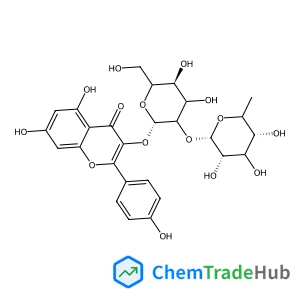
5,7-Dihydroxy-2-(4-hydroxyphenyl)-4-oxo-4H-chromen-3-yl 2-O-(6-deoxy-alpha-L-mannopyranosyl)-beta-D-glucopyranoside
CAS Number:
32602-81-6
Molecular Formula:
C27H30O15
A graphical abstract is available for this content
Xun-Lei Ding, Sheng-Gui He
DOI: 10.1039/C0CP00360C
R. Azouani, S. Tieng, K. Chhor, J.-F. Bocquet, P. Eloy, E. M. Gaigneaux, K. Klementiev, A. V. Kanaev
DOI: 10.1039/B923548E
Alexander Schnegg, Jan Behrends, Klaus Lips, Robert Bittl, Karsten Holldack
DOI: 10.1039/B905745E
Artur P. Terzyk, Piotr A. Gauden, Sylwester Furmaniak, Radosław P. Wesołowski, Piotr Kowalczyk
DOI: 10.1039/C003894F
Núria González-García, Matthias Olzmann
DOI: 10.1039/C0CP00284D
DOI: 10.1039/C0CP00380H
DOI: 10.1039/B905748J
Cai-Hong Liu, Yi-Yang Liu, Yong-Hui Zhang, Rui-Rui Wei, Hao-Li Zhang
DOI: 10.1039/B901517E
Renata Costa, Carlos M. Pereira, Fernando Silva
DOI: 10.1039/C003920A
Vijayasarathi Nagarajan, Barbara Müller, Oksana Storcheva, Klaus Köhler, Andreas Pöppl
DOI: 10.1039/B903826B
When handling 2-Chloro-1,2-bis(4-methylphenyl)ethanone (CAS: 71193-32-3), it is ...
4-Ethoxy-3-(5-methyl-4-oxo-7-propyl-1,4-dihydroimidazo[5,1-f][1,2,4]triazin-2-yl...
Methyl 3-Oxo-4-Androsten-17-Carboxylate (CAS: 2681-55-2) should be stored in a c...
(R)-3-Amino-4-(3-hexylphenylamino)-4-oxobutylphosphonic acid is primarily used i...
2-Methyl-2-propanyl 3-amino-3-carbamoyl-1-azetidinecarboxylate (CAS: 1254120-14-...
There are alternative reagents that can be used in synthesis instead of (E)-4-(t...
[2-(3-Chlorophenyl)-1,3-thiazol-4-yl]methanol (CAS: 121202-20-8) is a crystallin...
The market and research trends for Methyl (2S)-[(4S)-2,2-dimethyl-1,3-dioxolan-4...
The market for 1-Bromo-2-isocyanatoethane (CAS: 42865-19-0) is driven by its use...
4-Nitro-D-phenylalanine hydrochloride (CAS: 147065-06-3) is primarily used in re...

ChemComm publishes urgent research which is of outstanding significance and interest to experts in the field, while also appealing to the journal’s broad chemistry readership. Our communication format is ideally suited to short, urgent studies that are of such importance that they require accelerated publication. Our scope covers all topics in chemistry, and research at the interface of chemistry and other disciplines (such as materials science, nanoscience, physics, engineering and biology) where there is a significant novelty in the chemistry aspects. Major topic areas covered include: Analytical Chemistry Catalysis Chemical Biology and medicinal chemistry Computational Chemistry and Machine Learning Energy and sustainable chemistry Environmental Chemistry Green Chemistry Inorganic Chemistry Materials Chemistry Nanoscience Organic Chemistry Physical Chemistry Polymer Chemistry Supramolecular Chemistry