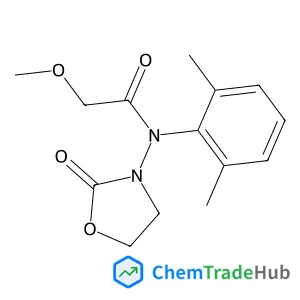
N-(2,6-Dimethylphenyl)-2-methoxy-N-(2-oxo-1,3-oxazolidin-3-yl)acetamide
CAS Number:
77732-09-3
Molecular Formula:
C14H18N2O4
A graphical abstract is available for this content
François-Xavier Coudert
DOI: 10.1039/C003434G
A. V. Okotrub, I. P. Asanov, S. V. Larionov, T. G. Leonova, L. G. Bulusheva
DOI: 10.1039/C000189A
Matvey V. Fedin, Galina V. Romanenko, Victor I. Ovcharenko, Renad Z. Sagdeev, Gudrun Klihm, Edward Reijerse, Wolfgang Lubitz, Elena G. Bagryanskaya
DOI: 10.1039/B906007C
Anna Åkesson, Kristian Moss Bendtsen, Manja A. Beherens, Jan Skov Pedersen, Viveka Alfredsson, Marité Cárdenas Gómez
DOI: 10.1039/C0CP00172D
O. G. Poluektov, S. V. Paschenko, L. M. Utschig
DOI: 10.1039/B906521K
Vijayasarathi Nagarajan, Barbara Müller, Oksana Storcheva, Klaus Köhler, Andreas Pöppl
DOI: 10.1039/B903826B
Konstantin Chingin, Roman M. Balabin, Konstantin Barylyuk, Huanwen Chen, Vladimir Frankevich, Renato Zenobi
DOI: 10.1039/C000807A
Esben Thormann, Per M. Claesson, Ole G. Mouritsen
DOI: 10.1039/C004413J
Dmitriy Tipikin, Vsevolod Livshits, Jack Freed
DOI: 10.1039/B903490K
When handling 2-Chloro-1,2-bis(4-methylphenyl)ethanone (CAS: 71193-32-3), it is ...
4-Ethoxy-3-(5-methyl-4-oxo-7-propyl-1,4-dihydroimidazo[5,1-f][1,2,4]triazin-2-yl...
Methyl 3-Oxo-4-Androsten-17-Carboxylate (CAS: 2681-55-2) should be stored in a c...
(R)-3-Amino-4-(3-hexylphenylamino)-4-oxobutylphosphonic acid is primarily used i...
2-Methyl-2-propanyl 3-amino-3-carbamoyl-1-azetidinecarboxylate (CAS: 1254120-14-...
There are alternative reagents that can be used in synthesis instead of (E)-4-(t...
[2-(3-Chlorophenyl)-1,3-thiazol-4-yl]methanol (CAS: 121202-20-8) is a crystallin...
The market and research trends for Methyl (2S)-[(4S)-2,2-dimethyl-1,3-dioxolan-4...
The market for 1-Bromo-2-isocyanatoethane (CAS: 42865-19-0) is driven by its use...
4-Nitro-D-phenylalanine hydrochloride (CAS: 147065-06-3) is primarily used in re...

ChemComm publishes urgent research which is of outstanding significance and interest to experts in the field, while also appealing to the journal’s broad chemistry readership. Our communication format is ideally suited to short, urgent studies that are of such importance that they require accelerated publication. Our scope covers all topics in chemistry, and research at the interface of chemistry and other disciplines (such as materials science, nanoscience, physics, engineering and biology) where there is a significant novelty in the chemistry aspects. Major topic areas covered include: Analytical Chemistry Catalysis Chemical Biology and medicinal chemistry Computational Chemistry and Machine Learning Energy and sustainable chemistry Environmental Chemistry Green Chemistry Inorganic Chemistry Materials Chemistry Nanoscience Organic Chemistry Physical Chemistry Polymer Chemistry Supramolecular Chemistry