












PEGylation of a shell over core–shell MOFs—a novel strategy for preventing agglomeration and synergism in terms of physicochemical and biological properties
Literature Information
Publication Date
2023-10-16
DOI
10.1039/D3TB01125A
Impact Factor
6.331
Authors
Nisha G. Pillai, Archana K., Kyong Yop Rhee, Asif A.
View Original
Abstract
We demonstrate a new strategy of PEGylation over core–shell MOFs of HKUST-1 and Cu-MOF-2 by a solvothermal method. The novel synthesized PEGylated core–shell MOFs has synergistic enhancement in terms of physicochemical and biological properties. FTIR spectroscopy and XRD analysis described the bonding characteristics of the double-shelled–core MOFs PEG@HKUST-1@CuMOF-2 and PEG@CuMOF-2@HKUST-1. XPS and EDAX spectroscopy confirmed the structural features of the PEG@core–shell MOFs. The as-synthesized PEG-modified core–shell MOFs showed a readily identifiable morphology with a reduction in particle size. The significant observation from SEM and TEM was that agglomeration disappeared completely, and the morphology of individual core–shell MOFs was clearly revealed. BET analysis provided the surface characteristics of MOF compounds. The chemical states of frameworks were established by XPS. The designed PEG-modified copper MOFs were evaluated for their activity against Gram-positive (Staphylococcus aureus, Enterococcus faecalis), Gram-negative (Escherichia coli and Klebsiella pneumoniae) bacterial species and activity against fungal species (Aspergillus niger and Candida albicans). This research work highlights a facile and synergistic approach to design promising biocompatible nano-dimensional core–shell MOFs for biological applications.
Related Literature
Glass formation of a DMSO–water mixture probed with a photosynthetic pigment
Adriana Huerta-Viga, Linh-Lan Nguyen, Jamie H. N. Sim, Zhengyang Zhang, Howe-Siang Tan
2018-06-06
Communication
DOI: 10.1039/C8CP03058H
A thermodynamically consistent phase diagram of a trimorphic pharmaceutical, l-tyrosine ethyl ester, based on limited experimental data
Maria Barrio, Pol Lloveras, Alain Polian, Jean-Paul Itié, Josep-Lluis Tamarit
2018-08-29
Paper
DOI: 10.1039/C8CP01813H
Multiporous sp2-hybridized boron nitride (d-BN): stability, mechanical properties, lattice thermal conductivity and promising application in energy storage
Yingxiang Cai, Li Zeng, Yu Zhang, Xuechun Xu
2018-07-23
Paper
DOI: 10.1039/C8CP03447H
Sub-molecular spectroscopy and temporary molecular charging of Ni-phthalocyanine on graphene with STM
Mali Zhao, Faisal Almarzouqi, Eric Duverger, Philippe Sonnet, Gérald Dujardin, Andrew J. Mayne
2018-07-05
Paper
DOI: 10.1039/C8CP02113A
An insight into the effects of transition metals on the thermal expansion of complex perovskite compounds: an experimental and density functional theory investigation
Xiao Wang, Ye Han, Xiaojie Song, Weihui Liu, Yinxi Jin, Wentao Liu, Hongzhi Cui
2018-06-05
Paper
DOI: 10.1039/C8CP02451K
Chemical kinetics in an atmospheric pressure helium plasma containing humidity
Sandra Schröter, Apiwat Wijaikhum, Andrew West, Nicolas Minesi, James Dedrick, Erik Wagenaars, Nelson de Oliveira, Laurent Nahon, Mark J. Kushner, Jean-Paul Booth, Kari Niemi, Timo Gans, Deborah O'Connell
2018-09-13
Paper
DOI: 10.1039/C8CP02473A
DFT investigation on the adsorption of munition compounds on α-Fe2O3: similarity and differences with α-Al2O3
Glen R. Jenness, Jennifer Seiter, Manoj K. Shukla
2018-06-27
Paper
DOI: 10.1039/C8CP02590H
Kinetics of the defunctionalization of oxidized few-layer graphene nanoflakes
Sergei A. Chernyak, Anton S. Ivanov, Angelina M. Podgornova, Ekaterina A. Arkhipova, Stepan Yu. Kupreenko, Alexei V. Shumyantsev, Natalia E. Strokova, Konstantin I. Maslakov, Serguei V. Savilov, Valery V. Lunin
2018-08-30
Paper
DOI: 10.1039/C8CP05149F
First-principles calculations of oxidation potentials of electrolytes in lithium–sulfur batteries and their variations with changes in environment
Jaebeom Han, Perla B. Balbuena
2018-06-27
Paper
DOI: 10.1039/C8CP02912A
You might also like
Compound Q&A
What precautions should be taken when handling 4-(2-Furylmethyl)thiomorpholine 1,1-dioxide (CAS: 79206-94-3)?
When handling 4-(2-Furylmethyl)thiomorpholine 1,1-dioxide (CAS: 79206-94-3), it ...
79206-94-34-(2-Furylmethyl)thi...
Compound Q&A
What precautions should be taken when handling 4-Chloro-N-[2-(4-morpholinyl)ethyl]benzamide (CAS: 71320-77-9)?
When handling 4-Chloro-N-[2-(4-morpholinyl)ethyl]benzamide (CAS: 71320-77-9), it...
71320-77-94-Chloro-N-[2-(4-mor...
Compound Q&A
How should waste containing 2-[2-(2-Methoxyethoxy)ethoxy]ethyl 4-methylbenzenesulfonate (CAS: 62921-74-8) be handled?
Waste containing this compound (CAS: 62921-74-8) should be handled according to ...
62921-74-82-[2-(2-Methoxyethox...
Compound Q&A
How should waste containing (S)-Methyl 2-amino-3-cyclohexylpropanoate be handled?
Waste containing (S)-Methyl 2-amino-3-cyclohexylpropanoate should be collected i...
40056-18-6(S)-Methyl 2-amino-3...
Compound Q&A
How is 5-({4-[(2S,4R)-4-Hydroxy-2-methyltetrahydro-2H-pyran-4-yl]-2-thienyl}sulfanyl)-1-methyl-1,3-dihydro-2H-indol-2-one (CAS: 166882-70-8) typically synthesized?
This compound can be synthesized using a multi-step process involving the conjug...
166882-70-85-({4-[(2S,4R)-4-Hyd...
Compound Q&A
Are there alternatives to (2E)-3-(3,4-Dichlorophenyl)acrylic acid (CAS: 7312-27-8) in synthesis?
There are several alternatives to (2E)-3-(3,4-Dichlorophenyl)acrylic acid in syn...
7312-27-8(2E)-3-(3,4-Dichloro...
Compound Q&A
How should Ethyl 6-(2-nitrophenyl)imidazo[2,1-b][1,3]thiazole-3-carboxylate (CAS: 925437-84-9) be stored?
Ethyl 6-(2-nitrophenyl)imidazo[2,1-b][1,3]thiazole-3-carboxylate (CAS: 925437-84...
925437-84-9Ethyl 6-(2-nitrophen...
Compound Q&A
How should waste containing 2-(1,3-Thiazol-2-yl)ethanamine (CAS: 18453-07-1) be handled?
Waste containing 2-(1,3-Thiazol-2-yl)ethanamine (CAS: 18453-07-1) should be coll...
18453-07-12-(1,3-Thiazol-2-yl)...
Compound Q&A
How is Methyl 5-iodo-2-methylbenzoate (CAS: 103440-54-6) typically synthesized?
Methyl 5-iodo-2-methylbenzoate can be synthesized through the iodination of meth...
103440-54-6Methyl 5-iodo-2-meth...
Compound Q&A
How is 5-Chloro[1,2,4]triazolo[1,5-a]pyridine (CAS: 1427399-34-5) typically synthesized?
5-Chloro[1,2,4]triazolo[1,5-a]pyridine is commonly synthesized via the condensat...
1427399-34-55-Chloro[1,2,4]triaz...
Source Journal
Journal of Materials Chemistry B

CiteScore:
12
Self-citation Rate:
4.9%
Articles per Year:
831
Journal of Materials Chemistry A, B & C cover high quality studies across all fields of materials chemistry. The journals focus on those theoretical or experimental studies that report new understanding, applications, properties and synthesis of materials. The journals have a strong history of publishing quality reports of interest to interdisciplinary communities and providing an efficient and rigorous service through peer review and publication. The journals are led by an international team of Editors-in-Chief and Associate Editors who are all active researchers in their fields. Journal of Materials Chemistry A, B & C are separated by the intended application of the material studied. Broadly, applications in energy and sustainability are of interest to Journal of Materials Chemistry A, applications in biology and medicine are of interest to Journal of Materials Chemistry B, and applications in optical, magnetic and electronic devices are of interest to Journal of Materials Chemistry C. More than one Journal of Materials Chemistry journal may be suitable for certain fields and researchers are encouraged to submit their paper to the journal that they feel best fits for their particular article. Example topic areas within the scope of Journal of Materials Chemistry B are listed below. This list is neither exhaustive nor exclusive. Antifouling coatings Biocompatible materials Bioelectronics Bioimaging Biomimetics Biomineralisation Bionics Biosensors Diagnostics Drug delivery Gene delivery Immunobiology Nanomedicine Regenerative medicine & Tissue engineering Scaffolds Soft robotics Stem cells Therapeutic devices image block All articles published in Journal of Materials Chemistry B from 2019 onwards will be indexed in MEDLINE®. Articles that primarily focus on providing insight into the underlying science and performance of biomaterials within a biological environment are more suited to our companion journal, Biomaterials Science.
Recommended Compounds
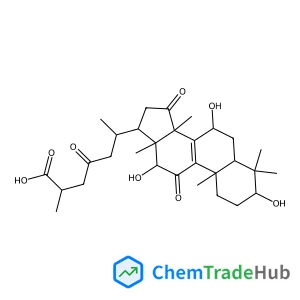
(3beta,7beta,12beta)-3,7,12-Trihydroxy-11,15,23-trioxolanost-8-en-26-oic acid
CAS Number:
98665-22-6
Molecular Formula:
C30H44O8

Recommended Suppliers




Disclaimer
This page provides academic journal information for reference and research purposes only. We are not affiliated with any journal publishers and do not handle publication submissions. For publication-related inquiries, please contact the respective journal publishers directly.
If you notice any inaccuracies in the information displayed, please contact us at support@chemtradehub.com. We will promptly review and address your concerns.