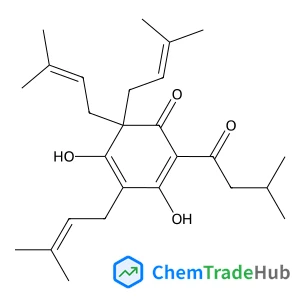
3,5-Dihydroxy-4-(3-methylbutanoyl)-2,6,6-tris(3-methyl-2-buten-1-yl)-2,4-cyclohexadien-1-one
CAS Number:
468-28-0
Molecular Formula:
C26H38O4
Kangpeng Wang, Zicai Shen, Wang Ni, Jifeng Zu
Perovskite solar cells (PSCs) hold great promise for space photovoltaics (PV) due to their impressive PV performance, excellent power-to-weight ratio, and cost-effectiveness. However, the environment in space presents numerous challenges for solar cells, especially cosmic radiation. PSCs have shown remarkable resistance to various forms of radiation, such as electrons, protons, ultraviolet, and γ-rays. Nevertheless, their stability in space applications still lags behind that of crystalline silicon (c-Si) and gallium arsenide (GaAs) cells. To facilitate the application of PSCs in space, it is vital to enhance their long-term stability. This mini-review examines the radiation resistance of PSCs, explores the mechanisms behind radiation-induced damage, and proposes potential strategies to bolster their resistance to radiation and reinforce overall stability.
Archan Dey, Gautam R. Desiraju, Raju Mondal, Judith A. K. Howard
DOI: 10.1039/B407510B
Miloslav Polášek, Jakub Rudovský, Petr Hermann, Ivan Lukeš, Luce Vander Elst, Robert N. Muller
DOI: 10.1039/B409996F
Florence Sallas, Kenichi Niikura, Shin-Ichiro Nishimura
DOI: 10.1039/B316365B
Olof Johansson, Henriette Wolpher, Magnus Borgström, Leif Hammarström, Jonas Bergquist, Licheng Sun, Björn Åkermark
DOI: 10.1039/B308101J
Marcel G. Friedrich, Frank Gieβ, Renate Naumann, Wolfgang Knoll, Kenichi Ataka, Joachim Heberle, Jana Hrabakova, Daniel H. Murgida, Peter Hildebrandt
DOI: 10.1039/B410998H
Zhaohui Wang, Mark D. Watson, Jishan Wu, Klaus Müllen
DOI: 10.1039/B311651D
Robert Wolf, Evamarie Hey-Hawkins
DOI: 10.1039/B410617B
Marilyn Daisy Milton, Youichi Inada, Yoshiaki Nishibayashi, Sakae Uemura
DOI: 10.1039/B411180J
José A. R. Martins, David H. G. Crout, Peter Critchley
DOI: 10.1039/B309154F
Pinhua Li, Yicheng Zhang
DOI: 10.1039/B314246A
When handling 2-Chloro-1,2-bis(4-methylphenyl)ethanone (CAS: 71193-32-3), it is ...
4-Ethoxy-3-(5-methyl-4-oxo-7-propyl-1,4-dihydroimidazo[5,1-f][1,2,4]triazin-2-yl...
Methyl 3-Oxo-4-Androsten-17-Carboxylate (CAS: 2681-55-2) should be stored in a c...
(R)-3-Amino-4-(3-hexylphenylamino)-4-oxobutylphosphonic acid is primarily used i...
2-Methyl-2-propanyl 3-amino-3-carbamoyl-1-azetidinecarboxylate (CAS: 1254120-14-...
There are alternative reagents that can be used in synthesis instead of (E)-4-(t...
[2-(3-Chlorophenyl)-1,3-thiazol-4-yl]methanol (CAS: 121202-20-8) is a crystallin...
The market and research trends for Methyl (2S)-[(4S)-2,2-dimethyl-1,3-dioxolan-4...
The market for 1-Bromo-2-isocyanatoethane (CAS: 42865-19-0) is driven by its use...
4-Nitro-D-phenylalanine hydrochloride (CAS: 147065-06-3) is primarily used in re...

Journal of Materials Chemistry A, B & C cover high quality studies across all fields of materials chemistry. The journals focus on those theoretical or experimental studies that report new understanding, applications, properties and synthesis of materials. The journals have a strong history of publishing quality reports of interest to interdisciplinary communities and providing an efficient and rigorous service through peer review and publication. The journals are led by an international team of Editors-in-Chief and Associate Editors who are all active researchers in their fields. Journal of Materials Chemistry A, B & C are separated by the intended application of the material studied. Broadly, applications in energy and sustainability are of interest to Journal of Materials Chemistry A, applications in biology and medicine are of interest to Journal of Materials Chemistry B, and applications in optical, magnetic and electronic devices are of interest to Journal of Materials Chemistry C. More than one Journal of Materials Chemistry journal may be suitable for certain fields and researchers are encouraged to submit their paper to the journal that they feel best fits for their particular article. Example topic areas within the scope of Journal of Materials Chemistry A are listed below. This list is neither exhaustive nor exclusive. Artificial photosynthesis Batteries Carbon dioxide conversion Catalysis Fuel cells Gas capture/separation/storage Green/sustainable materials Hydrogen generation Hydrogen storage Photocatalysis Photovoltaics Self-cleaning materials Self-healing materials Sensors Supercapacitors Thermoelectrics Water splitting Water treatment