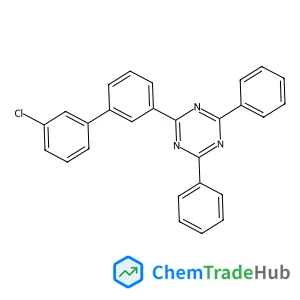
2-(3'-Chlorobiphenyl-3-yl)-4,6-diphenyl-1,3,5-triazine
CAS Number:
1443049-83-9
Molecular Formula:
C27H18ClN3
Zhangran Gao, Gang Zhou
This mini-review focuses on the recent advancements in ferroelectrics and multiferroics, highlighting the exploration in discovering new materials and efficient strategies for enhancing functionality. Firstly, various material systems, including perovskite oxides, organic–inorganic hybrid molecular materials, composites, and other novel compounds, are introduced. Then, modulation methods by force/pressure/stress, negative pressure, and light illumination to tailor the properties of ferroelectrics and multiferroics are analyzed, which enable access to large ferroelectric polarization, dynamics of domains, phase transitions, and room-temperature magnetoelectric coupling. Various characteristics and their underlying physical mechanisms are revealed. Finally, the significance of these studies in solving the drawbacks of ferroelectrics and multiferroics and their potential functional applications are concluded. In conclusion, these studies deepen our understanding of the fundamental mechanisms governing multiferroics and pave the way for new theoretical models and experimental techniques. These stimulus strategies can provide flexible and controllable means for designing and manufacturing devices with specific functionalities.
N. Hickey, P. Fornasiero, R. Di Monte, J. Kašpar, J. R. González-Velasco, M. A. Gutiérrez-Ortiz, M. P. González-Marcos, J. M. Gatica, S. Bernal
DOI: 10.1039/B308321G
Tao Gao, Taihong Wang
DOI: 10.1039/B411018H
Martin A. Schmidt, Klavs F. Jensen
DOI: 10.1039/B410078F
Mohammmad Afzaal, Mohammad A. Malik, Paul O'Brien
DOI: 10.1039/B313116E
Christian Dubs, Akiko Inagaki, Munetaka Akita
DOI: 10.1039/B409514F
Jordan H. Wosnick, Timothy M. Swager
DOI: 10.1039/B411489B
Snigdha Panda, Harkesh B. Singh, Ray J. Butcher
DOI: 10.1039/B312358H
Allen Burton, Saleh Elomari
DOI: 10.1039/B410010G
Christophe Corre, Cyrille A. S. Landreau, Michael Shipman, Philip A. S. Lowden
DOI: 10.1039/B410592C
When handling 2-Chloro-1,2-bis(4-methylphenyl)ethanone (CAS: 71193-32-3), it is ...
4-Ethoxy-3-(5-methyl-4-oxo-7-propyl-1,4-dihydroimidazo[5,1-f][1,2,4]triazin-2-yl...
Methyl 3-Oxo-4-Androsten-17-Carboxylate (CAS: 2681-55-2) should be stored in a c...
(R)-3-Amino-4-(3-hexylphenylamino)-4-oxobutylphosphonic acid is primarily used i...
2-Methyl-2-propanyl 3-amino-3-carbamoyl-1-azetidinecarboxylate (CAS: 1254120-14-...
There are alternative reagents that can be used in synthesis instead of (E)-4-(t...
[2-(3-Chlorophenyl)-1,3-thiazol-4-yl]methanol (CAS: 121202-20-8) is a crystallin...
The market and research trends for Methyl (2S)-[(4S)-2,2-dimethyl-1,3-dioxolan-4...
The market for 1-Bromo-2-isocyanatoethane (CAS: 42865-19-0) is driven by its use...
4-Nitro-D-phenylalanine hydrochloride (CAS: 147065-06-3) is primarily used in re...
Journal of Materials Chemistry A, B & C cover high quality studies across all fields of materials chemistry. The journals focus on those theoretical or experimental studies that report new understanding, applications, properties and synthesis of materials. The journals have a strong history of publishing quality reports of interest to interdisciplinary communities and providing an efficient and rigorous service through peer review and publication. The journals are led by an international team of Editors-in-Chief and Associate Editors who are all active researchers in their fields. Journal of Materials Chemistry A, B & C are separated by the intended application of the material studied. Broadly, applications in energy and sustainability are of interest to Journal of Materials Chemistry A, applications in biology and medicine are of interest to Journal of Materials Chemistry B, and applications in optical, magnetic and electronic devices are of interest to Journal of Materials Chemistry C. More than one Journal of Materials Chemistry journal may be suitable for certain fields and researchers are encouraged to submit their paper to the journal that they feel best fits for their particular article. Example topic areas within the scope of Journal of Materials Chemistry A are listed below. This list is neither exhaustive nor exclusive. Artificial photosynthesis Batteries Carbon dioxide conversion Catalysis Fuel cells Gas capture/separation/storage Green/sustainable materials Hydrogen generation Hydrogen storage Photocatalysis Photovoltaics Self-cleaning materials Self-healing materials Sensors Supercapacitors Thermoelectrics Water splitting Water treatment
![(1R)-3-Bromo-1,7,7-trimethylbicyclo[2.2.1]heptan-2-one structure](https://static.chemtradehub.com/structs/102/10293-06-8-dd8a.webp "(1R)-3-Bromo-1,7,7-trimethylbicyclo[2.2.1]heptan-2-one structure")