












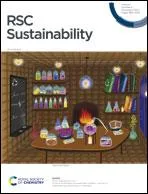
Chemical recycling of PET to value-added products
Literature Information
Publication Date
2023-10-19
DOI
10.1039/D3SU00311F
Impact Factor
0
Authors
Zixian Jia, Lin Gao, Lijiao Qin, Jianzhong Yin
View Original
Abstract
The term 'plastic' includes various materials (PP, PE, PET, PVC, and more), but most of them, but most of them take very long period of time to decompose and continue to cause harm to the environment. Currently, only a small percentage of plastic waste is recycled, usually for energy or the production of lower-quality products. Chemical recycling and upcycling offers a solution where plastic can be broken down into its original building blocks and transformed into new and high-quality plastics. When compared to traditional mechanical recycling, polymer upcycling systems may provide more energy-efficient pathways and have less impact on the environment. It is heartening to see recycling and upcycling techniques gain traction in industry, and creating new catalyst-driven technologies is critical to encourage better plastics recycling. This review highlights recent advancements in the development of efficient catalysts and effective strategies for the chemical recycling of polyethylene terephthalate (PET) into monomers, fine chemicals, and carbon materials.
Related Literature
Structure and stability of one-dimensional o-phthalaldehyde lines on the Si(100)-2 × 1:H surface
Jin-Ho Choi, Jun-Hyung Cho
2010-11-16
Communication
DOI: 10.1039/C0CP01284J
Construction and photophysics study of supramolecular complexes composed of three-point binding fullerene-trispyridylporphyrin dyads and zinc porphyrin
Lai Feng, Yishi Wu, Junfeng Xiang, Li Jiang, Chunying Shu, Chunru Wang
2010-11-19
Communication
DOI: 10.1039/C0CP01076F
Accurate determination of the dielectric parameters of spherical shells in suspension
Niloofar Asgharian, Zoltan A. Schelly
2010-06-08
Paper
DOI: 10.1039/B922123A
Enhanced field emission property of a novel Al2O3nanoparticle-decorated tubular SiC emitter with low turn-on and threshold field
H. Cui, L. Gong, G. Z. Yang, Y. Sun, J. Chen, C. X. Wang
2010-11-09
Paper
DOI: 10.1039/C0CP01313G
Self-assembly of trehalose molecules on a lysozyme surface: the broken glass hypothesis
Maxim V. Fedorov, Jonathan M. Goodman, Dmitry Nerukh, Stephan Schumm
2010-11-29
Paper
DOI: 10.1039/C0CP01705A
A method to tune the ionic current rectification of track-etched nanopores by using surfactant
Lin Wang, Yu Yan, Yanbo Xie, Long Chen
2010-11-01
Paper
DOI: 10.1039/C0CP00587H
Photoionization of 2-pyridone and 2-hydroxypyridine
J. C. Poully, J. P. Schermann, N. Nieuwjaer, F. Lecomte, G. Grégoire, C. Desfrançois, G. A. Garcia, L. Nahon, D. Nandi, L. Poisson, M. Hochlaf
2010-03-02
Paper
DOI: 10.1039/B923630A
Analysis and improvement of rate constant determination of reactions involving charged reactants
Keith M. Krise, Angela A. Hwang, Bratoljub H. Milosavljevic
2010-06-08
Paper
DOI: 10.1039/B927266F
Electronic structure and optical spectra of catechol on TiO2nanoparticles from real time TD-DFT simulations
R. Sánchez-de-Armas, M. A. San-Miguel, J. Oviedo, A. Márquez, J. F. Sanz
2010-11-25
Paper
DOI: 10.1039/C0CP00906G
You might also like
Compound Q&A
How should waste containing (6-Bromo-2-naphthyl)oxy](dimethyl)(2-methyl-2-propanyl)silane be handled?
Waste containing (6-Bromo-2-naphthyl)oxy](dimethyl)(2-methyl-2-propanyl)silane (...
100751-65-3[(6-Bromo-2-naphthyl...
Compound Q&A
How is 7-Fluoro-4-isoquinolinecarboxylic acid (CAS: 1841081-40-0) typically synthesized?
7-Fluoro-4-isoquinolinecarboxylic acid can be synthesized via a multi-step proce...
1841081-40-07-Fluoro-4-isoquinol...
Compound Q&A
What are the physical and chemical properties of 2,3,5,6-Tetrabromothieno[3,2-b]thiophene (CAS: 124638-53-5)?
2,3,5,6-Tetrabromothieno[3,2-b]thiophene is a crystalline compound with a high m...
124638-53-52,3,5,6-Tetrabromoth...
Compound Q&A
Is 1-[4-(Benzylamino)-7,8-dihydro-5H-pyrano[4,3-d]pyrimidin-2-yl]-2-methyl-1H-indole-4-carboxamide (CAS: 1542705-92-9) safe?
1-[4-(Benzylamino)-7,8-dihydro-5H-pyrano[4,3-d]pyrimidin-2-yl]-2-methyl-1H-indol...
1542705-92-91-[4-(Benzylamino)-7...
Compound Q&A
What is the market or research trend for imidazo[5,1-d]-1,2,3,5-tetrazine-8-carboxylic acid, 3,4-dihydro-3-methyl-4-oxo- (CAS: 113942-30-6)?
The market for imidazo[5,1-d]-1,2,3,5-tetrazine-8-carboxylic acid, 3,4-dihydro-3...
113942-30-6Imidazo[5,1-d]-1,2,3...
Compound Q&A
What is 3-(Triisopropylsilyl)propiolaldehyde (CAS: 163271-80-5)?
3-(Triisopropylsilyl)propiolaldehyde is a synthetic organic compound with the CA...
163271-80-53-(Triisopropylsilyl...
Compound Q&A
What regulatory guidelines apply to 6-Nitro-2H-1,4-benzoxazin-3(4H)-one (CAS: 81721-87-1)?
6-Nitro-2H-1,4-benzoxazin-3(4H)-one (CAS: 81721-87-1) is subject to various regu...
81721-87-16-Nitro-2H-1,4-benzo...
Compound Q&A
How should waste containing (3-Fluorophenyl)(4-{[(2-methyl-2-propanyl)oxy]carbonyl}-1-piperazinyl)acetic acid (CAS: 885272-91-3) be handled?
Waste containing (3-Fluorophenyl)(4-{[(2-methyl-2-propanyl)oxy]carbonyl}-1-piper...
885272-91-3(3-Fluorophenyl)(4-{...
Compound Q&A
What are the physical and chemical properties of N,N'-4,4'-Biphenyldiyldiisonicotinamide (CAS: 55119-40-9)?
N,N'-4,4'-Biphenyldiyldiisonicotinamide is a white crystalline solid with a mole...
55119-40-9N,N'-4,4'-Biphenyldi...
Compound Q&A
What industries use 6-Bromo-8-fluoro-2-quinazolinol (CAS: 1036756-15-6)?
6-Bromo-8-fluoro-2-quinazolinol is primarily used in the pharmaceutical industry...
1036756-15-66-Bromo-8-fluoro-2-q...
Source Journal
Recommended Compounds

Recommended Suppliers





Disclaimer
This page provides academic journal information for reference and research purposes only. We are not affiliated with any journal publishers and do not handle publication submissions. For publication-related inquiries, please contact the respective journal publishers directly.
If you notice any inaccuracies in the information displayed, please contact us at support@chemtradehub.com. We will promptly review and address your concerns.