












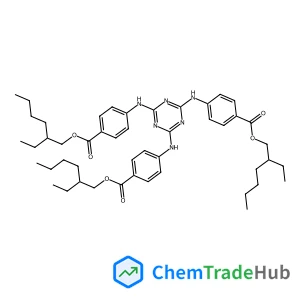
Tris(2-ethylhexyl) 4,4',4''-(1,3,5-triazine-2,4,6-triyltriimino)tribenzoate
CAS Number:
88122-99-0
Molecular Formula:
C48H66N6O6
A graphical abstract is available for this content
Bolong Huang, Jianfu Li, Zhenyi Jiang, Bo Wang, Zhigang Wang, Rui-Qin Zhang
DOI: 10.1039/C5CP02598B
Hjalte V. Kiefer, Elie Lattouf, Natascha W. Persen, Lars H. Andersen
DOI: 10.1039/C5CP02764K
Xiaoyan Zheng, Meiying Liu, Daidi Fan, Haixia Ma, Yaoyu Wang, Yen Wei
DOI: 10.1039/C5CP01845E
Jeffrey L. Bada, John H. Chalmers
DOI: 10.1039/C6CP03290G
Yuanyuan Cui, Lanli Chen, Yanfeng Gao
DOI: 10.1039/C5CP03267A
Sijing Yi, Jiao Wang, Xiao Chen
DOI: 10.1039/C5CP03659C
P. A. Vecino, Z. Huang, J. Mitchell, J. McGregor, H. Daly, C. Hardacre, J. M. Thomson, L. F. Gladden
DOI: 10.1039/C5CP02436F
Barbara Marchetti, Michael N. R. Ashfold, Wolfgang Domcke
DOI: 10.1039/C6CP00165C
DOI: 10.1039/C5CP03331D
Chao-Ching Chiang, Chien-You Su, An-Chih Yang, Ting-Yu Wang, Wen-Ya Lee, Chi-Chung Hua, Dun-Yen Kang
DOI: 10.1039/C6CP04166C
Ethyl 3-cyclohexylpropanoate is a clear, colorless to light yellow liquid with a...
Waste containing 2-(Hydroxymethyl)-5-(methoxycarbonyl)-6-methyl-4-(2-nitrophenyl...
Waste containing 2,4,6-Tris(pentafluoroethyl)-1,3,5-triazine (CAS: 858-46-8) sho...
When handling Chloroac-nle-oh (CAS: 56787-36-1), it is essential to wear appropr...
Ethyl 6-phenylimidazo[2,1-b][1,3]thiazole-3-carboxylate is primarily used in the...
Alternatives to alpha-(2-Bromophenyl)benzylamine (CAS: 55095-15-3) in synthesis ...
Waste containing 2-Chloro-5-methoxypyridine (CAS: 139585-48-1) should be managed...
1-(4-Methoxyphenyl)-2,5-dimethyl-1H-pyrrole (CAS: 5044-27-9) is used in various ...
There are alternative reagents and compounds that can be used in the synthesis o...
Tungsten(IV) oxide, also known as tungsten dioxide, is a chemical compound with ...
Soft Matter provides a unique forum for the communication of significant advances in interdisciplinary soft matter research. There is a particular focus on the interface between chemistry, physics, materials science, biology and chemical engineering. Research may report new soft materials or phenomena, encompass their design, synthesis, and use in new applications; or provide fundamental insight and observations on their behaviour. Experimental, theoretical and computational soft matter approaches are encouraged. The scope of Soft Matter covers the following. Soft matter assemblies, including colloids, granular matter, liquid crystals, gels & networks, polymers, hybrid materials, active matter and further examples Soft nanotechnology, soft robotics and devices Synthesis, self-assembly and directed assembly Biological aspects of soft matter including proteins, biopolymers, cells and tissues Surfaces, interfaces and interactions Phase behaviour, coacervation and rheological behaviour Sustainable soft materials including recycling, circular economy and end of life Mechanistic insights and modelling


![[2',6'-bis(propan-2-yloxy)-[1,1'-biphenyl]-3-yl]dicyclohexylphosphane structure](https://static.chemtradehub.com/structs/787/787618-22-8-dda2.webp "[2',6'-bis(propan-2-yloxy)-[1,1'-biphenyl]-3-yl]dicyclohexylphosphane structure")




