













A three-dimensional microfluidic flow cell and system integration for improved electrochemical substrate detection in HRP/TMB-based immunoassays
Literature Information
Publication Date
2023-06-12
DOI
10.1039/D3SD00095H
Impact Factor
0
Authors
Jérémy Bell
View Original
Abstract
Immunoassays, based on the recognition and capture of analytes by highly selective antibodies, are now used extensively in all areas of diagnostics, but the challenge is to further integrate them into online sensors. To improve the transition from laboratory immunoassays to immunosensors, we have developed a complete flow system, based on a microfluidic core flow cell to enable automated detection of one of the most commonly used immunoassay substrates, TMB, by chronoamperometry. The architecture and fluidic optimisation of the system showed that a specially designed 3D flow cell allows higher flow rates (500 μL min−1) than a standard enlarged microfluidic channel (50 μL min−1) resulting in a significantly shorter detection time of 30 seconds per sample and making the system more robust against interferences due to bubble formation in the chip. The electrochemical measurements showed an improved signal-to-noise ratio (SNR) and thus higher sensitivity for a model immunoassay for diclofenac (SNR = 59), compared to the analytical performance of a conventional laboratory microplate-based assay with optical detection (SNR = 19). In general, this system facilitates the conversion of any conventional immunoassay into an immunosensor with automatic and continuous detection.
Related Literature
An organoferroelasticity driven by molecular conformational change
Sajjad Husain Mir, Satoshi Takamizawa
2017-12-04
Communication
DOI: 10.1039/C7CP07206F
2-Chloromalonaldehyde, a model system of resonance-assisted hydrogen bonding: vibrational investigation
Michèle Chevalier, Justinas Ceponkus, Germán A. Rojas-Lorenzo, Claudine Crépin
2018-04-16
Paper
DOI: 10.1039/C7CP06481K
Spectral and energy transfer in Bi3+–Ren+ (n = 2, 3, 4) co-doped phosphors: extended optical applications
Jung Hyun Jeong
2018-03-29
Perspective
DOI: 10.1039/C8CP00433A
Mobilities of iodide anions in aqueous solutions for applications in natural dye-sensitized solar cells
Giuseppe Cassone, Giuseppe Calogero, Jiri Sponer, Franz Saija
2018-04-12
Paper
DOI: 10.1039/C8CP01155A
The origin of absorptive features in the two-dimensional electronic spectra of rhodopsin
Marwa H. Farag, Thomas L. C. Jansen, Jasper Knoester
2018-04-18
Paper
DOI: 10.1039/C8CP00638E
Metal alloy solid-state nanopores for single nanoparticle detection
Diego Coglitore, Andrea Merenda, Nicoletta Giamblanco, Ludovic F. Dumée, Jean-Marc Janot, Sébastien Balme
2018-04-03
Paper
DOI: 10.1039/C8CP01787E
Thermal equilibration between excited states or solvent effects: unveiling the origins of anomalous emissions in heteroleptic Ru(ii) complexes
Denis Jacquemin, Daniel Escudero
2018-04-04
Communication
DOI: 10.1039/C8CP01101J
Monitoring photo-induced population dynamics in metastable linkage isomer crystals: a crystallographic kinetic study of [Pd(Bu4dien)NO2]BPh4
Lauren E. Hatcher, Jonathan M. Skelton, Mark R. Warren, Clare Stubbs, E. Lora da Silva, Paul R. Raithby
2018-01-31
Paper
DOI: 10.1039/C7CP05422J
Halogen-like properties of the Al13 cluster mimicking astatine
B. Molina, J. R. Soto, J. J. Castro
2018-04-04
Communication
DOI: 10.1039/C8CP00494C
You might also like
Compound Q&A
What are the main uses of 1-(3-Aminophenyl)-3-[(3R)-1-(3,3-dimethyl-2-oxobutyl)-2-oxo-5-(2-pyridinyl)-2,3-dihydro-1H-1,4-benzodiazepin-3-yl]urea (CAS: 155412-88-7)?
This compound is mainly used as an intermediate in the synthesis of antipsychoti...
155412-88-71-(3-Aminophenyl)-3-...
Compound Q&A
How should waste containing 1-(D-Ribofuranosyl)-1,4-dihydro-3-pyridinecarboxamide (CAS: 19132-12-8) be handled?
Waste containing 1-(D-Ribofuranosyl)-1,4-dihydro-3-pyridinecarboxamide (CAS: 191...
19132-12-81-(D-Ribofuranosyl)-...
Compound Q&A
What regulatory guidelines apply to 2-Methyl-2-propanyl 3-bromo-3-(hydroxymethyl)-1-azetidinecarboxylate (CAS: 2007919-81-3)?
2-Methyl-2-propanyl 3-bromo-3-(hydroxymethyl)-1-azetidinecarboxylate (CAS: 20079...
2007919-81-32-Methyl-2-propanyl ...
Compound Q&A
What is N-(4-Chloro-2-pyridinyl)acetamide (CAS: 245056-66-0)?
N-(4-Chloro-2-pyridinyl)acetamide (CAS: 245056-66-0) is a chemical compound with...
245056-66-0N-(4-Chloro-2-pyridi...
Compound Q&A
What is 5-Chloro-2-hydroxybenzoic acid (CAS: 321-14-2)?
5-Chloro-2-hydroxybenzoic acid, also known as 5-chlorosalicylic acid, is an arom...
321-14-25-Chloro-2-hydroxybe...
Compound Q&A
What precautions should be taken when handling 1,1-Dichloro-1-fluoroethane (CAS: 1717-00-6)?
When handling 1,1-Dichloro-1-fluoroethane (CAS: 1717-00-6), it is important to u...
1717-00-61,1-Dichloro-1-fluor...
Compound Q&A
What are the physical and chemical properties of Fmoc-(2S,3R)-3-phenylpyrrolidine-2-carboxylic acid (CAS: 281655-32-1)?
Fmoc-(2S,3R)-3-phenylpyrrolidine-2-carboxylic acid is a white crystalline solid ...
281655-32-1Fmoc-(2S,3R)-3-pheny...
Compound Q&A
What are the main uses of 4-Amino-5-bromo-2-pyridinecarboxylic acid (CAS: 1363381-01-4)?
4-Amino-5-bromo-2-pyridinecarboxylic acid is primarily used as a precursor in th...
1363381-01-44-Amino-5-bromo-2-py...
Compound Q&A
What precautions should be taken when handling (S)-tert-butyl 2-((2-(4-bromophenyl)-2-oxoethyl)carbamoyl)pyrrolidine-1-carboxylate (CAS: 1007881-98-2)?
Handling this compound should be done with personal protective equipment (PPE) i...
1007881-98-2(S)-tert-butyl 2-((2...
Compound Q&A
What precautions should be taken when handling 8-bromo-2,2-dimethyl-3,4-dihydro-2H-1,4-benzoxazin-3-one (CAS: 688363-73-7)?
When handling 8-bromo-2,2-dimethyl-3,4-dihydro-2H-1,4-benzoxazin-3-one, use prop...
688363-73-78-bromo-2,2-dimethyl...
Source Journal
Recommended Compounds
![2,6-Bis({(2R)-2-[hydroxy(diphenyl)methyl]-1-pyrrolidinyl}methyl)-4-methylphenol structure](https://static.chemtradehub.com/structs/877/877395-58-9-70bf.webp "2,6-Bis({(2R)-2-[hydroxy(diphenyl)methyl]-1-pyrrolidinyl}methyl)-4-methylphenol structure")
2,6-Bis({(2R)-2-[hydroxy(diphenyl)methyl]-1-pyrrolidinyl}methyl)-4-methylphenol
CAS Number:
877395-58-9
Molecular Formula:
C43H46N2O3
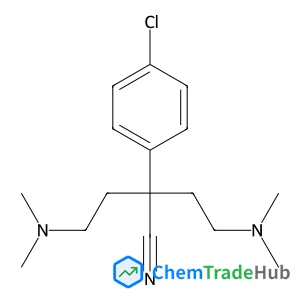
2-(4-Chlorophenyl)-4-(dimethylamino)-2-(2-(dimethylamino)ethyl)butanenitrile
CAS Number:
1246816-57-8
Molecular Formula:
C16H24ClN3
Recommended Suppliers






Disclaimer
This page provides academic journal information for reference and research purposes only. We are not affiliated with any journal publishers and do not handle publication submissions. For publication-related inquiries, please contact the respective journal publishers directly.
If you notice any inaccuracies in the information displayed, please contact us at support@chemtradehub.com. We will promptly review and address your concerns.