












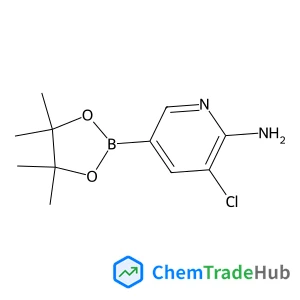
3-Chloro-5-(4,4,5,5-tetramethyl-1,3,2-dioxaborolan-2-yl)-2-pyridinamine
CAS Number:
1032758-99-8
Molecular Formula:
C11H16BClN2O2
Rebecca L. Spicer, Helen M. O'Connor, Yael Ben-Tal, Hang Zhou, Patrick J. Boaler, Fraser C. Milne, Euan K. Brechin, Guy. C. Lloyd-Jones, Paul J. Lusby
Coordination cage catalysis has commonly relied on the endogenous binding of substrates, exploiting the cavity microenvironment and spatial constraints to engender increased reactivity or interesting selectivity. Nonetheless, there are issues with this approach, such as the frequent occurrence of product inhibition or the limited applicability to a wide range of substrates and reactions. Here we describe a strategy in which the cage acts as an exogenous catalyst, wherein reactants, intermediates and products remain unbound throughout the course of the catalytic cycle. Instead, the cage is used to alter the properties of a cofactor guest, which then transfers reactivity to the bulk-phase. We have exemplified this approach using photocatalysis, showing that a photoactivated host–guest complex can mediate [4 + 2] cycloadditions and the aza-Henry reaction. Detailed in situ photolysis experiments show that the cage can both act as a photo-initiator and as an on-cycle catalyst where the quantum yield is less than unity.
Jagotamoy Das, Srikanta Patra, Haesik Yang
DOI: 10.1039/B806984K
Biswajit Kalita, Angus A. Lamar, Kenneth M. Nicholas
DOI: 10.1039/B805783D
Meghan A. Dureen, A. Lough, Thomas M. Gilbert, Douglas W. Stephan
DOI: 10.1039/B808348G
Magali Bonne, Nicolas Bion, Frédéric Pailloux, Sabine Valange, Sébastien Royer, Jean-Michel Tatibouët, Daniel Duprez
DOI: 10.1039/B808699K
Jared Skey, Rachel K. O’Reilly
DOI: 10.1039/B804260H
Gregory W. O’Neil, Alois Fürstner
DOI: 10.1039/B806898D
Illa Ramakanth, Balachandran Vijai Shankar, Archita Patnaik
DOI: 10.1039/B806772D
Junhui He
DOI: 10.1039/B807787H
Denis Damiron, Thierry Hamaide, Jean-Pierre Pascault, Etienne Fleury, Eric Drockenmuller
DOI: 10.1039/B805164J
Christopher J. Wilson, Leanne James, Georg H. Mehl, Ross W. Boyle
DOI: 10.1039/B806672H
When handling 4-(2-Furylmethyl)thiomorpholine 1,1-dioxide (CAS: 79206-94-3), it ...
When handling 4-Chloro-N-[2-(4-morpholinyl)ethyl]benzamide (CAS: 71320-77-9), it...
Waste containing this compound (CAS: 62921-74-8) should be handled according to ...
Waste containing (S)-Methyl 2-amino-3-cyclohexylpropanoate should be collected i...
This compound can be synthesized using a multi-step process involving the conjug...
There are several alternatives to (2E)-3-(3,4-Dichlorophenyl)acrylic acid in syn...
Ethyl 6-(2-nitrophenyl)imidazo[2,1-b][1,3]thiazole-3-carboxylate (CAS: 925437-84...
Waste containing 2-(1,3-Thiazol-2-yl)ethanamine (CAS: 18453-07-1) should be coll...
Methyl 5-iodo-2-methylbenzoate can be synthesized through the iodination of meth...
5-Chloro[1,2,4]triazolo[1,5-a]pyridine is commonly synthesized via the condensat...

Our journal has a wide-ranging scope which covers the full breadth of the chemical sciences. The research we publish contains the sorts of novel ideas, challenging questions and progressive thinking that bring undiscovered breakthroughs within reach. Your paper could focus on a single area, or cross many. It could be beyond the accepted bounds of the chemical sciences. It might address an immediate challenge, contribute to a future breakthrough or be wholly conceptual. We’re a team from every field of the chemical sciences, and know from experience that breakthroughs that drive the solutions to global challenges can come from anywhere, at any time. You could even start an entirely new area of research. Too bold? Too progressive? No such thing
![6-Benzyl-4,5,6,7-tetrahydro-1H-pyrazolo[3,4-c]pyridin-3(2H)-one structure](https://static.chemtradehub.com/structs/909/909187-64-0-f54f.webp "6-Benzyl-4,5,6,7-tetrahydro-1H-pyrazolo[3,4-c]pyridin-3(2H)-one structure")




