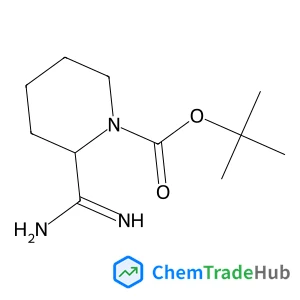
2-Methyl-2-propanyl 2-carbamimidoyl-1-piperidinecarboxylate
CAS Number:
1258640-98-0
Molecular Formula:
C11H21N3O2
Thomas Shaw, Adam D. Clayton, Ricardo Labes, Thomas M. Dixon, Sarah Boyall, Oliver J. Kershaw, Richard A. Bourne, Bruce C. Hanson
In an effort to advance the development of hydrometallurgical reprocessing of used nuclear fuel across the globe, this work sets out to explore and identify an optimised, cost effective pathway to synthesise the ligand DEHiBA (N,N-di-(2-ethylhexyl)isobutyramide). Currently, very few chemical suppliers stock and distribute this specialist ligand, designed for selective uranium chelation and extraction from nuclear fuel. The current high cost of DEHiBA therefore restricts access to essential large-scale testing of this promising ligand designed to advance nuclear reprocessing. This work utilises an automated flow reactor platform for the efficient optimisation of four synthetic routes to DEHiBA. These optimisations focus on optimising cost, reagent efficiency, yield, and productivity target functions by exploiting the power of machine-learning algorithms for rapid process development. Ultimately, we have identified an efficient and cost-effective solvent-free route to DEHiBA from isobutyric anhydride and di-2-ethylhexylamine for <£100 (current prices) per litre of DEHiBA in reagent costs enabling affordable access to litres of this material for subsequent testing. The exothermic nature of this reaction required a tubular flow reactor to control the reaction and mitigate this safety risk. This enabled the continuous production of crude DEHiBA with the capability to achieve yields >99%, at a purity of 76%, and a process mass intensity of 1.29 g g−1, whilst alternative conditions demonstrated productivities >75 kg L−1 h−1, all whilst maintaining a high level of process control with outlet temperatures not exceeding 35 °C.
Anke Horneber, Anne-Laure Baudrion, Pierre-Michel Adam, Alfred J. Meixner, Dai Zhang
DOI: 10.1039/C3CP43349H
D. Fazzi, A. Milani, D. Brida, C. Manzoni, E. Cinquanta, M. Devetta, L. Ravagnan, P. Milani, F. Cataldo, L. Lüer, R. Wannemacher, J. Cabanillas-Gonzalez, M. Negro, S. Stagira, C. Vozzi
DOI: 10.1039/C3CP50508A
Faiz Ullah Shah, Mamoun Taher
DOI: 10.1039/C3CP51132D
Sirous Asgari, Doretta Capsoni, Piercarlo Mustarelli
DOI: 10.1039/C3CP51481A
Javier Catalán
DOI: 10.1039/C3CP44627A
C. J. Benmore, M. C. Wilding, S. K. Tumber
DOI: 10.1039/C3CP44347G
Mark Wilson, Chris J. Benmore, J. K. R. Weber, Paul F. McMillan
DOI: 10.1039/C3CP51209F
Kwan Kim, Kyung Lock Kim, Kuan Soo Shin
DOI: 10.1039/C3CP51204E
Masatoshi Nakatani, Atsushi Nobuhiro, Nobuhiko Yokoshi, Hajime Ishihara
DOI: 10.1039/C3CP43834A
N-(4-Methoxybenzyl)-2-pyridinamine (CAS: 52818-63-0) is increasingly being used ...
When handling Ethyl 4-(2-chlorophenyl)-1,3-thiazole-2-carboxylate, appropriate p...
Diethyldiselane (CAS: 628-39-7) is classified under the Globally Harmonized Syst...
The market for oxocopper (CAS: 12053-18-8) is primarily driven by its use in cat...
The market for 5-{[(2-Methyl-2-propanyl)oxy]carbonyl}-5-azaspiro[2.4]heptane-7-c...
2-(1-Pyrrolidinyl)-4-pyridinamine is a chemical compound with the CAS number 359...
2-(3-Pyridinyl)-1-azabicyclo[2.2.2]octane (CAS: 91556-75-1) is a crystalline sol...
(S)-Alpha-allyl-proline hydrochloride is usually synthesized via a Wittig reacti...
3-Methyl-1,2-oxazole-5-carboxylic acid (CAS: 4857-42-5) is an organic compound w...
Lys-SMCC-DM1 is synthesized via a multi-step process involving the coupling of S...

Reaction Chemistry & Engineering is an interdisciplinary journal reporting cutting-edge research focused on enhancing the understanding and efficiency of reactions. Reaction engineering leverages the interface where fundamental molecular chemistry meets chemical engineering and technology. Challenges in chemistry can be overcome by the application of new technologies, while engineers may find improved solutions for process development from the latest developments in reaction chemistry. Reaction Chemistry & Engineering is a unique forum for researchers whose interests span the broad areas of chemical engineering and chemical sciences to come together in solving problems of importance to wider society. All papers should be written to be approachable by readers across the engineering and chemical sciences. Papers that consider multiple scales, from the laboratory up to and including plant scale, are particularly encouraged.

![1-(1-Benzyl-1,2,3,6-tetrahydropyridin-4-yl)-1H-benzo[d]imidazol-2(3H)-one structure](https://static.chemtradehub.com/structs/603/60373-71-9-7dfb.webp "1-(1-Benzyl-1,2,3,6-tetrahydropyridin-4-yl)-1H-benzo[d]imidazol-2(3H)-one structure")