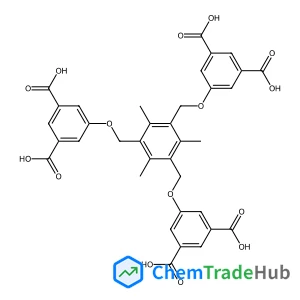
5,5',5''-(((2,4,6-Trimethylbenzene-1,3,5-triyl)tris(methylene))tris(oxy))triisophthalic acid
CAS Number:
1159974-70-5
Molecular Formula:
C36H30O15
Zhengqiang Liu, Wenbo H. Liu
Olefin synthesis is a fundamentally important process in organic chemistry. Among the numerous approaches to obtaining olefins such as alcohol/halide eliminations, alkyne-based reductions and additions, pericyclic reactions, metal-mediated cross-couplings, olefin metathesis, etc., carbonyl olefinations are particularly of significance, as exemplified by the Wittig-type reactions. In this report, we describe a new decarboxylative carbonyl olefination in one step with a broad substrate scope under mild conditions by merging an aldehyde and the α-halo carboxylic N-hydroxyphthalimide (NHPI) ester. Mechanistic investigations reveal that this reaction takes place via a tandem nucleophilic addition/reductive E1cb process. The operational simplicity, the ready availability of both starting materials and the versatility of the olefin product demonstrate the potential synthetic utility of this decarboxylative carbonyl olefination.

Journal of Natural Medicines

Current Opinion in Solid State & Materials Science

Nature Medicine

Russian Journal of Organic Chemistry

New Journal of Chemistry

Crystallography Reports

Drug Discovery Today

Organic Process Research & Development

Russian Journal of Bioorganic Chemistry

Russian Journal of General Chemistry
Maria Rosa Antognazza, Francesco Scotognella, Karol Miszta, Dirk Dorfs, Marco Zanella, Margherita Zavelani-Rossi, Liberato Manna, Francesco Tassone
DOI: 10.1039/C1CP21402K
Ah-Young Jee, Seohyun Park, Minyung Lee
DOI: 10.1039/C1CP20835G
Kelei Zhuo, Yujuan Chen, Jing Chen, Guangyue Bai, Jianji Wang
DOI: 10.1039/C1CP20948E
Junki Nagakubo, Minoru Ashizawa, Tadashi Kawamoto, Akihiko Tanioka
DOI: 10.1039/C1CP21507H
Jason Fang, Antonios Kelarakis, Yueh-Wei Lin, Chi-Yun Kang, Ming-Huan Yang, Cheng-Liang Cheng, Yue Wang, Emmanuel P. Giannelis, Li-Duan Tsai
DOI: 10.1039/C1CP22017A
Christine Cézard, Frédéric Aubry, Florence Djedaïni-Pilard, François-Yves Dupradeau
DOI: 10.1039/C1CP20854C
Princia Salvatore, Allan Glargaard Hansen, Thomas Bjørnholm, Richard John Nichols, Jens Ulstrup
DOI: 10.1039/C1CP21197H
Jakob Kryger Sørensen, Emanuel Lörtscher, Tom Vosch, Heike Riel, Kristine Kilså, Thomas Bjørnholm, Herre van der Zant
DOI: 10.1039/C1CP20861F
2-Methylbenzene-1,4-diamine dihydrochloride (CAS: 615-45-2) should be stored in ...
(1S,4S)-2,5-Diazabicyclo[2.2.1]heptane dihydrobromide is generally considered sa...
(6-Chloropyridazin-3-YL)methanamine finds applications in the pharmaceutical ind...
2-Fluoro-3-methylphenol is primarily used in the synthesis of pharmaceuticals, p...
When handling 3-Methoxy-4-nitrobenzonitrile, it is important to wear appropriate...
When handling 1,3-Oxazolo[4,5-b]pyridine-2(3H)-thione (CAS: 211949-57-4), it is ...
4-Ethynylbenzamide (CAS: 90347-86-7) falls under various regulatory guidelines i...
3-(2-Ethylphenyl)-2-thioxo-4-imidazolidinone is primarily used as an intermediat...
(2-Fluoro-6-methoxyphenyl)acetic acid, also known as 4-fluoro-3-methoxybenzoic a...
Market trends for 2-[4-(Hydroxymethyl)phenoxy]ethanol (CAS: 102196-18-9) indicat...

Organic Chemistry Frontiers publishes high-quality research from across organic chemistry. Emphases are placed on studies that make significant contributions to the field of organic chemistry by reporting either new or significantly improved protocols or methodologies. Topics include, but are not limited to the following: Organic synthesis Development of synthetic methodologies Catalysis Natural products Functional organic materials Supramolecular and macromolecular chemistry Physical and computational organic chemistry