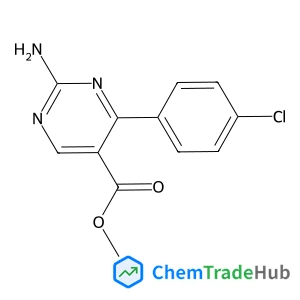
Methyl 2-amino-4-(4-chlorophenyl)-5-pyrimidinecarboxylate
CAS Number:
1133115-56-6
Molecular Formula:
C12H10ClN3O2
A graphical abstract is available for this content
François Jérôme, Michel Ferreira, Hervé Bricout, Stéphane Menuel, Eric Monflier, Sébastien Tilloy
DOI: 10.1039/C4GC00591K
Pankaj Nehra, Bharti Khungar, Kasiviswanadharaju Pericherla, S. C. Sivasubramanian, Anil Kumar
DOI: 10.1039/C4GC00525B
Tao Li, Xuan Li
DOI: 10.1039/C4GC00565A
Valeria Bugatti, Bluma Guenther Soares
DOI: 10.1039/C4GC00969J
Jinquan Wang, Jiayu Leong, Yugen Zhang
DOI: 10.1039/C4GC01060D
Kiki Adi Kurnia, João A. P. Coutinho
DOI: 10.1039/C4GC00954A
Lin Wang, Zhi-Gang Ma, Xiao-Jing Wei, Qing-Yuan Meng, Deng-Tao Yang, Shao-Fu Du, Zi-Fei Chen, Li-Zhu Wu, Qiang Liu
DOI: 10.1039/C4GC00337C
Lin He, Helfried Neumann, Matthias Beller
DOI: 10.1039/C4GC00801D
Juan Liu, Yanmei Yang, Naiyun Liu, Yang Liu, Hui Huang, Zhenhui Kang
DOI: 10.1039/C4GC01126K
2-Methylbenzene-1,4-diamine dihydrochloride (CAS: 615-45-2) should be stored in ...
(1S,4S)-2,5-Diazabicyclo[2.2.1]heptane dihydrobromide is generally considered sa...
(6-Chloropyridazin-3-YL)methanamine finds applications in the pharmaceutical ind...
2-Fluoro-3-methylphenol is primarily used in the synthesis of pharmaceuticals, p...
When handling 3-Methoxy-4-nitrobenzonitrile, it is important to wear appropriate...
When handling 1,3-Oxazolo[4,5-b]pyridine-2(3H)-thione (CAS: 211949-57-4), it is ...
4-Ethynylbenzamide (CAS: 90347-86-7) falls under various regulatory guidelines i...
3-(2-Ethylphenyl)-2-thioxo-4-imidazolidinone is primarily used as an intermediat...
(2-Fluoro-6-methoxyphenyl)acetic acid, also known as 4-fluoro-3-methoxybenzoic a...
Market trends for 2-[4-(Hydroxymethyl)phenoxy]ethanol (CAS: 102196-18-9) indicat...

Organic & Biomolecular Chemistry (OBC) publishes original and high impact research and reviews in organic chemistry. We welcome research that shows new or significantly improved protocols or methodologies in total synthesis, synthetic methodology or physical and theoretical organic chemistry as well as research that shows a significant advance in the organic chemistry or molecular design aspects of chemical biology, catalysis, supramolecular and macromolecular chemistry, theoretical chemistry, mechanism-oriented physical organic chemistry, medicinal chemistry or natural products. Articles published in the journal should report new work which makes a highly-significant impact in the field. Routine and incremental work is generally not suitable for publication in the journal. More details about key areas of our scope are below. In all cases authors should include in their article clear rationale for why their research has been carried out.