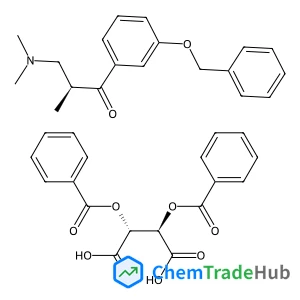
(S)-1-(3-(Benzyloxy)phenyl)-3-(dimethylamino)-2-methylpropan-1-one (2r,3r)-2,3-bis(benzoyloxy)succinate
CAS Number:
1004315-81-4
Molecular Formula:
C37H37NO10
Ghanshyam Mali, Vinay Kumar Yadav, Himani Priya, Manjari Shukla, Peeyush Pandey, Akhilesh Kumar, Manikandan Paranjothy, Sudipta Bhattacharyya, Rohan D. Erande
Lewis-acid cascade reactions promoted by BF3路OEt2 are reported for the synthesis of highly substituted pyrrolo[1,2-a]indoles and congeners of benzofuro[2,3-b]indoles. These reactions are highly regio- and diastereoselective towards generating up to five contiguous stereogenic centers, including two vicinal quaternary centers. Furthermore, an established cascade approach and the mechanism proposed herein are well supported by quantum chemistry calculations. In addition, a self-dimerization intermediate was trapped and isolated to establish a strategy for potential access to both pyrrolo and benzo indole derivatives, leaving sufficient freedom for broadening. Furthermore, in-silico molecular docking and all atomistic molecular dynamic (MD) simulation analysis suggests that the synthesized pyrrolo[1,2-a]indole derivatives stably bind at the active site of the mycobacterial secreted tyrosine phosphatase B (MptpB) enzyme, an emerging anti-mycobacterial drug target. Deep learning-based affinity predictions and MMPBGBSA-based energy calculations of the docked poses are presented herein.
Patrícia A. Russo, Margarida M. Antunes, Patrícia Neves, Paul V. Wiper, Enza Fazio, Fortunato Neri, Francesco Barreca, Luís Mafra, Martyn Pillinger, Nicola Pinna, Anabela A. Valente
DOI: 10.1039/C4GC01037J
Martin Trautmann, Yvonne Traa
DOI: 10.1039/C4GC00649F
Manoj B. Gawande, Anuj K. Rathi, Jiri Tucek, Klara Safarova, Nenad Bundaleski, Orlando M. N. D. Teodoro, Libor Kvitek, Rajender S. Varma, Radek Zboril
DOI: 10.1039/C4GC00774C
Paula M. Uberman, Natalia J. S. Costa, Rafaela C. Carmona, Alcindo A. Dos Santos, Liane M. Rossi
DOI: 10.1039/C4GC00669K
Lin He, Helfried Neumann, Matthias Beller
DOI: 10.1039/C4GC00801D
Sadu Nageswara Rao, Darapaneni Chandra Mohan, Subbarayappa Adimurthy
DOI: 10.1039/C4GC01402B
Beatrice Bechi, Susanne Herter, Shane McKenna, Christopher Riley, Silke Leimkühler, Nicholas J. Turner, Andrew J. Carnell
DOI: 10.1039/C4GC01321B
Juan Liu, Yanmei Yang, Naiyun Liu, Yang Liu, Hui Huang, Zhenhui Kang
DOI: 10.1039/C4GC01126K
Patrick Wagner, Maud Bollenbach, Christelle Doebelin, Frédéric Bihel, Jean-Jacques Bourguignon, Martine Schmitt
DOI: 10.1039/C4GC00853G
Marijana Blesic, H. Q. Nimal Gunaratne, Johan Jacquemin, Peter Nockemann, Sonia Olejarz, Kenneth R. Seddon, Christopher R. Strauss
DOI: 10.1039/C4GC01159G
2-Methylbenzene-1,4-diamine dihydrochloride (CAS: 615-45-2) should be stored in ...
(1S,4S)-2,5-Diazabicyclo[2.2.1]heptane dihydrobromide is generally considered sa...
(6-Chloropyridazin-3-YL)methanamine finds applications in the pharmaceutical ind...
2-Fluoro-3-methylphenol is primarily used in the synthesis of pharmaceuticals, p...
When handling 3-Methoxy-4-nitrobenzonitrile, it is important to wear appropriate...
When handling 1,3-Oxazolo[4,5-b]pyridine-2(3H)-thione (CAS: 211949-57-4), it is ...
4-Ethynylbenzamide (CAS: 90347-86-7) falls under various regulatory guidelines i...
3-(2-Ethylphenyl)-2-thioxo-4-imidazolidinone is primarily used as an intermediat...
(2-Fluoro-6-methoxyphenyl)acetic acid, also known as 4-fluoro-3-methoxybenzoic a...
Market trends for 2-[4-(Hydroxymethyl)phenoxy]ethanol (CAS: 102196-18-9) indicat...

Organic & Biomolecular Chemistry (OBC) publishes original and high impact research and reviews in organic chemistry. We welcome research that shows new or significantly improved protocols or methodologies in total synthesis, synthetic methodology or physical and theoretical organic chemistry as well as research that shows a significant advance in the organic chemistry or molecular design aspects of chemical biology, catalysis, supramolecular and macromolecular chemistry, theoretical chemistry, mechanism-oriented physical organic chemistry, medicinal chemistry or natural products. Articles published in the journal should report new work which makes a highly-significant impact in the field. Routine and incremental work is generally not suitable for publication in the journal. More details about key areas of our scope are below. In all cases authors should include in their article clear rationale for why their research has been carried out.