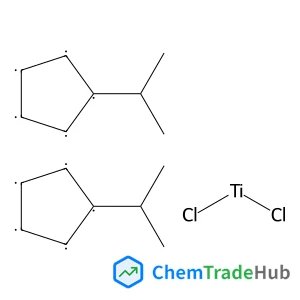
BIS(I-PROPYLCYCLOPENTADIENYL)TITANIUM DICHLORIDE
CAS Number:
12130-65-3
Molecular Formula:
C16H22Cl2Ti
Cláudia Brito da Silva, Luana Silva, Natalí Pires Debia, Diogo Seibert Lüdtke, Fabiano Severo Rodembusch
This study presents the synthesis of novel glycoconjugates by connecting benzazole and carbohydrate units with a 1,2,3-triazole linker. A simple synthetic route employing a copper(I) catalyzed azide–alkyne 1,3-dipolar cycloaddition (CuAAC) was utilized. The synthesized compounds exhibit excited-state intramolecular proton transfer (ESIPT), resulting in longer wavelength emission with a significantly large Stokes shift (∼10 000 cm−1). These compounds show potential as chemical sensors due to their ability to detect Cu2+ ions, causing a decrease in fluorescence emission (turn-off effect). Additionally, they demonstrate strong interaction with proteins, exemplified by their interaction with bovine serum albumin (BSA) as a model protein.
Tobias Stemmler, Felix A. Westerhaus, Annette-Enrica Surkus, Marga-Martina Pohl, Kathrin Junge, Matthias Beller
DOI: 10.1039/C4GC00536H
Luigi Vaccaro, Daniela Lanari, Assunta Marrocchi, Giacomo Strappaveccia
DOI: 10.1039/C4GC00410H
P. Moriel, A. B. García
DOI: 10.1039/C4GC00755G
Do Joong Kim, Kyung Hwan Oh, Jin Kyoon Park
DOI: 10.1039/C4GC00684D
Rajeev Kumar
DOI: 10.1039/C4GC00747F
DOI: 10.1039/C4GC00602J
Chenhua Shu, Tonghua Sun, Qingbin Guo, Jinping Jia, Ziyang Lou
DOI: 10.1039/C4GC00695J
Manoj B. Gawande, Anuj K. Rathi, Jiri Tucek, Klara Safarova, Nenad Bundaleski, Orlando M. N. D. Teodoro, Libor Kvitek, Rajender S. Varma, Radek Zboril
DOI: 10.1039/C4GC00774C
Ruichang Xiong, Stanley I. Sandler, Dionisios G. Vlachos, Paul J. Dauenhauer
DOI: 10.1039/C4GC00727A
A. Figoli, T. Marino, S. Simone, E. Di Nicolò, X.-M. Li, T. He, S. Tornaghi, E. Drioli
DOI: 10.1039/C4GC00613E
2-Methylbenzene-1,4-diamine dihydrochloride (CAS: 615-45-2) should be stored in ...
(1S,4S)-2,5-Diazabicyclo[2.2.1]heptane dihydrobromide is generally considered sa...
(6-Chloropyridazin-3-YL)methanamine finds applications in the pharmaceutical ind...
2-Fluoro-3-methylphenol is primarily used in the synthesis of pharmaceuticals, p...
When handling 3-Methoxy-4-nitrobenzonitrile, it is important to wear appropriate...
When handling 1,3-Oxazolo[4,5-b]pyridine-2(3H)-thione (CAS: 211949-57-4), it is ...
4-Ethynylbenzamide (CAS: 90347-86-7) falls under various regulatory guidelines i...
3-(2-Ethylphenyl)-2-thioxo-4-imidazolidinone is primarily used as an intermediat...
(2-Fluoro-6-methoxyphenyl)acetic acid, also known as 4-fluoro-3-methoxybenzoic a...
Market trends for 2-[4-(Hydroxymethyl)phenoxy]ethanol (CAS: 102196-18-9) indicat...

Organic & Biomolecular Chemistry (OBC) publishes original and high impact research and reviews in organic chemistry. We welcome research that shows new or significantly improved protocols or methodologies in total synthesis, synthetic methodology or physical and theoretical organic chemistry as well as research that shows a significant advance in the organic chemistry or molecular design aspects of chemical biology, catalysis, supramolecular and macromolecular chemistry, theoretical chemistry, mechanism-oriented physical organic chemistry, medicinal chemistry or natural products. Articles published in the journal should report new work which makes a highly-significant impact in the field. Routine and incremental work is generally not suitable for publication in the journal. More details about key areas of our scope are below. In all cases authors should include in their article clear rationale for why their research has been carried out.
![[1-(5-Methyl-2-pyridinyl)-1H-pyrazol-4-yl]methanol structure](https://static.chemtradehub.com/structs/143/1439822-99-7-6cc9.webp "[1-(5-Methyl-2-pyridinyl)-1H-pyrazol-4-yl]methanol structure")