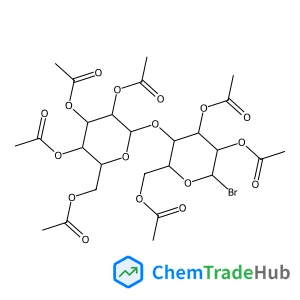
2,3,6-Tri-O-acetyl-4-O-(2,3,4,6-tetra-O-acetyl-beta-D-galactopyranosyl)-alpha-D-glucopyranosyl bromide
CAS Number:
4753-07-5
Molecular Formula:
C26H35BrO17
Rajeev Kumar
Metal halides are selective catalysts suitable for production of the fuel precursors furfural and 5-HMF from sugars derived from lignocellulosic biomass. However, they do not perform nearly as well when applied to biomass even in combination with immiscible extracting solvents or expensive ionic co-solvents. Here, we couple metal halides with a highly tunable co-solvent system employing renewable tetrahydrofuran (THF) to significantly enhance co-production of furfural and 5-HMF from biomass in a single phase reaction strategy capable of integrating biomass deconstruction with catalytic dehydration of sugars. Screening of several promising metal halide species at 170 °C in pH-controlled reactions with sugar solutions and larger 1 L reactions with maple wood and corn stover revealed how the interplay between relative Brønsted and Lewis acidities was responsible for enhancing catalytic performance in THF co-solvent. Combining FeCl3 with THF co-solvent was particularly effective, achieving one of the highest reported simultaneous yields of furfural (95%) and 5-HMF (51%) directly from biomass with minimal levulinic acid formation (6%). Furthermore, over 90% of the lignin from biomass was extracted by THF and recovered as a fine lignin powder. Tuning the volume ratio of THF to water from 4 : 1 to 1 : 1 preserved 10% to 31% of the reacted biomass as a glucan-rich solid suitable for further catalytic reaction, enzymatic digestion, or possible pulp and paper production.
Guy Schmitz
DOI: 10.1039/C1CP00006C
Tomáš Skála, Nataliya Tsud, Tevfik Onur Menteş, Andrea Locatelli, Kevin Charles Prince, Vladimír Matolín
DOI: 10.1039/C0CP03012K
François Gaie-Levrel, Gustavo A. Garcia, Martin Schwell, Laurent Nahon
DOI: 10.1039/C0CP02798G
Deepthi Jose, Ayan Datta
DOI: 10.1039/C0CP02580A
B. Grüner, M. Schlesinger, Ph. Heister, W. T. Strunz, F. Stienkemeier, M. Mudrich
DOI: 10.1039/C0CP02355H
E. R. Mysak, J. D. Smith, P. D. Ashby, J. T. Newberg, K. R. Wilson, H. Bluhm
DOI: 10.1039/C0CP02323J
Shuangyin Wang, Xin Wang, San Ping Jiang
DOI: 10.1039/C0CP02495C
Milán Szőri, Balázs Jójárt, Kornél Szőri, Béla Viskolcz
DOI: 10.1039/C0CP02687E
2-Methylbenzene-1,4-diamine dihydrochloride (CAS: 615-45-2) should be stored in ...
(1S,4S)-2,5-Diazabicyclo[2.2.1]heptane dihydrobromide is generally considered sa...
(6-Chloropyridazin-3-YL)methanamine finds applications in the pharmaceutical ind...
2-Fluoro-3-methylphenol is primarily used in the synthesis of pharmaceuticals, p...
When handling 3-Methoxy-4-nitrobenzonitrile, it is important to wear appropriate...
When handling 1,3-Oxazolo[4,5-b]pyridine-2(3H)-thione (CAS: 211949-57-4), it is ...
4-Ethynylbenzamide (CAS: 90347-86-7) falls under various regulatory guidelines i...
3-(2-Ethylphenyl)-2-thioxo-4-imidazolidinone is primarily used as an intermediat...
(2-Fluoro-6-methoxyphenyl)acetic acid, also known as 4-fluoro-3-methoxybenzoic a...
Market trends for 2-[4-(Hydroxymethyl)phenoxy]ethanol (CAS: 102196-18-9) indicat...

Green Chemistry provides a unique forum for the publication of innovative research on the development of alternative green and sustainable technologies. The scope of Green Chemistry is based on, but not limited to, the definition proposed by Anastas and Warner (Green Chemistry: Theory and Practice, P T Anastas and J C Warner, Oxford University Press, Oxford, 1998). Green chemistry is the utilisation of a set of principles that reduces or eliminates the use or generation of hazardous substances in the design, manufacture and application of chemical products. Green Chemistry is at the frontiers of this continuously-evolving interdisciplinary science and publishes research that attempts to reduce the environmental impact of the chemical enterprise by developing a technology base that is inherently non-toxic to living things and the environment. Submissions on all aspects of research relating to the endeavour are welcome. The journal publishes original and significant cutting-edge research that is likely to be of wide general appeal. To be published, work must present a significant advance in green chemistry. Papers must contain a comparison with existing methods and demonstrate advantages over those methods before publication can be considered. For more information please see this Editorial. Coverage includes the following, but is not limited to: Design (e.g. biomimicry, design for degradation/recycling/reduced toxicity…) Reagents & Feedstocks (e.g. renewables, CO2, solvents, auxiliary agents, waste utilization…) Synthesis (e.g. organic, inorganic, synthetic biology…) Catalysis (e.g. homogeneous, heterogeneous, enzyme, whole cell…) Process (e.g. process design, intensification, separations, recycling, efficiency…) Energy (e.g. renewable energy, fuels, photovoltaics, fuel cells, energy storage, energy carriers…) Applications (e.g. electronics, dyes, consumer products, coatings, pharmaceuticals, preservatives, building materials, chemicals for industry/agriculture/mining…) Impact (e.g. safety, metrics, LCA, sustainability, (eco)toxicology…) Green chemistry is, by definition, a continuously-evolving frontier. Therefore, the inclusion of a particular material or technology does not, of itself, guarantee that a paper is suitable for the journal. To be suitable, the novel advance should have the potential for reduced environmental impact relative to the state of the art. Green Chemistry does not normally deal with research associated with 'end-of-pipe' or remediation issues.
![5-Bromo-3-isopropyl-1H-pyrrolo[2,3-b]pyridine structure](https://static.chemtradehub.com/structs/125/1256819-54-1-8620.webp "5-Bromo-3-isopropyl-1H-pyrrolo[2,3-b]pyridine structure")