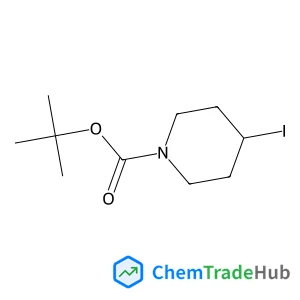
2-Methyl-2-propanyl 4-iodo-1-piperidinecarboxylate
CAS Number:
301673-14-3
Molecular Formula:
C10H18INO2
Cyclodextrin, which has the advantages of being resource-rich, low cost, eco-friendly, high purity and good stability, is a potential precursor to prepare hard carbons for sodium ion batteries (SIBs), but is rarely explored so far. In this work, a simple and commercializable pre-crosslinking strategy was developed to modulate the local structure of cyclodextrin-derived carbons, because the direct carbonization of cyclodextrin leads to a limited capacity of 154.7 mA h g−1. The original cyclic monomer structure of cyclodextrin is transformed into a three-dimensional cross-linked structure via carbonyl groups as binding sites. The cross-linking reaction tends to produce more sp3-hybrid carbon, which finally results in more curved and shorter carbon layers as well as much more closed pores. Thus, the best sample obtained with a thirty-minute pre-crosslinking treatment delivers an improved reversible specific capacity of 332.5 mA h g−1 at a current density of 30 mA g−1 with an initial Coulombic efficiency of 83.4%, where the low-voltage plateau region (230.1 mA h g−1) contributes up to 70% of the total capacity. To the best of our knowledge, this work offers a tentative exploration of cyclodextrin-derived carbons for the first time, which possibly opens up the investigation of this new kind of carbon anode.
Linlin Wang, Lei Li, Xing Wang, Da Huang, Fei Yang, Hong Shen, Zichen Li, Decheng Wu
DOI: 10.1039/C5PY01925G
Shaojia Zhu, Yongsheng Li, Ping Shi, Zhong Huang, Xiaoyu Huang
DOI: 10.1039/C4PY00903G
T. Kotaki, N. Nishimura, M. Ozawa, A. Fujimori, H. Muraoka, S. Ogawa, T. Korenaga, E. Suzuki, Y. Oishi, Y. Shibasaki
DOI: 10.1039/C5PY01920F
Lei Dong, Yu-Cheng Chiu, Chu-Chen Chueh, An-Dih Yu, Wen-Chang Chen
DOI: 10.1039/C4PY00988F
Ying-Hsuan Chou, Chia-Liang Tsai, Guey-Sheng Liou
DOI: 10.1039/C4PY00825A
Rajeev Kumar, Priyadarsi De, Bin Zheng, Kuo-Wei Huang, Jack Emert, Rudolf Faust
DOI: 10.1039/C4PY01039F
Yan Kang, Anaïs Pitto-Barry, Helen Willcock, Wen-Dong Quan, Nigel Kirby, Ana M. Sanchez, Rachel K. O'Reilly
DOI: 10.1039/C4PY01074D
Waste containing (6-Bromo-2-naphthyl)oxy](dimethyl)(2-methyl-2-propanyl)silane (...
7-Fluoro-4-isoquinolinecarboxylic acid can be synthesized via a multi-step proce...
2,3,5,6-Tetrabromothieno[3,2-b]thiophene is a crystalline compound with a high m...
1-[4-(Benzylamino)-7,8-dihydro-5H-pyrano[4,3-d]pyrimidin-2-yl]-2-methyl-1H-indol...
The market for imidazo[5,1-d]-1,2,3,5-tetrazine-8-carboxylic acid, 3,4-dihydro-3...
3-(Triisopropylsilyl)propiolaldehyde is a synthetic organic compound with the CA...
6-Nitro-2H-1,4-benzoxazin-3(4H)-one (CAS: 81721-87-1) is subject to various regu...
Waste containing (3-Fluorophenyl)(4-{[(2-methyl-2-propanyl)oxy]carbonyl}-1-piper...
N,N'-4,4'-Biphenyldiyldiisonicotinamide is a white crystalline solid with a mole...
6-Bromo-8-fluoro-2-quinazolinol is primarily used in the pharmaceutical industry...

NJC (New Journal of Chemistry) is a broad-based primary journal encompassing all branches of chemistry and its sub-disciplines. It contains full research articles, communications, perspectives and focus articles. This well-established journal, owned by the Centre National de la Recherche Scientifique (CNRS) of France, has been co-published with the Royal Society of Chemistry since January 1998. NJC is the forum for the publication of high-quality, original and significant work that opens new directions in chemistry or other scientific disciplines. In addition to having a significant chemical component, work published in NJC must demonstrate that it will have an impact on areas of research other than that of the reported work.
![N-[(E)-Phenylmethylene]benzenesulfonamide structure](https://static.chemtradehub.com/structs/139/13909-34-7-8167.webp "N-[(E)-Phenylmethylene]benzenesulfonamide structure")