












Molecularly imprinted polymers for the analysis and removal of polychlorinated aromatic compounds in the environment: a review
Literature Information
Publication Date
2016-03-31
DOI
10.1039/C6AN00293E
Impact Factor
4.616
Authors
Elizabeth N. Ndunda, Boris Mizaikoff
View Original
Abstract
Synthetic receptors and in particular molecularly imprinted polymers (MIPs) are gaining relevance as selective sorbent materials and biomimetic recognition elements for analyzing polychlorinated aromatic compounds (PACs) in the environment. PACs are still ubiquitous toxic pollutants requiring their continuous environmental assessment for protecting humans and animals from exposure. Since nowadays most PACs occur at ultra-trace concentration levels and in complex matrices, the selectivity of MIPs renders them ideally suited for facilitating either sample pre-treatment and quantitative enrichment, or acting as biomimetic recognition elements as an integral component of corresponding sensing schemes. Due to the diversity of PACs, imprinting polymers for these constituents appears particularly challenging. This review focuses on prevalent strategies towards successfully templating polymer materials towards polychlorinated biphenyls and their hydroxy forms, chlorophenols, dioxins and furans, and organochlorine pesticides, and successful applications of the polymer materials in monitoring of these compounds at trace-levels in real-world environmental matrices. Discussed are also group-selective sorbents for facilitating simultaneous detection and quantification of PACs.
Recommended Journals
Related Literature
Preparation of high performance supercapacitor materials by fast pyrolysis of corn gluten meal waste
Ke Tian, Hong Jiang
2017-04-03
Paper
DOI: 10.1039/C7SE00029D
Liquid flow-induced electricity in carbon nanomaterials
Junxian Pei, Jun Huang, Zhi Huang, Kang Liu
2019-01-30
Review Article
DOI: 10.1039/C8SE00604K
Polyaniline coated Fe3O4 hollow nanospheres as anode materials for lithium ion batteries
Xiaoliang Wang, Yanguo Liu, Hongyan Han, Yanyan Zhao, Wuming Ma
2017-04-12
Paper
DOI: 10.1039/C7SE00139H
Suppression of byproduct accumulation in rechargeable aluminum–air batteries using non-oxide ceramic materials as air cathode materials
Ryohei Mori
2017-05-12
Paper
DOI: 10.1039/C7SE00087A
Ultrahigh stability of high-power nanofibrillar PEDOT supercapacitors
Shinjita Acharya, Luciano M. Santino, Yang Lu, Hari Anandarajah, Aly Wayne
2017-03-27
Paper
DOI: 10.1039/C7SE00057J
A low cost ultra-microporous carbon scaffold with confined chain-like sulfur molecules as a superior cathode for lithium–sulfur batteries
Junkai Han, Shuangwen Li, Peng Long, Chen Cao, Yu Cao, Weizhe Wang
2018-05-22
Paper
DOI: 10.1039/C8SE00185E
You might also like
Compound Q&A
How should waste containing 6-Chloro-5-(2'-hydroxy-3'-methoxy-4-biphenylyl)-3-(3-methoxyphenyl)-1H-pyrrolo[3,2-d]pyrimidine-2,4(3H,5H)-dione (CAS: 1346607-05-3) be handled?
Waste containing 6-Chloro-5-(2'-hydroxy-3'-methoxy-4-biphenylyl)-3-(3-methoxyphe...
1346607-05-36-Chloro-5-(2'-hydro...
Compound Q&A
What are the main uses of (3alpha,5alpha)-3-Hydroxypregnane-11,20-dione (CAS: 23930-19-0)?
(3alpha,5alpha)-3-Hydroxypregnane-11,20-dione is primarily used in the pharmaceu...
23930-19-0(3alpha,5alpha)-3-Hy...
Compound Q&A
What is the market or research trend for 4-Amino-6-chloro-2-pyridinecarboxylic acid (CAS: 546141-56-4)?
The market for 4-Amino-6-chloro-2-pyridinecarboxylic acid (CAS: 546141-56-4) is ...
546141-56-44-Amino-6-chloro-2-p...
Compound Q&A
Are there alternatives to (2-Benzoylethyl)trimethylammonium chloride (CAS: 24472-88-6) in synthesis?
Alternatives to (2-Benzoylethyl)trimethylammonium chloride (CAS: 24472-88-6) in ...
24472-88-6(2-Benzoylethyl)trim...
Compound Q&A
Is N-[4-Nitro-3-(trifluoromethyl)phenyl]acetamide (CAS: 393-12-4) safe?
N-[4-Nitro-3-(trifluoromethyl)phenyl]acetamide (CAS: 393-12-4) is generally safe...
393-12-4N-[4-Nitro-3-(triflu...
Compound Q&A
Are there alternatives to [(4R,5R,6S)-5-hydroxy-10-imino-3,7-dioxa-1,9-diazatricyclo[6.4.0.02,6]dodeca-8,11-dien-4-yl]methyl dihydrogen phosphate (CAS: 39679-56-6) in synthesis?
Alternative reagents such as other phosphates or similar functional groups can b...
39679-56-6[(4R,5R,6S)-5-hydrox...
Compound Q&A
Are there alternatives to N,N'-Bis(3-aminopropyl)-1,3-propanediamine (CAS: 4605-14-5) in synthesis?
There are alternatives to N,N'-Bis(3-aminopropyl)-1,3-propanediamine (CAS: 4605-...
4605-14-5N,N'-Bis(3-aminoprop...
Compound Q&A
What precautions should be taken when handling Aluminium trihexadecanoate (CAS: 555-35-1)?
When handling Aluminium trihexadecanoate, it is important to use appropriate per...
555-35-1Aluminium trihexadec...
Compound Q&A
What is (1,1-Dioxido-3-oxo-1,2-benzothiazol-2(3H)-yl)acetic acid (CAS: 52188-11-1)?
(1,1-Dioxido-3-oxo-1,2-benzothiazol-2(3H)-yl)acetic acid is a chemical compound ...
52188-11-1(1,1-Dioxido-3-oxo-1...
Compound Q&A
Are there alternatives to 5,5-dimethyloxolan-2-one (CAS: 3123-97-5) in synthesis?
Several alternatives to 5,5-dimethyloxolan-2-one (CAS: 3123-97-5) can be used in...
3123-97-55,5-dimethyloxolan-2...
Source Journal
Analyst

CiteScore:
7.8
Self-citation Rate:
5.6%
Articles per Year:
653
Analyst publishes analytical and bioanalytical research that reports premier fundamental discoveries and inventions, and the applications of those discoveries, unconfined by traditional discipline barriers.
Recommended Compounds
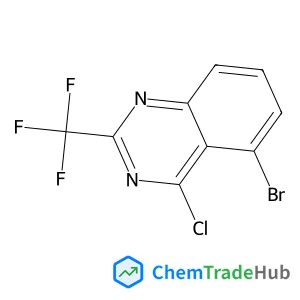
5-Bromo-4-chloro-2-(trifluoromethyl)quinazoline
CAS Number:
2089311-03-3
Molecular Formula:
C9H3BrClF3N2
![Benzyl 2-{[(tert-butoxy)carbonyl]amino}acetate structure](https://static.chemtradehub.com/structs/542/54244-69-8-6399.webp "Benzyl 2-{[(tert-butoxy)carbonyl]amino}acetate structure")

Recommended Suppliers





Disclaimer
This page provides academic journal information for reference and research purposes only. We are not affiliated with any journal publishers and do not handle publication submissions. For publication-related inquiries, please contact the respective journal publishers directly.
If you notice any inaccuracies in the information displayed, please contact us at support@chemtradehub.com. We will promptly review and address your concerns.