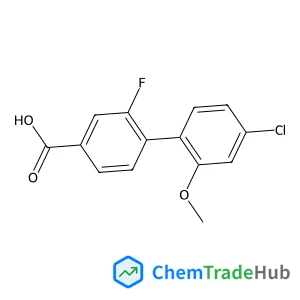
4-(4-Chloro-2-methoxyphenyl)-3-fluorobenzoic acid
CAS Number:
1261970-23-3
Molecular Formula:
C14H10ClFO3
Amaresh Mishra, Nirmala Niharika Bhuyan, Haijun Xu, Ganesh D. Sharma
Layer-by-layer (LBL) deposition using solution processing is a promising technique for fabricating organic solar cells (OSCs) with high efficiency and stability. In comparison with bulk-heterojunction (BHJ) structures, in the LBL method, the donor (D) and acceptor (A) materials are deposited sequentially, presenting many distinct advantages including a p–i–n-like configuration (D/D:A/A) that may create well-defined and controllable nanostructures to facilitate charge generation and extraction. This concept is an advisable option to fabricate pseudo-bilayer configurations in the active layer of OSCs. At present, high power conversion efficiencies (PCEs) of over 19% in ternary LBL processed OSCs and 11.97% in the processed module (11.52 cm2) have been successfully realized, indicating that the selection of an appropriate ternary system is an effective strategy to improve the morphology of the active layer towards efficient and stable OSCs. Moreover, the unique merits of LBL configuration in individual layer processing enable it to be a promising approach for large-scale printing and further commercialization of OSCs. In this article, we summarize the recent advances in LBL OSCs, focusing on the selection of materials, solvents, processing parameters, device architectures, and stability. We also discuss the key strategies used for further improvement of LBL OSCs from the perspectives of structural design, performance, and scalability. Finally, we discuss the current limitations of BHJ devices and the prospect of LBL OSCs as a promising alternative for high-performance and stable OSCs. We also highlight some key research directions that can help enhance the efficiency and stability of LBL OSCs for their potential applications in the future.
M. B. Figueirêdo, H. J. Heeres, P. J. Deuss
DOI: 10.1039/C9SE00740G
Marion Tisseraud, Jürgen Schulz, Delphine Vimont, Murielle Berlande, Philippe Fernandez, Philippe Hermange, Eric Fouquet
DOI: 10.1039/C8CC01782D
SeongYeon Kim, Md. Salahuddin Mina, Kiwhan Kim, Jihye Gwak, JunHo Kim
DOI: 10.1039/C9SE00778D
Roudabeh Valiollahi, Mikhail Vagin, Viktor Gueskine, Amritpal Singh, Sergey A. Grigoriev, Xianjie Liu, Ziyauddin Khan
DOI: 10.1039/C9SE00687G
Xiaojuan Chen, Yan Meng, Taotao Gao, Jinmei Zhang, Xiaoqin Li, Hongyan Yuan
DOI: 10.1039/C9SE00348G
Prakhar Arora, Houman Ojagh, You Wayne Cheah, Louise Olsson, Derek Creaser
DOI: 10.1039/C9SE00507B
DOI: 10.1039/C9SE00540D
Jia Li, Yongxing Zhang, Li Li, Lixun Cheng, Song Dai, Fei Wang, Yanming Wang
DOI: 10.1039/C9SE00770A
(5-Sulfamoyl-3-pyridinyl)boronic acid is primarily used in chemical synthesis, p...
Benzyl 2-methyl-2-(methylsulfonyl)-4-pentenoate is typically synthesized via est...
When handling 8-Fluoroquinolin-6-ol (CAS: 209353-22-0), it is important to use p...
1,3-Dibromo-5-(2-methyl-2-propanyl)benzene (CAS: 129316-09-2) is a crystalline c...
Ethyl 7-chloro-4-oxo-1-(1,3-thiazol-2-yl)-1,4-dihydro-1,8-naphthyridine-3-carbox...
When handling Delta-7-Avenasterol (CAS: 23290-26-8), it is important to wear app...
Proper handling involves the use of personal protective equipment such as gloves...
When handling 2-Methyl-2-proanyl 4-[(2-aminophenyl)amino]-1-piperidinecarboxylat...
N-Methyl-4-chlorobenzylamine hydrochloride (CAS: 65542-24-7) is a organic compou...
[2-(Dodecyloxy)ethoxy]acetic acid (CAS: 27306-90-7) is generally considered safe...
![4,10-Dihydroxy-3H-pyrano[3,4,5-kl]xanthen-3-one structure](https://static.chemtradehub.com/structs/125/1259330-61-4-de48.webp "4,10-Dihydroxy-3H-pyrano[3,4,5-kl]xanthen-3-one structure")