













Fabrication of a self-powered broadband photodetector by 50% replacement of Pb by Mg in the CH3NH3Pb0.5Mg0.5Cl2I perovskite lattice
Literature Information
Publication Date
2023-08-29
DOI
10.1039/D3MA00411B
Impact Factor
0
Authors
Smrutiranjan Panda, Easwaramoorthi Ramasamy, Sushmee Badhulika, Ganapathy Veerappan, Pramod H. Borse
View Original
Abstract
Methyl ammonium lead halide (MAPbX3) suffers from high toxicity of the Pb2+ cation leading to a major roadblock to its end-application. To alleviate the toxicity issue, a complete or partial substitution of Pb2+ by eco-friendly Mg-ions is attempted in the present study. The substitution of Pb2+ with Mg2+ cations in the MAPbX3 crystal structure was carried out by tuning the stoichiometry of Mg2+ in MAPbxMg1−xCl2I (for x = 0.1, 0.3, 0.5, 0.7, 0.9). Here MAPbxMg1−xCl2I has been demonstrated for the first time in the application of a self-powered photodetector. A facile one-step anti-solvent approach has been used to synthesize the hybrid halide perovskite. Systematic structural and optical characterization indicates the formation of the desired tetragonal perovskite phase that exhibits a bandgap of 1.5–1.6 eV. The synthesized MAPbxMg1−xCl2I has been used for device fabrication with (i) a simple hole transport material (HTM)-free configuration, and (ii) an economical carbon as the top electrode contact. MAPb0.5Mg0.5Cl2I perovskite was found to be the best performing device, with an excellent responsivity of 153.74 mA W−1 at zero bias, high detectivity of 6.5 × 10¹⁰ Jones, and a fast response/recovery time of 411 ms/50 ms. The optimum Mg substituted perovskite film thus yields an eco-friendly option compared to the conventional MAPbX3 with nearly 50% replacement of the toxic Pb by benign Mg2+ cations. The demonstration of a MAPb0.5Mg0.5X3-based novel performance photodetector thus paves an important path to the replacement of toxic Pb2+ in perovskite opto-electronic devices, thereby leading to eco-friendly devices.
Related Literature
Calibration diagnostic and updating strategy based on quantitative modeling of near-infrared spectral residuals
Hua Yu, Gary W. Small
2014-12-04
Paper
DOI: 10.1039/C4AN01849D
Characterization of a new rechargeable Zn/PVA-KOH/Bi2O3 battery: structural changes of the Bi2O3 electrode
Sebastián Lorca, Florencio Santos, José Abad, Yves Huttel, Antonio Urbina, Antonio J. Fernández Romero
2020-06-08
Paper
DOI: 10.1039/D0SE00551G
Synergetic FeCo nanorods embedded in nitrogen-doped carbon nanotubes with abundant metal–NCNT heterointerfaces as efficient air electrocatalysts for rechargeable zinc–air batteries
Hao Hu, Yuhua Xie, Farhad M. D. Kazim, Konggang Qu, Min Li, Zehui Yang
2020-08-10
Paper
DOI: 10.1039/D0SE01023E
Carbon-based materials as heterogeneous antioxidants for biodiesel: efficiency and synergy with soluble antioxidants
Tais da C. Soares, Paulo R. M. Silva, Gilberto A. Romeiro, Mauricio G. Fonseca, Luciano N. Batista
2017-01-06
Communication
DOI: 10.1039/C6SE00017G
Fe–N co-decorated hierarchically porous graphene as a highly efficient electrocatalyst for the oxygen reduction reaction
Jianyu Cao, Xiaodi Jia, Mengwei Guo, Yingying Du, Juan Xu
2017-10-24
Paper
DOI: 10.1039/C7SE00458C
The role of layer-by-layer, compact TiO2 films in dye-sensitized photoelectrosynthesis cells
Rodolfo L. Coppo, Byron H. Farnum, Benjamin D. Sherman, Neyde Y. Murakami Iha, Thomas J. Meyer
2017-01-09
Paper
DOI: 10.1039/C6SE00022C
Bipyrimidine core structure-based hole transport materials for efficient perovskite solar cells
Yang Yang, Fei Wu, Huiqiang Lu, Shufang Li, Cheng Zhong, Linna Zhu
2020-08-07
Paper
DOI: 10.1039/D0SE01062F
In situ fabrication of dendritic tin-based carbon nanostructures for hydrogen evolution reaction
Oluwafunmilola Ola, Yu Chen, Yanqiu Zhu
2020-08-12
Paper
DOI: 10.1039/D0SE00812E
Synthesis of a nano-sized hybrid C3N4/TiO2 sample for enhanced and steady solar energy absorption and utilization
Junqing Yan, Ping Li, Hui Bian, Huan Wu
2017-01-21
Paper
DOI: 10.1039/C6SE00048G
You might also like
Compound Q&A
Is 2-(2-chloroacetamido)-3-phenylpropanoic acid (CAS: 7765-11-9) safe?
2-(2-Chloroacetamido)-3-phenylpropanoic acid (CAS: 7765-11-9) is generally consi...
7765-11-92-(2-chloroacetamido...
Compound Q&A
Is 2-(Benzyloxy)-5-bromobenzoic acid (CAS: 62176-31-2) safe?
2-(Benzyloxy)-5-bromobenzoic acid can be handled safely if appropriate precautio...
62176-31-22-(Benzyloxy)-5-brom...
Compound Q&A
What is (4-Methyl-1,2,5-oxadiazol-3-yl)methanamine hydrochloride (CAS: 1159825-48-5)?
(4-Methyl-1,2,5-oxadiazol-3-yl)methanamine hydrochloride is a chemical compound ...
1159825-48-5(4-Methyl-1,2,5-oxad...
Compound Q&A
What is 2-(5-Hexylthiophen-2-yl)-4,4,5,5-tetramethyl-1,3,2-dioxaborolane (CAS: 917985-54-7)?
2-(5-Hexylthiophen-2-yl)-4,4,5,5-tetramethyl-1,3,2-dioxaborolane (CAS: 917985-54...
917985-54-72-(5-Hexylthiophen-2...
Compound Q&A
Are there alternatives to 4-(8-Methyl-9H-1,3-dioxolo[4,5-h][2,3]benzodiazepin-5-yl)benzenamine (CAS: 102771-26-6) in synthesis?
While 4-(8-Methyl-9H-1,3-dioxolo[4,5-h][2,3]benzodiazepin-5-yl)benzenamine (CAS:...
102771-26-64-(8-Methyl-9H-1,3-d...
Compound Q&A
What is the market or research trend for tert-butyl 3-hydroxy-4,5,7,8-tetrahydro-2H-pyrazolo[3,4-d]azepine-6-carboxylate (CAS: 851376-80-2)?
The market for tert-butyl 3-hydroxy-4,5,7,8-tetrahydro-2H-pyrazolo[3,4-d]azepine...
851376-80-2tert-butyl 3-hydroxy...
Compound Q&A
How should waste containing 3,5-Diamino-1H-pyrazole-4-carbonitrile (CAS: 6844-58-2) be handled?
Waste containing 3,5-Diamino-1H-pyrazole-4-carbonitrile (CAS: 6844-58-2) should ...
6844-58-23,5-Diamino-1H-pyraz...
Compound Q&A
How is (6-Fluoro-3-pyridinyl)boronic acid (CAS: 351019-18-6) typically synthesized?
(6-Fluoro-3-pyridinyl)boronic acid can be synthesized through the reaction of 6-...
351019-18-6(6-Fluoro-3-pyridiny...
Compound Q&A
What industries use Dibenzyl carbonimidoylbiscarbamate (CAS: 10065-79-9)?
Dibenzyl carbonimidoylbiscarbamate (CAS: 10065-79-9) finds applications in vario...
10065-79-9Dibenzyl carbonimido...
Compound Q&A
What is the market or research trend for (beta,beta,2,3,4,5,6-~2~H_7_)Phenylalanine (CAS: 74228-83-4)?
The market for (beta,beta,2,3,4,5,6-~2~H_7_)Phenylalanine (CAS: 74228-83-4) is g...
74228-83-4(beta,beta,2,3,4,5,6...
Source Journal
Recommended Compounds
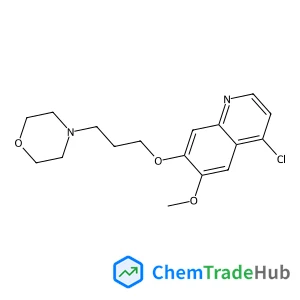
4-(3-((4-Chloro-6-methoxyquinolin-7-yl)oxy)propyl)morpholine
CAS Number:
205448-32-4
Molecular Formula:
C17H21ClN2O3
Recommended Suppliers





Disclaimer
This page provides academic journal information for reference and research purposes only. We are not affiliated with any journal publishers and do not handle publication submissions. For publication-related inquiries, please contact the respective journal publishers directly.
If you notice any inaccuracies in the information displayed, please contact us at support@chemtradehub.com. We will promptly review and address your concerns.