












Revisiting the bonding of the pentagonal-pyramidal C6H62+ and C6(CH3)62+ dications
Literature Information
Publication Date
2023-11-22
DOI
10.1039/D3CP04247B
Impact Factor
3.676
Authors
Luis E. Seijas, Rafael Almeida, Luis Rincón, Cesar Zambrano, Vladimir Rodríguez, Gabriel Merino
View Original
Abstract
This work delves into the bonding nature of the pentagonal-pyramidal benzene and hexamethylbenzene dications, C6R62+ (R = H and CH3), which contain a hexacoordinate carbon. The study employs a range of methodologies to analyze a series of scalar fields, including electron density, electron localization function, local momentum representation, and the evaluation of the Coulomb hole through information theory-derived functions. The findings unveil that electron density undergoes transfer from the pentagonal ring to the apical group. As a result, the base of the complex accumulates the positive charge. Moreover, an extended electron density domain emerges between the carbon pentagon and the apical carbon atom. This phenomenon is related to the molecular orbitals with a dipolar character aligned with the principal axis of the molecule. The results also indicate an electron density polarization towards the apical carbon, coupled with an exclusion of electron density surrounding both the apical carbon and the lower portion of the pentagonal ring. These provide valuable insights into the complex bonding nature of hexacoordinate carbon and its implications for organic chemistry.
Recommended Journals
Related Literature
Reactivity of 4Fe+(CO)n=0–2 + O2: oxidation of CO by O2 at an isolated metal atom
Shaun G. Ard, Oscar Martinez, Jr., Steven A. Brown, Jordan C. Sawyer, P. B. Armentrout, Albert A. Viggiano, Nicholas S. Shuman
2017-02-27
Paper
DOI: 10.1039/C6CP08703E
Oligomerization process of Bcl-2 associated X protein revealed from intermediate structures in solution
Orion Shih, Yi-Qi Yeh, Kuei-Fen Liao, Tai-Ching Sung, Yun-Wei Chiang
2017-02-27
Paper
DOI: 10.1039/C6CP08820A
Solid–liquid and liquid–solid transitions in metal nanoparticles
2017-01-23
Paper
DOI: 10.1039/C6CP08606C
Interfacial defects induced electronic property transformation at perovskite SrVO3/SrTiO3 and LaCrO3/SrTiO3 heterointerfaces
Junjie Li, Deqiang Yin, Qiang Li, Rong Sun, Sumei Huang, Fanzhi Meng
2017-02-01
Communication
DOI: 10.1039/C6CP07691B
Strong current polarization and perfect negative differential resistance in few-FeN4-embedded zigzag graphene nanoribbons
Xiao-Fei Li, Lingling Liu, Qing Yan, Qin-Kun Li, Yunxiang Wang, Mingsen Deng, Qi Qiu
2016-12-21
Communication
DOI: 10.1039/C6CP08357A
A DFT+U investigation of hydrogen adsorption on the LaFeO3(010) surface
Isaac W. Boateng, Richard Tia, Evans Adei, Nelson Y. Dzade
2017-02-17
Paper
DOI: 10.1039/C6CP08698E
Theoretically derived mechanisms of HPALD photolysis in isoprene oxidation
Zhen Liu, Vinh Son Nguyen, Jeremy Harvey, Jean-François Müller, Jozef Peeters
2017-03-03
Paper
DOI: 10.1039/C7CP00288B
Thiocyanates as attractive redox-active electrolytes for high-energy and environmentally-friendly electrochemical capacitors
Barbara Gorska, Paulina Bujewska, Krzysztof Fic
2017-02-16
Paper
DOI: 10.1039/C7CP00722A
Tuning calcium biosensors with a single-site mutation: structural dynamics insights from femtosecond Raman spectroscopy
Sean R. Tachibana, Longteng Tang, Yanli Wang, Weimin Liu
2017-02-13
Paper
DOI: 10.1039/C6CP08821J
Effects of Ge and Sn substitution on the metal–semiconductor transition and thermoelectric properties of Cu12Sb4S13 tetrahedrite
Yasufumi Kosaka, Koichiro Suekuni, Katsuaki Hashikuni, Yohan Bouyrie, Michihiro Ohta
2017-03-06
Paper
DOI: 10.1039/C7CP00351J
You might also like
Compound Q&A
How should 2-Methylbenzene-1,4-diamine dihydrochloride (CAS: 615-45-2) be stored?
2-Methylbenzene-1,4-diamine dihydrochloride (CAS: 615-45-2) should be stored in ...
615-45-22-Methylbenzene-1,4-...
Compound Q&A
Is (1S,4S)-2,5-Diazabicyclo[2.2.1]heptane dihydrobromide (CAS: 132747-20-7) safe?
(1S,4S)-2,5-Diazabicyclo[2.2.1]heptane dihydrobromide is generally considered sa...
132747-20-7(1S,4S)-2,5-Diazabic...
Compound Q&A
What industries use (6-Chloropyridazin-3-YL)methanamine (CAS: 871826-15-2)?
(6-Chloropyridazin-3-YL)methanamine finds applications in the pharmaceutical ind...
871826-15-2(6-Chloropyridazin-3...
Compound Q&A
What are the main uses of 2-Fluoro-3-methylphenol (CAS: 77772-72-6)?
2-Fluoro-3-methylphenol is primarily used in the synthesis of pharmaceuticals, p...
77772-72-62-Fluoro-3-methylphe...
Compound Q&A
What precautions should be taken when handling 3-Methoxy-4-nitrobenzonitrile (CAS: 177476-75-4)?
When handling 3-Methoxy-4-nitrobenzonitrile, it is important to wear appropriate...
177476-75-43-Methoxy-4-nitroben...
Compound Q&A
What precautions should be taken when handling 1,3-Oxazolo[4,5-b]pyridine-2(3H)-thione (CAS: 211949-57-4)?
When handling 1,3-Oxazolo[4,5-b]pyridine-2(3H)-thione (CAS: 211949-57-4), it is ...
211949-57-4[1,3]Oxazolo[4,5-b]p...
Compound Q&A
What regulatory guidelines apply to 4-Ethynylbenzamide (CAS: 90347-86-7)?
4-Ethynylbenzamide (CAS: 90347-86-7) falls under various regulatory guidelines i...
90347-86-74-Ethynylbenzamide
Compound Q&A
What are the main uses of 3-(2-Ethylphenyl)-2-thioxo-4-imidazolidinone (CAS: 186822-57-1)?
3-(2-Ethylphenyl)-2-thioxo-4-imidazolidinone is primarily used as an intermediat...
186822-57-13-(2-Ethylphenyl)-2-...
Compound Q&A
What is (2-Fluoro-6-methoxyphenyl)acetic acid (CAS: 500912-19-6)?
(2-Fluoro-6-methoxyphenyl)acetic acid, also known as 4-fluoro-3-methoxybenzoic a...
500912-19-6(2-Fluoro-6-methoxyp...
Compound Q&A
What is the market or research trend for 2-[4-(Hydroxymethyl)phenoxy]ethanol (CAS: 102196-18-9)?
Market trends for 2-[4-(Hydroxymethyl)phenoxy]ethanol (CAS: 102196-18-9) indicat...
102196-18-92-[4-(Hydroxymethyl)...
Source Journal
Physical Chemistry Chemical Physics

CiteScore:
5.5
Self-citation Rate:
10.3%
Articles per Year:
3036
Physical Chemistry Chemical Physics (PCCP) is an international journal co-owned by 19 physical chemistry and physics societies from around the world. This journal publishes original, cutting-edge research in physical chemistry, chemical physics and biophysical chemistry. To be suitable for publication in PCCP, articles must include significant innovation and/or insight into physical chemistry; this is the most important criterion that reviewers and Editors will judge against when evaluating submissions. The journal has a broad scope and welcomes contributions spanning experiment, theory, computation and data science. Topical coverage includes spectroscopy, dynamics, kinetics, statistical mechanics, thermodynamics, electrochemistry, catalysis, surface science, quantum mechanics, quantum computing and machine learning. Interdisciplinary research areas such as polymers and soft matter, materials, nanoscience, energy, surfaces/interfaces, and biophysical chemistry are welcomed if they demonstrate significant innovation and/or insight into physical chemistry. Joined experimental/theoretical studies are particularly appreciated when complementary and based on up-to-date approaches.
Recommended Compounds
![5-Bromo-3-isopropyl-1H-pyrrolo[2,3-b]pyridine structure](https://static.chemtradehub.com/structs/125/1256819-54-1-8620.webp "5-Bromo-3-isopropyl-1H-pyrrolo[2,3-b]pyridine structure")
![(3R,4aR,7aS,9aR,10S,11R,13aR,13bS,15aS,15bR)-3,11-Dihydroxy-10-(hydroxymethyl)-4,4,7a,10,13a,15b-hexamethyl-1,2,3,4,4a,7,7a,8,9,9a,10,11,12,13,13a,13b,14,15,15a,15b-icosahydro-5H-naphtho[2',1':4,5]cyc
lohepta[1,2-a]naphthalen-5-one structure](https://static.chemtradehub.com/structs/538/53800-21-8-9f18.webp "(3R,4aR,7aS,9aR,10S,11R,13aR,13bS,15aS,15bR)-3,11-Dihydroxy-10-(hydroxymethyl)-4,4,7a,10,13a,15b-hexamethyl-1,2,3,4,4a,7,7a,8,9,9a,10,11,12,13,13a,13b,14,15,15a,15b-icosahydro-5H-naphtho[2',1':4,5]cyc
lohepta[1,2-a]naphthalen-5-one structure")
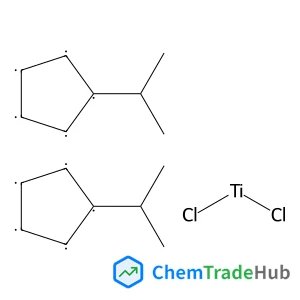
BIS(I-PROPYLCYCLOPENTADIENYL)TITANIUM DICHLORIDE
CAS Number:
12130-65-3
Molecular Formula:
C16H22Cl2Ti

Recommended Suppliers





Disclaimer
This page provides academic journal information for reference and research purposes only. We are not affiliated with any journal publishers and do not handle publication submissions. For publication-related inquiries, please contact the respective journal publishers directly.
If you notice any inaccuracies in the information displayed, please contact us at support@chemtradehub.com. We will promptly review and address your concerns.