












![3-[(4-Nitrobenzyl)oxy]-3-oxopropanoic Acid structure](https://static.chemtradehub.com/structs/773/77359-11-6-0d04.webp "3-[(4-Nitrobenzyl)oxy]-3-oxopropanoic Acid structure")
Development and test of highly accurate endpoint free energy methods. 3: partition coefficient prediction using a Poisson–Boltzmann method combined with a solvent accessible surface area model for SAMPL challenges
Literature Information
Publication Date
2023-11-21
DOI
10.1039/D3CP04174C
Impact Factor
3.676
Authors
Taoyu Niu, Xibing He, Fengyang Han, Luxuan Wang, Junmei Wang
View Original
Abstract
Accurately predicting solvation free energy is the key to predict protein–ligand binding free energy. In addition, the partition coefficient (log P), which is an important physicochemical property that determines the distribution of a drug in vivo, can be derived directly from transfer free energies, i.e., the difference between solvation free energies (SFEs) in different solvents. Within the Statistical Assessment of the Modeling of Proteins and Ligands (SAMPL) 9 challenge, we applied the Poisson–Boltzmann (PB) surface area (SA) approach to predict the toluene/water transfer free energy and partition coefficient (log Ptoluene/water) from SFEs. For each solute, only a single conformation automatically generated by the free software Open Babel was used. The PB calculation directly adopts our previously optimized boundary definition – a set of general AMBER force field 2 (GAFF2) atom-type based sphere radii for solute atoms. For the non-polar SA model, we newly developed the solvent-related molecular surface tension parameters γ and offset b for toluene and cyclohexane targeting experimental SFEs. This approach yielded the highest predictive accuracy in terms of root mean square error (RMSE) of 1.52 kcal mol−1 in transfer free energy for 16 small drug molecules among all 18 submissions in the SAMPL9 blind prediction challenge. The re-evaluation of the challenge set using multi-conformation strategies based on molecular dynamics (MD) simulations further reduces the prediction RMSE to 1.33 kcal mol−1. At the same time, an additional evaluation of our PBSA method on the SAMPL5 cyclohexane/water distribution coefficient (log Dcyclohexane/water) prediction revealed that our model outperformed COSMO-RS, the best submission model with RMSEPBSA = 1.88 versus RMSECOSMO-RS = 2.11 log units. Two external log Ptoluene/water and log Pcyclohexane/water datasets that contain 110 and 87 data points, respectively, are collected for extra validation and provide an in-depth insight into the error source of the PBSA method.
Related Literature
Novel magnetic hollow zein nanoparticles for preconcentration of chlorpyrifos from water and soil samples prior to analysis via high-performance liquid chromatography (HPLC)
Mojtaba Rahimi Moghadam, Behrooz Zargar, Saadat Rastegarzadeh
2018-04-03
Paper
DOI: 10.1039/C7AN01526G
Electroanalytical identification of 25I-NBOH and 2C-I via differential pulse voltammetry: a rapid and sensitive screening method to avoid misidentification
Ana Flávia Belchior de Andrade, Jose Gonzalez-Rodriguez
2019-02-20
Paper
DOI: 10.1039/C9AN00062C
An automatic integrated microfluidic system for allergy microarray chips‡
Wen-Yen Huang, Shang-Ta Chou, Chia-Hui Chen, Shan-Ying Chou, Jia-Han Wu, Yu-Chen Chen
2018-03-27
Paper
DOI: 10.1039/C8AN00247A
Metal–organic frameworks as affinity agents to enhance the microdialysis sampling efficiency of fatty acids
Yangyang Zhang, Zhenpeng Wang
2018-03-26
Paper
DOI: 10.1039/C8AN00238J
A homogeneous electrochemical sensor for Hg2+ determination in environmental water based on the T–Hg2+–T structure and exonuclease III-assisted recycling amplification
Hao Yu, Lingshan Su, Chang Liu, Yanling Song, Shaoyun Wang, Zhenyu Lin, Fang Chen
2018-03-29
Paper
DOI: 10.1039/C8AN00462E
Frequency division multiplex HPLC-MS for simultaneous analyses
Hiroka Kishi, Takashi Kumazaki, Shinya Kitagawa, Hajime Ohtani
2019-03-11
Paper
DOI: 10.1039/C8AN02352B
An implanted pH sensor read using radiography
Md. Arifuzzaman, Paul W. Millhouse, Yash Raval, Thomas B. Pace, Shayesteh Beladi Behbahani, John D. DesJardins, Tzuen-Rong J. Tzeng
2019-03-19
Paper
DOI: 10.1039/C8AN02337A
A new functional membrane protein microarray based on tethered phospholipid bilayers
Ofelia Maniti, Christophe Marquette, Bruno Tillier, Sandra Cortès, Agnès Girard-Egrot
2018-03-28
Paper
DOI: 10.1039/C8AN00260F
Label-free density-based detection of adipocytes of bone marrow origin using magnetic levitation
Oyku Sarigil, Muge Anil-Inevi, Esra Yilmaz, Gulistan Mese, H. Cumhur Tekin, Engin Ozcivici
2019-03-11
Paper
DOI: 10.1039/C8AN02503G
Multiplex detection of quality indicator molecule targets in urine using programmable hairpin probes based on a simple double-T type microchip electrophoresis platform and isothermal polymerase-catalyzed target recycling
Lingying Zhou, Ning Gan, Yongxiang Wu, Futao Hu, Jianyuan Lin, Yuting Cao, Dazhen Wu
2018-05-04
Paper
DOI: 10.1039/C8AN00141C
You might also like
Compound Q&A
What precautions should be taken when handling lithium chloride hydrate (1:1:1) (CAS: 16712-20-2)?
When handling lithium chloride hydrate (1:1:1) (CAS: 16712-20-2), it is importan...
16712-20-2Lithium chloride hyd...
Compound Q&A
Is 4-(4H-1,2,4-Triazol-4-yl)piperidine (CAS: 690261-92-8) safe?
4-(4H-1,2,4-Triazol-4-yl)piperidine is generally considered safe for use in phar...
690261-92-84-(4H-1,2,4-Triazol-...
Compound Q&A
How should waste containing 1,3-Thiazole-2-carboxamide (CAS: 16733-85-0) be handled?
Waste containing 1,3-Thiazole-2-carboxamide (CAS: 16733-85-0) should be collecte...
16733-85-01,3-Thiazole-2-carbo...
Compound Q&A
What regulatory guidelines apply to 5-(Difluoromethyl)-2-fluorobenzonitrile (CAS: 934175-58-3)?
5-(Difluoromethyl)-2-fluorobenzonitrile (CAS: 934175-58-3) is subject to regulat...
934175-58-35-(Difluoromethyl)-2...
Compound Q&A
How is Methyl 3-acetamido-2-thiophenecarboxylate (CAS: 22288-79-5) typically synthesized?
Methyl 3-acetamido-2-thiophenecarboxylate can be synthesized by the reaction of ...
22288-79-5Methyl 3-acetamido-2...
Compound Q&A
What is 4-Isoquinolinecarbonitrile (CAS: 34846-65-6)?
4-Isoquinolinecarbonitrile is a chemical compound with the CAS number 34846-65-6...
34846-65-64-Isoquinolinecarbon...
Compound Q&A
How should Methyl 1H-1,2,3-triazole-4-carboxylate (CAS: 877309-59-6) be stored?
Store Methyl 1H-1,2,3-triazole-4-carboxylate (CAS: 877309-59-6) in a cool, dry p...
877309-59-6Methyl 1H-1,2,3-tria...
Compound Q&A
What regulatory guidelines apply to 6-Bromo[1,3]thiazolo[5,4-b]pyridin-2-amine (CAS: 1160791-13-8)?
6-Bromo[1,3]thiazolo[5,4-b]pyridin-2-amine (CAS: 1160791-13-8) is subject to the...
1160791-13-86-Bromo[1,3]thiazolo...
Compound Q&A
Is (2S,3S)-2-Ammonio-3-(3,4-dihydroxyphenyl)-3-hydroxypropanoate (CAS: 23651-95-8) safe?
(2S,3S)-2-Ammonio-3-(3,4-dihydroxyphenyl)-3-hydroxypropanoate (CAS: 23651-95-8) ...
23651-95-8(2S,3S)-2-Ammonio-3-...
Compound Q&A
What are the physical and chemical properties of 7-bromo-3-methyl-3,4-dihydroquinazolin-4-one (CAS: 1293987-84-4)?
7-Bromo-3-methyl-3,4-dihydroquinazolin-4-one is a solid with a crystalline form....
1293987-84-47-bromo-3-methyl-3,4...
Source Journal
Physical Chemistry Chemical Physics

CiteScore:
5.5
Self-citation Rate:
10.3%
Articles per Year:
3036
Physical Chemistry Chemical Physics (PCCP) is an international journal co-owned by 19 physical chemistry and physics societies from around the world. This journal publishes original, cutting-edge research in physical chemistry, chemical physics and biophysical chemistry. To be suitable for publication in PCCP, articles must include significant innovation and/or insight into physical chemistry; this is the most important criterion that reviewers and Editors will judge against when evaluating submissions. The journal has a broad scope and welcomes contributions spanning experiment, theory, computation and data science. Topical coverage includes spectroscopy, dynamics, kinetics, statistical mechanics, thermodynamics, electrochemistry, catalysis, surface science, quantum mechanics, quantum computing and machine learning. Interdisciplinary research areas such as polymers and soft matter, materials, nanoscience, energy, surfaces/interfaces, and biophysical chemistry are welcomed if they demonstrate significant innovation and/or insight into physical chemistry. Joined experimental/theoretical studies are particularly appreciated when complementary and based on up-to-date approaches.
Recommended Compounds

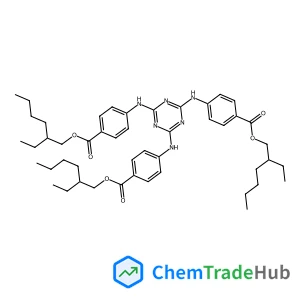
Tris(2-ethylhexyl) 4,4',4''-(1,3,5-triazine-2,4,6-triyltriimino)tribenzoate
CAS Number:
88122-99-0
Molecular Formula:
C48H66N6O6


Recommended Suppliers





Disclaimer
This page provides academic journal information for reference and research purposes only. We are not affiliated with any journal publishers and do not handle publication submissions. For publication-related inquiries, please contact the respective journal publishers directly.
If you notice any inaccuracies in the information displayed, please contact us at support@chemtradehub.com. We will promptly review and address your concerns.