












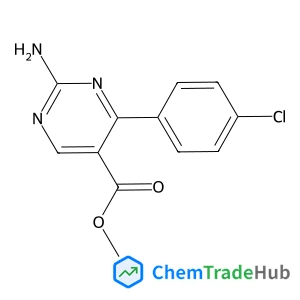
Methyl 2-amino-4-(4-chlorophenyl)-5-pyrimidinecarboxylate
CAS Number:
1133115-56-6
Molecular Formula:
C12H10ClN3O2
Li Zhao, Xuehui Geng, Guoxia Han, Yahui Guo, Runze Liu, Junsheng Chen
The high photostability of DNAs and RNAs is inextricably related to the photochemical and photophysical properties of their building blocks, nucleobases and nucleosides, which can dissipate the absorbed UV light energy in a harmless manner. The deactivation mechanism of the nucleosides, especially the decay pathways of cytidine (Cyd), has been a matter of intense debate. In the current study, we employ high-level electronic structure calculations combined with excited state non-adiabatic dynamic simulations to provide a clear picture of the excited state deactivation of Cyd in both gas phase and aqueous solution. In both environments, a barrierless decay path driven by the ring-puckering motion and a relaxation channel with a small energy barrier driven by the elongation motion of CO bond are assigned to <200 fs and sub-picosecond decay time component, respectively. The presence of ribose group has a subtle effect on the dynamic behavior of Cyd in gas phase as the ribose-to-base hydrogen/proton transfer process is energetically inaccessible with a sizable energy barrier of about 1.4 eV. However, this energy barrier is significantly reduced in water, especially when an explicit water molecule is present. Therefore, we argue that the long-lived decay channel found in aqueous solution could be assigned to the Cyd–water intermolecular hydrogen/proton transfer process. The present study postulates a novel scenario toward deep understanding the intrinsic photostability of DNAs and RNAs and provides solid evidence to disclose the long history debate of cytidine excited-state decay mechanism, especially for the assignment of experimentally observed time components.
Yun-Guang Zhang, Hua Zhang, Hai-Yang Song, You Yu, Ming-Jie Wan
DOI: 10.1039/C7CP02295F
Xi Yuan, Xuemin Hou, Ji Li, Chaoqun Qu, Wenjin Zhang, Haibo Li
DOI: 10.1039/C6CP08824D
DOI: 10.1039/C7CP01594A
Cristina Africh, Jascha Repp
DOI: 10.1039/C7CP01341H
Luis A. Mancera, Albert K. Engstfeld, Andreas Bensch, R. Jürgen Behm, Axel Groß
DOI: 10.1039/C7CP03320F
José Pedro Cerón-Carrasco
DOI: 10.1039/C7CP01034F
M. Lozynski, J. Pernak, Z. Gdaniec, B. Gorska, F. Béguin
DOI: 10.1039/C7CP04481J
Zhanning Liu, Chenxi Liu, Qiang Li, Jun Chen, Xianran Xing
DOI: 10.1039/C7CP03937A
Liang Xu, Haitao Lei, Zongyao Zhang, Zhen Yao, Jianfeng Li, Zhiyong Yu
DOI: 10.1039/C6CP08495H
2-Methylbenzene-1,4-diamine dihydrochloride (CAS: 615-45-2) should be stored in ...
(1S,4S)-2,5-Diazabicyclo[2.2.1]heptane dihydrobromide is generally considered sa...
(6-Chloropyridazin-3-YL)methanamine finds applications in the pharmaceutical ind...
2-Fluoro-3-methylphenol is primarily used in the synthesis of pharmaceuticals, p...
When handling 3-Methoxy-4-nitrobenzonitrile, it is important to wear appropriate...
When handling 1,3-Oxazolo[4,5-b]pyridine-2(3H)-thione (CAS: 211949-57-4), it is ...
4-Ethynylbenzamide (CAS: 90347-86-7) falls under various regulatory guidelines i...
3-(2-Ethylphenyl)-2-thioxo-4-imidazolidinone is primarily used as an intermediat...
(2-Fluoro-6-methoxyphenyl)acetic acid, also known as 4-fluoro-3-methoxybenzoic a...
Market trends for 2-[4-(Hydroxymethyl)phenoxy]ethanol (CAS: 102196-18-9) indicat...

Physical Chemistry Chemical Physics (PCCP) is an international journal co-owned by 19 physical chemistry and physics societies from around the world. This journal publishes original, cutting-edge research in physical chemistry, chemical physics and biophysical chemistry. To be suitable for publication in PCCP, articles must include significant innovation and/or insight into physical chemistry; this is the most important criterion that reviewers and Editors will judge against when evaluating submissions. The journal has a broad scope and welcomes contributions spanning experiment, theory, computation and data science. Topical coverage includes spectroscopy, dynamics, kinetics, statistical mechanics, thermodynamics, electrochemistry, catalysis, surface science, quantum mechanics, quantum computing and machine learning. Interdisciplinary research areas such as polymers and soft matter, materials, nanoscience, energy, surfaces/interfaces, and biophysical chemistry are welcomed if they demonstrate significant innovation and/or insight into physical chemistry. Joined experimental/theoretical studies are particularly appreciated when complementary and based on up-to-date approaches.
![(1R,6R)-6-({[(2-Methyl-2-propanyl)oxy]carbonyl}amino)-3-cyclohexene-1-carboxylic acid structure](https://static.chemtradehub.com/structs/865/865689-24-3-5fef.webp "(1R,6R)-6-({[(2-Methyl-2-propanyl)oxy]carbonyl}amino)-3-cyclohexene-1-carboxylic acid structure")
![5-Bromo-3-isopropyl-1H-pyrrolo[2,3-b]pyridine structure](https://static.chemtradehub.com/structs/125/1256819-54-1-8620.webp "5-Bromo-3-isopropyl-1H-pyrrolo[2,3-b]pyridine structure")



