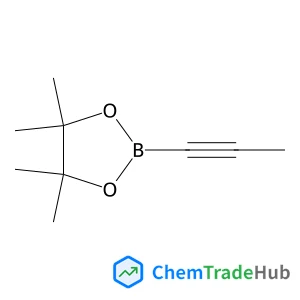
4,4,5,5-Tetramethyl-2-(1-propyn-1-YL)-1,3,2-dioxaborolane
CAS Number:
347389-75-7
Molecular Formula:
C9H15BO2
Liang Xu, Haitao Lei, Zongyao Zhang, Zhen Yao, Jianfeng Li, Zhiyong Yu
A series of cobalt complexes of 5,10,15-tris(pentafluorophenyl)-corrole [Co(tpfc)] (1) with various axial ligands were synthesized and examined as single-site catalysts for water oxidation. The used axial ligands include 4-cyanopyridine (py-CN), pyridine (py), 4-(dimethylamino)pyridine (py-NMe2), 4-methoxypyridine (py-OMe), 1-methylimidazole (im-Me), and thiophenolate (thi). Complexes 1–py and 1–py-OMe were structurally characterized. The Co ion in both structures has an almost identical distorted octahedral coordination environment with the four N atoms of tpfc defining the equatorial plane and the two molecules of pyridine (for 1–py) or 4-methoxypyridine (for 1–py-OMe) occupying the axial positions. Electrochemical studies of these Co corroles in acetonitrile showed that they all display two oxidation events and the oxidation waves shift to the cathodic direction with electron-donating axial ligands, a trend that is consistent with increased electron densities on Co ions. All these Co corroles were found to be active for electrocatalytic water oxidation: by using catalyst-coated fluorine-doped tin oxide (FTO) working electrodes, cyclic voltammograms displayed pronounced catalytic waves for water oxidation in 0.1 M pH 7.0 phosphate buffer solutions. The onset overpotentials are in the range of 510 to 580 mV, depending on the electron-donating ability of the trans axial ligands. These results demonstrate that the catalytic activities of Co corroles for water oxidation are considerably affected by the trans axial ligands on Co centers and provide valuable insights into the design of new catalysts for water oxidation.
Liyun Deng, Xiangyi Huang, Chaoqing Dong, Jicun Ren
DOI: 10.1039/D1AN00090J
Fei Cheng, Longfang Ren, Tianyu Liang, Xiaoyang Gao, Baoshuai Wang
DOI: 10.1039/D1AN00208B
Michihiko Nakano, Masafumi Inaba, Junya Suehiro
DOI: 10.1039/D0AN02349C
Shanmin Gao, Jun Lu, Yan Zhao, Nan Chen, Yi Xie
DOI: 10.1039/B208076A
Muhammad A. Sami, Muhammad Tayyab, Priya Parikh, Harshitha Govindaraju
DOI: 10.1039/D0AN02451A
Kelsey A. Morrison, Brian H. Clowers
DOI: 10.1039/D0AN01793K
Mengjia Xu, Shu Xing, Yang Zhao, Chao Zhao
DOI: 10.1039/D1AN00037C
Tribidasari A. Ivandini, Muhammad S. P. Luhur, Munawar Khalil, Yasuaki Einaga
DOI: 10.1039/D0AN02414G
Jane Y. Zhang, Andrew T. Bender, David S. Boyle
DOI: 10.1039/D0AN01988G
2-Methylbenzene-1,4-diamine dihydrochloride (CAS: 615-45-2) should be stored in ...
(1S,4S)-2,5-Diazabicyclo[2.2.1]heptane dihydrobromide is generally considered sa...
(6-Chloropyridazin-3-YL)methanamine finds applications in the pharmaceutical ind...
2-Fluoro-3-methylphenol is primarily used in the synthesis of pharmaceuticals, p...
When handling 3-Methoxy-4-nitrobenzonitrile, it is important to wear appropriate...
When handling 1,3-Oxazolo[4,5-b]pyridine-2(3H)-thione (CAS: 211949-57-4), it is ...
4-Ethynylbenzamide (CAS: 90347-86-7) falls under various regulatory guidelines i...
3-(2-Ethylphenyl)-2-thioxo-4-imidazolidinone is primarily used as an intermediat...
(2-Fluoro-6-methoxyphenyl)acetic acid, also known as 4-fluoro-3-methoxybenzoic a...
Market trends for 2-[4-(Hydroxymethyl)phenoxy]ethanol (CAS: 102196-18-9) indicat...

Physical Chemistry Chemical Physics (PCCP) is an international journal co-owned by 19 physical chemistry and physics societies from around the world. This journal publishes original, cutting-edge research in physical chemistry, chemical physics and biophysical chemistry. To be suitable for publication in PCCP, articles must include significant innovation and/or insight into physical chemistry; this is the most important criterion that reviewers and Editors will judge against when evaluating submissions. The journal has a broad scope and welcomes contributions spanning experiment, theory, computation and data science. Topical coverage includes spectroscopy, dynamics, kinetics, statistical mechanics, thermodynamics, electrochemistry, catalysis, surface science, quantum mechanics, quantum computing and machine learning. Interdisciplinary research areas such as polymers and soft matter, materials, nanoscience, energy, surfaces/interfaces, and biophysical chemistry are welcomed if they demonstrate significant innovation and/or insight into physical chemistry. Joined experimental/theoretical studies are particularly appreciated when complementary and based on up-to-date approaches.
![[1-(5-Methyl-2-pyridinyl)-1H-pyrazol-4-yl]methanol structure](https://static.chemtradehub.com/structs/143/1439822-99-7-6cc9.webp "[1-(5-Methyl-2-pyridinyl)-1H-pyrazol-4-yl]methanol structure")
![3-[(3R,4R)-3-[(6-aminopyrimidin-4-yl)-methyl-amino]-4-methyl-1-piperidyl]-3-oxo-propanenitrile structure](https://static.chemtradehub.com/structs/164/1640971-60-3-83a4.webp "3-[(3R,4R)-3-[(6-aminopyrimidin-4-yl)-methyl-amino]-4-methyl-1-piperidyl]-3-oxo-propanenitrile structure")