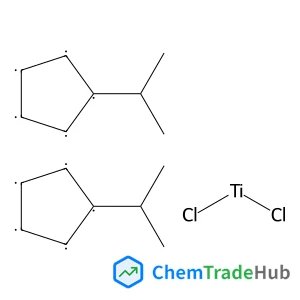
BIS(I-PROPYLCYCLOPENTADIENYL)TITANIUM DICHLORIDE
CAS Number:
12130-65-3
Molecular Formula:
C16H22Cl2Ti
Lucas N. Wong, Silvia. Imberti, Gregory G. Warr, Rob. Atkin
Neutron diffraction with empirical potential structure refinement (EPSR) show the deep eutectic solvent (DES) 1 : 4 choline chloride : butyric acid is amphiphilically nanostructured. Nanostructure results from solvophobic interactions between the alkyl chains of the butyric acid hydrogen bond donor (HBD) and is retained with addition of 10 wt% water. EPSR fits to the diffraction data is used to produce a three-dimensional model of the liquid which is interrogated to reveal the interactions leading to the solvophobic effect, and therefore nanostructure, in this DES at atomic resolution. The model shows electrostatic and hydrogen bond interactions cause the cation, anion and HBD acid group to cluster into a polar domain, from which the acid alkyl chains are solvophobically excluded into theapolar domain. The polar and apolar domains percolate through the liquid in a bicontinuous sponge-like structure. The effect of adding 10 wt% water is probed, revealing that water molecules are sequestered around the cation and anion within the polar domain, while the neat bulk structure is retained. Alkyl chain packing in the apolar domain becomes slightly better-defined indicating water marginally strengthens solvophobic segregation. These findings reveal bulk self-assembled nanostructure can be produced in DESs via an amphiphilic HBD.
José Pedro Cerón-Carrasco
DOI: 10.1039/C7CP01034F
Pingyun Li, Qingqing Wang, Guodong Deng, Xiaode Guo, Wei Jiang, Hongying Liu, Fengsheng Li
DOI: 10.1039/C7CP04097K
Afik Shachar, Nitzan Mayorkas, Ilana Bar
DOI: 10.1039/C7CP04195K
A. Mariani, L. Gontrani
DOI: 10.1039/C6CP08450H
Guiyang Yu, Wenxiang Zhang, Jungang Cao, Wenfu Yan, Gang Liu
DOI: 10.1039/C7CP04463A
J. A. Puszkiel, M. V. Castro Riglos, F. Karimi, A. Santoru, C. Pistidda, T. Klassen, J. M. Bellosta von Colbe, M. Dornheim
DOI: 10.1039/C6CP08278E
Jing Pan, Rui Wang, Xiaoyu Zhou, Jiansheng Zhong, Xiaoyong Xu, Jingguo Hu
DOI: 10.1039/C7CP03151C
Luis A. Mancera, Albert K. Engstfeld, Andreas Bensch, R. Jürgen Behm, Axel Groß
DOI: 10.1039/C7CP03320F
Sandeep K. Jain, Vladimir Juričić, Gerard T. Barkema
DOI: 10.1039/C6CP08535K
Wenqi Huang, Hong Yang, Buwen Cheng, Chunlai Xue
DOI: 10.1039/C7CP05840C
2-Methylbenzene-1,4-diamine dihydrochloride (CAS: 615-45-2) should be stored in ...
(1S,4S)-2,5-Diazabicyclo[2.2.1]heptane dihydrobromide is generally considered sa...
(6-Chloropyridazin-3-YL)methanamine finds applications in the pharmaceutical ind...
2-Fluoro-3-methylphenol is primarily used in the synthesis of pharmaceuticals, p...
When handling 3-Methoxy-4-nitrobenzonitrile, it is important to wear appropriate...
When handling 1,3-Oxazolo[4,5-b]pyridine-2(3H)-thione (CAS: 211949-57-4), it is ...
4-Ethynylbenzamide (CAS: 90347-86-7) falls under various regulatory guidelines i...
3-(2-Ethylphenyl)-2-thioxo-4-imidazolidinone is primarily used as an intermediat...
(2-Fluoro-6-methoxyphenyl)acetic acid, also known as 4-fluoro-3-methoxybenzoic a...
Market trends for 2-[4-(Hydroxymethyl)phenoxy]ethanol (CAS: 102196-18-9) indicat...

Physical Chemistry Chemical Physics (PCCP) is an international journal co-owned by 19 physical chemistry and physics societies from around the world. This journal publishes original, cutting-edge research in physical chemistry, chemical physics and biophysical chemistry. To be suitable for publication in PCCP, articles must include significant innovation and/or insight into physical chemistry; this is the most important criterion that reviewers and Editors will judge against when evaluating submissions. The journal has a broad scope and welcomes contributions spanning experiment, theory, computation and data science. Topical coverage includes spectroscopy, dynamics, kinetics, statistical mechanics, thermodynamics, electrochemistry, catalysis, surface science, quantum mechanics, quantum computing and machine learning. Interdisciplinary research areas such as polymers and soft matter, materials, nanoscience, energy, surfaces/interfaces, and biophysical chemistry are welcomed if they demonstrate significant innovation and/or insight into physical chemistry. Joined experimental/theoretical studies are particularly appreciated when complementary and based on up-to-date approaches.
![3-[(3R,4R)-3-[(6-aminopyrimidin-4-yl)-methyl-amino]-4-methyl-1-piperidyl]-3-oxo-propanenitrile structure](https://static.chemtradehub.com/structs/164/1640971-60-3-83a4.webp "3-[(3R,4R)-3-[(6-aminopyrimidin-4-yl)-methyl-amino]-4-methyl-1-piperidyl]-3-oxo-propanenitrile structure")