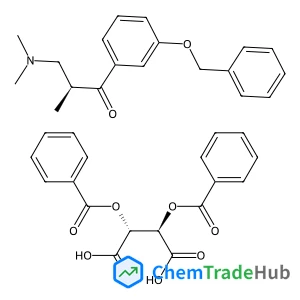
(S)-1-(3-(Benzyloxy)phenyl)-3-(dimethylamino)-2-methylpropan-1-one (2r,3r)-2,3-bis(benzoyloxy)succinate
CAS Number:
1004315-81-4
Molecular Formula:
C37H37NO10
Guiyang Yu, Wenxiang Zhang, Jungang Cao, Wenfu Yan, Gang Liu
Spatial separation of the reduction center (photosystem I) and oxidation center (photosystem II) is an obvious characteristic of natural photosynthesis. Enlightened by this natural process, a simple material based on silica-sphere-supported Pt nanoparticles (SSP) was designed as a freestanding hydrogen evolution center for semiconductor photocatalysts. In situ photoluminescence characterization showed that the radiation recombination of electron–hole pairs in semiconductors (i.e. TiO2 and CdS) was well suppressed due to the presence of SSP. And the quenching efficiency increases with the hydrogen evolution rate of photocatalysts. These results indicated that SSP could effectively trap electrons from the photoexcited semiconductors during collision between SSP and semiconductor, and then complete the hydrogen evolution reaction over the Pt nanoparticles. Detailed investigation also showed that the performance of SSP was influenced by several factors, including the particle size of the silica sphere and the physical and chemical states of Pt nanoparticles. Besides, it was demonstrated that the loaded metal was not limited to Pt. Pd, Ni and Au can also be used as active sites in this freestanding cocatalyst strategy.
Robin N. Perutz
DOI: 10.1039/B206154F
Oliver Deeg, Peer Kirsch, Detlef Pauluth, Peter Bäuerle
DOI: 10.1039/B207630F
Xin Xing Zhang, Qiu Yan Zhu, Jiao Yang Lu, Fu Rui Zhang, Wei Tao Huang, Xue Zhi Ding, Li Qiu Xia
DOI: 10.1039/C8AN01565A
Yingjiu Zhang, Hiroki Ago, Motoo Yumura, Toshiki Komatsu, Satoshi Ohshima, Kunio Uchida
DOI: 10.1039/B207449D
Yuh-Yih Chien, Ken-Tsung Wong, Pi-Tai Chou, Yi-Ming Cheng
DOI: 10.1039/B208269A
Jennifer E. Readman, Namjun Kim, Martine Ziliox, Clare P. Grey
DOI: 10.1039/B208356F
Xiaoying Wang, Qinghua Liu, Xiaofeng Tan, Luyao Liu, Feimeng Zhou
DOI: 10.1039/C8AN01794H
Ming Chen, Xinling Lu, Xiaofei Ma, Yin Xiao, Yong Wang
DOI: 10.1039/D1AN00145K
Priyanka Bansal, Ahmed Ben Faleh, Stephan Warnke, Thomas R. Rizzo
DOI: 10.1039/D1AN01861B
2-Methylbenzene-1,4-diamine dihydrochloride (CAS: 615-45-2) should be stored in ...
(1S,4S)-2,5-Diazabicyclo[2.2.1]heptane dihydrobromide is generally considered sa...
(6-Chloropyridazin-3-YL)methanamine finds applications in the pharmaceutical ind...
2-Fluoro-3-methylphenol is primarily used in the synthesis of pharmaceuticals, p...
When handling 3-Methoxy-4-nitrobenzonitrile, it is important to wear appropriate...
When handling 1,3-Oxazolo[4,5-b]pyridine-2(3H)-thione (CAS: 211949-57-4), it is ...
4-Ethynylbenzamide (CAS: 90347-86-7) falls under various regulatory guidelines i...
3-(2-Ethylphenyl)-2-thioxo-4-imidazolidinone is primarily used as an intermediat...
(2-Fluoro-6-methoxyphenyl)acetic acid, also known as 4-fluoro-3-methoxybenzoic a...
Market trends for 2-[4-(Hydroxymethyl)phenoxy]ethanol (CAS: 102196-18-9) indicat...

Physical Chemistry Chemical Physics (PCCP) is an international journal co-owned by 19 physical chemistry and physics societies from around the world. This journal publishes original, cutting-edge research in physical chemistry, chemical physics and biophysical chemistry. To be suitable for publication in PCCP, articles must include significant innovation and/or insight into physical chemistry; this is the most important criterion that reviewers and Editors will judge against when evaluating submissions. The journal has a broad scope and welcomes contributions spanning experiment, theory, computation and data science. Topical coverage includes spectroscopy, dynamics, kinetics, statistical mechanics, thermodynamics, electrochemistry, catalysis, surface science, quantum mechanics, quantum computing and machine learning. Interdisciplinary research areas such as polymers and soft matter, materials, nanoscience, energy, surfaces/interfaces, and biophysical chemistry are welcomed if they demonstrate significant innovation and/or insight into physical chemistry. Joined experimental/theoretical studies are particularly appreciated when complementary and based on up-to-date approaches.
![[1-(5-Methyl-2-pyridinyl)-1H-pyrazol-4-yl]methanol structure](https://static.chemtradehub.com/structs/143/1439822-99-7-6cc9.webp "[1-(5-Methyl-2-pyridinyl)-1H-pyrazol-4-yl]methanol structure")
![Methyl 2-[5-(3-Phenoxyphenyl)-2H-tetrazol-2-yl]acetate structure](https://static.chemtradehub.com/structs/130/1305320-60-8-84b4.webp "Methyl 2-[5-(3-Phenoxyphenyl)-2H-tetrazol-2-yl]acetate structure")