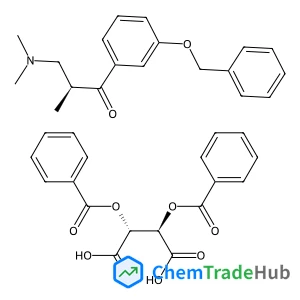
(S)-1-(3-(Benzyloxy)phenyl)-3-(dimethylamino)-2-methylpropan-1-one (2r,3r)-2,3-bis(benzoyloxy)succinate
CAS Number:
1004315-81-4
Molecular Formula:
C37H37NO10
Shreerang D. Datar, Nitish Kumar, Vrushali Sawant, Noora Shaikh, Neetu Jha
Capacitive deionization (CDI) has emerged as a low-cost, reagent-free technique for the desalination of water. This technique is based on the immobilization of dissolved ions on the electrically charged electrodes, by the electrosorption phenomenon. The electrosorption of dissolved ions by using CDI is limited for feed water having a low concentration of salts. To address this problem, we employ an asymmetric capacitive deionization (Asy-CDI) architecture having solar reduced graphene oxide decorated with manganese dioxide nanostructures (SRGO–MnO2 composite). The Asy-CDI possesses an SRGO–MnO2 composite as the cathode and SRGO as the anode with an anion exchange membrane. The cathode formed from the SRGO–MnO2 composite serves the purpose of immobilization of cations, whereas the anode formed from SRGO is responsible for anion removal. The crystal structure, chemical composition and morphology of the as-synthesized SRGO–MnO2 composite electrode materials are characterized by several techniques, confirming that the surface of SRGO is successfully loaded with α-MnO2 nanostructures. The electrochemical characterization reveals a high specific capacitance of the as-synthesized SRGO–MnO2 composite (419.9 F g−1) at 100 mV s−1. The Asy-CDI provides a higher salt adsorption capacity (40.2 mg g−1) compared to Sy-CDI (28.3 mg g−1) with feed water containing a salt concentration of 2000 mg L−1. These results indicate that the Asy-CDI may be employed as an efficient technique for the desalination of high concentration salt water.
Zhanning Liu, Chenxi Liu, Qiang Li, Jun Chen, Xianran Xing
DOI: 10.1039/C7CP03937A
Luuk J. G. W. van Wilderen, Daniela Kern-Michler, Henrike M. Müller-Werkmeister, Jens Bredenbeck
DOI: 10.1039/C7CP90063E
Vyacheslav Kuzmin, Andrey Stanislavovas
DOI: 10.1039/C7CP03949B
Bo-wen Sun, Hong-yu Yu, Yong-jing Yang, Hui-jun Li, Cheng-yu Zhai, Dong-Jin Qian, Meng Chen
DOI: 10.1039/C7CP05242A
Rafael Grande-Aztatzi, Jose M. Mercero, Jesus M. Ugalde
DOI: 10.1039/C7CP00092H
Zhen Pu, Wenjie Yu, Soumendra K. Roy, Chaoyang Li, Bingyun Ao, Tianwei Liu, Maobing Shuai, Xuefeng Wang
DOI: 10.1039/C7CP00419B
Afik Shachar, Nitzan Mayorkas, Ilana Bar
DOI: 10.1039/C7CP04195K
Divya Puthusseri, Deepu J. Babu, Sherif Okeil, Jörg J. Schneider
DOI: 10.1039/C7CP05022D
Guiyang Yu, Wenxiang Zhang, Jungang Cao, Wenfu Yan, Gang Liu
DOI: 10.1039/C7CP04463A
2-Methylbenzene-1,4-diamine dihydrochloride (CAS: 615-45-2) should be stored in ...
(1S,4S)-2,5-Diazabicyclo[2.2.1]heptane dihydrobromide is generally considered sa...
(6-Chloropyridazin-3-YL)methanamine finds applications in the pharmaceutical ind...
2-Fluoro-3-methylphenol is primarily used in the synthesis of pharmaceuticals, p...
When handling 3-Methoxy-4-nitrobenzonitrile, it is important to wear appropriate...
When handling 1,3-Oxazolo[4,5-b]pyridine-2(3H)-thione (CAS: 211949-57-4), it is ...
4-Ethynylbenzamide (CAS: 90347-86-7) falls under various regulatory guidelines i...
3-(2-Ethylphenyl)-2-thioxo-4-imidazolidinone is primarily used as an intermediat...
(2-Fluoro-6-methoxyphenyl)acetic acid, also known as 4-fluoro-3-methoxybenzoic a...
Market trends for 2-[4-(Hydroxymethyl)phenoxy]ethanol (CAS: 102196-18-9) indicat...

Physical Chemistry Chemical Physics (PCCP) is an international journal co-owned by 19 physical chemistry and physics societies from around the world. This journal publishes original, cutting-edge research in physical chemistry, chemical physics and biophysical chemistry. To be suitable for publication in PCCP, articles must include significant innovation and/or insight into physical chemistry; this is the most important criterion that reviewers and Editors will judge against when evaluating submissions. The journal has a broad scope and welcomes contributions spanning experiment, theory, computation and data science. Topical coverage includes spectroscopy, dynamics, kinetics, statistical mechanics, thermodynamics, electrochemistry, catalysis, surface science, quantum mechanics, quantum computing and machine learning. Interdisciplinary research areas such as polymers and soft matter, materials, nanoscience, energy, surfaces/interfaces, and biophysical chemistry are welcomed if they demonstrate significant innovation and/or insight into physical chemistry. Joined experimental/theoretical studies are particularly appreciated when complementary and based on up-to-date approaches.