












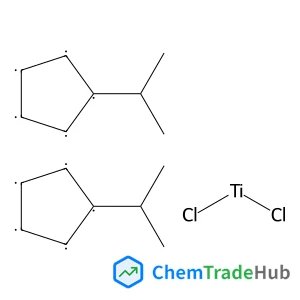
BIS(I-PROPYLCYCLOPENTADIENYL)TITANIUM DICHLORIDE
CAS Number:
12130-65-3
Molecular Formula:
C16H22Cl2Ti
Xia Mu, Dinglin Zhang, Rui Lai, Chenyi Liao, Guohui Li
Acetylcholinesterase (AChE) is an important hydrolase in cholinergic synapses and a candidate target in the treatment of Alzheimer's disease. The lithium treatment widely used in neurological disorders can alter the AChE activity, yet the underlying mechanism of how the ion species regulate the enzymatic activity remains unclear. In this work, we performed combined quantum mechanics/molecular mechanics (QM/MM) and molecular dynamics (MD) simulations and well-tempered metadynamics to understand the modulation of human AChE (hAChE) activity using three alkali metal ions (Li+, Na+, and K+) in different concentrations. Our simulations show that the binding affinity and catalytic activity are affected by different ion species through allosteric ion coordination geometries on the hAChE complex and distant electrostatic screening effect. A Li+ cluster involving D330, E393, and D397 residues and three Li+ ions was found to be highly conserved and can be critical to the enzyme activity. Binding energy calculations indicate that the electrostatic screening from allosterically bound cations can affect the key residues at the catalytic site and active-site gorge, including E199. Furthermore, an increase in ion concentration can lead to lower reactivity, especially for Li+ ions, which exhibit more cation-hAChE contacts than Na+ and K+. The selective ion binding and their preferred modulation on hAChE are highly related to ion species. This work provides a molecular perspective on selective modulation by different ion species of the enzyme catalytic processes.
Deping Qian, Ahmed Hesham Balawi, Yang Wu, Wei Ma, Frédéric Laquai, Zheng Tang, Fengling Zhang, Weiwei Li
DOI: 10.1039/C7CP04780K
Yun-Guang Zhang, Hua Zhang, Hai-Yang Song, You Yu, Ming-Jie Wan
DOI: 10.1039/C7CP02295F
Y. Unutulmazsoy, R. Merkle, D. Fischer, J. Mannhart, J. Maier
DOI: 10.1039/C7CP00476A
Elizabeth Kohr, Buddini I. Karawdeniya, Jason R. Dwyer, Anju Gupta, William B. Euler
DOI: 10.1039/C7CP05569B
Vyacheslav Kuzmin, Andrey Stanislavovas
DOI: 10.1039/C7CP03949B
José Pedro Cerón-Carrasco
DOI: 10.1039/C7CP01034F
G. V. Janjić, M. D. Milosavljević, D. Ž. Veljković
DOI: 10.1039/C6CP08796E
Aurimas Vyšniauskas, Ismael López-Duarte, Nicolas Duchemin, Thanh-Truc Vu, Yilei Wu, Ekaterina M. Budynina, Yulia A. Volkova, Eduardo Peña Cabrera, Diana E. Ramírez-Ornelas, Marina K. Kuimova
DOI: 10.1039/C7CP03571C
2-Methylbenzene-1,4-diamine dihydrochloride (CAS: 615-45-2) should be stored in ...
(1S,4S)-2,5-Diazabicyclo[2.2.1]heptane dihydrobromide is generally considered sa...
(6-Chloropyridazin-3-YL)methanamine finds applications in the pharmaceutical ind...
2-Fluoro-3-methylphenol is primarily used in the synthesis of pharmaceuticals, p...
When handling 3-Methoxy-4-nitrobenzonitrile, it is important to wear appropriate...
When handling 1,3-Oxazolo[4,5-b]pyridine-2(3H)-thione (CAS: 211949-57-4), it is ...
4-Ethynylbenzamide (CAS: 90347-86-7) falls under various regulatory guidelines i...
3-(2-Ethylphenyl)-2-thioxo-4-imidazolidinone is primarily used as an intermediat...
(2-Fluoro-6-methoxyphenyl)acetic acid, also known as 4-fluoro-3-methoxybenzoic a...
Market trends for 2-[4-(Hydroxymethyl)phenoxy]ethanol (CAS: 102196-18-9) indicat...

Physical Chemistry Chemical Physics (PCCP) is an international journal co-owned by 19 physical chemistry and physics societies from around the world. This journal publishes original, cutting-edge research in physical chemistry, chemical physics and biophysical chemistry. To be suitable for publication in PCCP, articles must include significant innovation and/or insight into physical chemistry; this is the most important criterion that reviewers and Editors will judge against when evaluating submissions. The journal has a broad scope and welcomes contributions spanning experiment, theory, computation and data science. Topical coverage includes spectroscopy, dynamics, kinetics, statistical mechanics, thermodynamics, electrochemistry, catalysis, surface science, quantum mechanics, quantum computing and machine learning. Interdisciplinary research areas such as polymers and soft matter, materials, nanoscience, energy, surfaces/interfaces, and biophysical chemistry are welcomed if they demonstrate significant innovation and/or insight into physical chemistry. Joined experimental/theoretical studies are particularly appreciated when complementary and based on up-to-date approaches.
![1H-Imidazo[4,5-c]pyridine-7-carboxylic acid structure](https://static.chemtradehub.com/structs/123/1234616-39-7-1344.webp "1H-Imidazo[4,5-c]pyridine-7-carboxylic acid structure")
![Methyl 2-[5-(3-Phenoxyphenyl)-2H-tetrazol-2-yl]acetate structure](https://static.chemtradehub.com/structs/130/1305320-60-8-84b4.webp "Methyl 2-[5-(3-Phenoxyphenyl)-2H-tetrazol-2-yl]acetate structure")
![(1R,6R)-6-({[(2-Methyl-2-propanyl)oxy]carbonyl}amino)-3-cyclohexene-1-carboxylic acid structure](https://static.chemtradehub.com/structs/865/865689-24-3-5fef.webp "(1R,6R)-6-({[(2-Methyl-2-propanyl)oxy]carbonyl}amino)-3-cyclohexene-1-carboxylic acid structure")




