












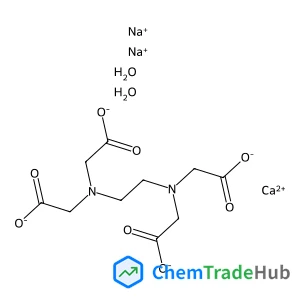
EthylenediaminetetraaceticacidcalciumDisodiumsalthydrate
CAS Number:
23411-34-9
Molecular Formula:
C10H16CaN2Na2O10
Ahmed M. Hegazy, Nesreen S. Haiba, Mohamed K. Awad, Fatma M. Mahgoub
A novel thiourea derivative has been successfully synthesized via green routes and fully characterized by FT-IR, 1H, 13C-NMR, and elemental analysis. The synthetic inhibitor 2-amino-N-(phenylcarbamothioyl) benzamide (APCB) was assessed as a corrosion inhibitor for mild steel (MS) in 0.5 M H2SO4. Various electrochemical techniques, such as electrochemical impedance spectroscopy (EIS) and potentiodynamic polarization (PDP), have been used to evaluate inhibition efficiency. As a result, EIS and PDP agreed with each other, indicating that APCB exhibits an inhibition performance that exceeds 96% at a concentration of 2 × 10⁻⁴ M and increases with an increase in temperature up to 98% at 333 K. However, PDP measurements showed that APCB is a mixed type of inhibitor. In addition, SEM, EDX, AFM, and contact angle measurements were used as a topological surface characterization technique that confirmed the formation of a protective layer over the MS surface. Additionally, the complex formation was thoroughly confirmed by UV-Vis measurements. The adsorption of APCB proved the highest compliance with the Langmuir adsorption isotherm. Furthermore, density functional theory (DFT) calculations were conducted to establish the correlation between the electronic structure and excellent inhibition efficiency. Moreover, molecular dynamics (MD) simulations were used to find interaction energy in different media. Finally, the adsorption affinity of the MS surface for different concentrations of APCB was verified via Monte Carlo (MC) simulations. Owing to the outcomes of this study, it is remarkable that APCB, with its low cost and simple synthesis, might be an exceptionally prominent option for mild steel protection.
Sebastian Jeremias, Franca Castiglione
DOI: 10.1039/C6CP02092E
DOI: 10.1039/C6CP03671F
Andhika Kiswandhi, Peter Niedbalski, Christopher Parish, Pavanjeet Kaur, André Martins, Leila Fidelino, Chalermchai Khemtong, Likai Song, Lloyd Lumata
DOI: 10.1039/C6CP03954E
Andrey Laktionov, Emilie Chemineau-Chalaye, Tomasz A. Wesolowski
DOI: 10.1039/C6CP00497K
Valeriu Mereacre, Christopher E. Anson
DOI: 10.1039/C6CP02942F
Vrushali R. Hande, Suman Chakrabarty
DOI: 10.1039/C6CP04378J
M. J. Winiarski, B. Wiendlocha, S. Gołąb, S. K. Kushwaha, P. Wiśniewski, D. Kaczorowski, J. D. Thompson, R. J. Cava, T. Klimczuk
DOI: 10.1039/C6CP02856J
Timothy C. Davenport, Chirranjeevi Balaji Gopal
DOI: 10.1039/C6CP01935H
Waste containing (6-Bromo-2-naphthyl)oxy](dimethyl)(2-methyl-2-propanyl)silane (...
7-Fluoro-4-isoquinolinecarboxylic acid can be synthesized via a multi-step proce...
2,3,5,6-Tetrabromothieno[3,2-b]thiophene is a crystalline compound with a high m...
1-[4-(Benzylamino)-7,8-dihydro-5H-pyrano[4,3-d]pyrimidin-2-yl]-2-methyl-1H-indol...
The market for imidazo[5,1-d]-1,2,3,5-tetrazine-8-carboxylic acid, 3,4-dihydro-3...
3-(Triisopropylsilyl)propiolaldehyde is a synthetic organic compound with the CA...
6-Nitro-2H-1,4-benzoxazin-3(4H)-one (CAS: 81721-87-1) is subject to various regu...
Waste containing (3-Fluorophenyl)(4-{[(2-methyl-2-propanyl)oxy]carbonyl}-1-piper...
N,N'-4,4'-Biphenyldiyldiisonicotinamide is a white crystalline solid with a mole...
6-Bromo-8-fluoro-2-quinazolinol is primarily used in the pharmaceutical industry...

Physical Chemistry Chemical Physics (PCCP) is an international journal co-owned by 19 physical chemistry and physics societies from around the world. This journal publishes original, cutting-edge research in physical chemistry, chemical physics and biophysical chemistry. To be suitable for publication in PCCP, articles must include significant innovation and/or insight into physical chemistry; this is the most important criterion that reviewers and Editors will judge against when evaluating submissions. The journal has a broad scope and welcomes contributions spanning experiment, theory, computation and data science. Topical coverage includes spectroscopy, dynamics, kinetics, statistical mechanics, thermodynamics, electrochemistry, catalysis, surface science, quantum mechanics, quantum computing and machine learning. Interdisciplinary research areas such as polymers and soft matter, materials, nanoscience, energy, surfaces/interfaces, and biophysical chemistry are welcomed if they demonstrate significant innovation and/or insight into physical chemistry. Joined experimental/theoretical studies are particularly appreciated when complementary and based on up-to-date approaches.

![(1S)-1,5-Anhydro-1-[3-(1-benzothiophen-2-ylmethyl)-4-fluorophenyl]-D-glucitol structure](https://static.chemtradehub.com/structs/761/761423-87-4-dbeb.webp "(1S)-1,5-Anhydro-1-[3-(1-benzothiophen-2-ylmethyl)-4-fluorophenyl]-D-glucitol structure")




