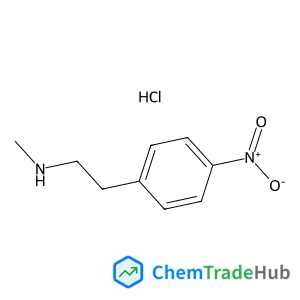
N-Methyl-2-(4-nitrophenyl)ethanamine hydrochloride (1:1)
CAS Number:
166943-39-1
Molecular Formula:
C9H13ClN2O2
Adél Szerlauth, Tamara Madácsy, Gergely Ferenc Samu, Péter Bíró, Miklós Erdélyi, Gábor Varga, Zhi Ping Xu, József Maléth, István Szilágyi
Biocompatible Cu(II)-doped layered double hydroxide (CMA) nanoparticles were developed to combat reactive oxygen species. The 2-dimensional nanozymes showed both superoxide dismutase- and catalase-like activities in chemical assays, while proving as efficient antioxidants in the reduction of intracellular oxidative stress. The results indicate the great promise of CMA in antioxidant therapies.

Heteroatom Chemistry

Bioorganic & Medicinal Chemistry

Chinese Journal of Chemistry

Electroanalysis

Bioorganic & Medicinal Chemistry Letters

Atomization and Sprays

NDT & E International

Medicinal Chemistry Research

Critical Reviews in Solid State and Materials Sciences

Journal of the Indian Institute of Science
Christopher T. Rodgers, C. J. Wedge, Stuart A. Norman, Philipp Kukura, Karen Nelson, Neville Baker, Kevin B. Henbest, P. J. Hore
DOI: 10.1039/B906102A
François-Xavier Coudert
DOI: 10.1039/C003434G
Liping Li, Guangshe Li, Jiaoxing Xu, Jing Zheng, Wenming Tong, Wanbiao Hu
DOI: 10.1039/C004282J
Toshimasa Ishida, Jun-ichi Aihara
DOI: 10.1039/B903815A
Ilia Kaminker, Alexey Potapov, Akiva Feintuch, Shimon Vega, Daniella Goldfarb
DOI: 10.1039/B906177K
Akira Miyoshi, Jun-ichi Yoshida, Naoya Shiki, Mitsuo Koshi
DOI: 10.1039/B905787K
Silvia Sottini, Guinevere Mathies, Peter Gast, Dimitrios Maganas, Panayotis Kyritsis, Edgar J.J. Groenen
DOI: 10.1039/B905726A
Esben Thormann, Per M. Claesson, Ole G. Mouritsen
DOI: 10.1039/C004413J
Ulrich Sternberg, Stephan L. Grage, Raiker Witter
DOI: 10.1039/B908236K
DOI: 10.1039/B821751C
When handling 2-Chloro-1,2-bis(4-methylphenyl)ethanone (CAS: 71193-32-3), it is ...
4-Ethoxy-3-(5-methyl-4-oxo-7-propyl-1,4-dihydroimidazo[5,1-f][1,2,4]triazin-2-yl...
Methyl 3-Oxo-4-Androsten-17-Carboxylate (CAS: 2681-55-2) should be stored in a c...
(R)-3-Amino-4-(3-hexylphenylamino)-4-oxobutylphosphonic acid is primarily used i...
2-Methyl-2-propanyl 3-amino-3-carbamoyl-1-azetidinecarboxylate (CAS: 1254120-14-...
There are alternative reagents that can be used in synthesis instead of (E)-4-(t...
[2-(3-Chlorophenyl)-1,3-thiazol-4-yl]methanol (CAS: 121202-20-8) is a crystallin...
The market and research trends for Methyl (2S)-[(4S)-2,2-dimethyl-1,3-dioxolan-4...
The market for 1-Bromo-2-isocyanatoethane (CAS: 42865-19-0) is driven by its use...
4-Nitro-D-phenylalanine hydrochloride (CAS: 147065-06-3) is primarily used in re...

ChemComm publishes urgent research which is of outstanding significance and interest to experts in the field, while also appealing to the journal’s broad chemistry readership. Our communication format is ideally suited to short, urgent studies that are of such importance that they require accelerated publication. Our scope covers all topics in chemistry, and research at the interface of chemistry and other disciplines (such as materials science, nanoscience, physics, engineering and biology) where there is a significant novelty in the chemistry aspects. Major topic areas covered include: Analytical Chemistry Catalysis Chemical Biology and medicinal chemistry Computational Chemistry and Machine Learning Energy and sustainable chemistry Environmental Chemistry Green Chemistry Inorganic Chemistry Materials Chemistry Nanoscience Organic Chemistry Physical Chemistry Polymer Chemistry Supramolecular Chemistry