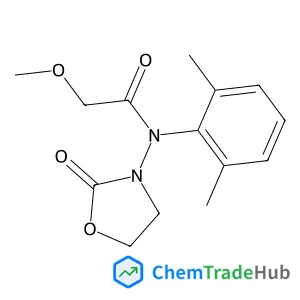
N-(2,6-Dimethylphenyl)-2-methoxy-N-(2-oxo-1,3-oxazolidin-3-yl)acetamide
CAS Number:
77732-09-3
Molecular Formula:
C14H18N2O4
Han-Bo Yang, Yan Guo, Ke Cao, Qi-Jia Jiang, Chao-Chao Teng, Dao-Yong Zhu, Shao-Hua Wang
This work discloses an iridium-catalyzed selective arylation of B(6)–H of 3-Ar-o-carboranes with arylboronic acid via direct B–H activation for the first time. A series of unsymmetric and symmetric 3,6-diaryl-o-carboranes decorated with diverse active groups have been synthesized with moderate to excellent yields under mild conditions. This work offers an efficient approach for selective arylation of B(6)–H with arylboronic acid and has important value for selective functionalization of o-carboranes.
Julian Eastoe, Margarita Sánchez-Dominguez, Paul Wyatt, Richard K. Heenan
DOI: 10.1039/B410158H
Anthony D'Aléo, Jean-Luc Pozzo, Frédéric Fages, Marc Schmutz, Gudrun Mieden-Gundert, Fritz Vögtle, Vesna Caplar, Mladen Zinic
DOI: 10.1039/B307846A
Olof Johansson, Henriette Wolpher, Magnus Borgström, Leif Hammarström, Jonas Bergquist, Licheng Sun, Björn Åkermark
DOI: 10.1039/B308101J
Victorio Cadierno, Josefina Díez, Sergio E. García-Garrido, José Gimeno
DOI: 10.1039/B410812D
Antonio Rosales, Juan L. Oller-López, José Justicia, Andreas Gansäuer, J. Enrique Oltra, Juan M. Cuerva
DOI: 10.1039/B411173G
Jonathan Bould, Yvonne M. McInnes, Michael J. Carr, John D. Kennedy
DOI: 10.1039/B406974A
Marjan Jereb, Stojan Stavber
DOI: 10.1039/B409919B
Nandita Madhavan, Mary S. Gin
DOI: 10.1039/B408482A
Johan Nilsson
DOI: 10.1039/B411451E
Masaru Sakomura, Kazuyoshi Ueda, Masamichi Fujihira
DOI: 10.1039/B410262B
When handling 2-Chloro-1,2-bis(4-methylphenyl)ethanone (CAS: 71193-32-3), it is ...
4-Ethoxy-3-(5-methyl-4-oxo-7-propyl-1,4-dihydroimidazo[5,1-f][1,2,4]triazin-2-yl...
Methyl 3-Oxo-4-Androsten-17-Carboxylate (CAS: 2681-55-2) should be stored in a c...
(R)-3-Amino-4-(3-hexylphenylamino)-4-oxobutylphosphonic acid is primarily used i...
2-Methyl-2-propanyl 3-amino-3-carbamoyl-1-azetidinecarboxylate (CAS: 1254120-14-...
There are alternative reagents that can be used in synthesis instead of (E)-4-(t...
[2-(3-Chlorophenyl)-1,3-thiazol-4-yl]methanol (CAS: 121202-20-8) is a crystallin...
The market and research trends for Methyl (2S)-[(4S)-2,2-dimethyl-1,3-dioxolan-4...
The market for 1-Bromo-2-isocyanatoethane (CAS: 42865-19-0) is driven by its use...
4-Nitro-D-phenylalanine hydrochloride (CAS: 147065-06-3) is primarily used in re...

ChemComm publishes urgent research which is of outstanding significance and interest to experts in the field, while also appealing to the journal’s broad chemistry readership. Our communication format is ideally suited to short, urgent studies that are of such importance that they require accelerated publication. Our scope covers all topics in chemistry, and research at the interface of chemistry and other disciplines (such as materials science, nanoscience, physics, engineering and biology) where there is a significant novelty in the chemistry aspects. Major topic areas covered include: Analytical Chemistry Catalysis Chemical Biology and medicinal chemistry Computational Chemistry and Machine Learning Energy and sustainable chemistry Environmental Chemistry Green Chemistry Inorganic Chemistry Materials Chemistry Nanoscience Organic Chemistry Physical Chemistry Polymer Chemistry Supramolecular Chemistry