












D–A–D–T-type four-component radical dual-difunctionalization and acylative azidation of two different alkenes
Literature Information
Publication Date
2023-05-17
DOI
10.1039/D3CC01463K
Impact Factor
6.222
Authors
Ren-Xiang Liu, Xin Chen, Luo Yang
View Original
Abstract
From a single alkene to two different alkenes! An iron-catalyzed four-component reaction involving an aldehyde, two different alkenes and TMSN3 is developed to assemble these four reactants in an orderly fashion based on the inherent nucleophilic/electrophilic reaction activity of the radicals and alkenes via a double radical addition, providing various multifunctional compounds containing an azido group and two carbonyl groups.
Recommended Journals
Related Literature
Facile resolution of constrained geometry indenyl-phenoxide ligation
Luke E. Turner, Matthew G. Thorn, Phillip E. Fanwick, Ian P. Rothwell
2003-03-28
Communication
DOI: 10.1039/B212724E
Coordination polymers with macrocyclic cages and pockets within their backbones
Moonhyun Oh, Charlotte L. Stern, Chad A. Mirkin
2004-10-08
Communication
DOI: 10.1039/B408084J
Comment: 2004’s fastest organic and biomolecular chemistry!
Caroline V. Potter, Sarah Thomas, Janet L. Dean, Adrian P. Kybett, Richard Kidd, Melanie James, Helen Saxton
2004-11-26
Comment
DOI: 10.1039/B417565B
Highly substituted pyridinesvia tethered imine–enamine (TIE) methodology
Steven A. Raw, Richard J. K. Taylor
2004-01-27
Communication
DOI: 10.1039/B316107B
Modified micro-space using self-organized nanoparticles for reduction of methylene blue
Xianying Li, Hongzhi Wang, Kouzou Inoue, Masato Uehara, Hiroyuki Nakamura, Masaya Miyazaki, Eiichi Abe, Hideaki Maeda
2003-03-18
Communication
DOI: 10.1039/B300765K
Carene terpenoids by gold-catalyzed cycloisomerization reactions
Alois Fürstner, Peter Hannen
2004-10-06
Communication
DOI: 10.1039/B412354A
Zeolitenanoparticles with immobilized metal ions: isolation and MALDI-TOF-MS/MS identification of phosphopeptides
Yahong Zhang, Xijuan Yu, Xiaoyan Wang, Wei Shan, Pengyuan Yang, Yi Tang
2004-10-25
Communication
DOI: 10.1039/B411336E
The role of isomorphism in synthetic analysis. Pruning the search tree by finding disjoint isomorphic substructures
Steven H. Bertz, Toby J. Sommer
2003-03-25
Communication
DOI: 10.1039/B300935A
Phase-transfer alkylation reactions using microreactors
Masaharu Ueno, Hideaki Hisamoto, Takehiko Kitamori, Shū Kobayashi
2003-03-27
Communication
DOI: 10.1039/B301638B
You might also like
Compound Q&A
What industries use (1R,3S)-1,3-Cyclopentanediol (CAS: 16326-97-9)?
(1R,3S)-1,3-Cyclopentanediol finds applications in various industries. In the ph...
16326-97-9(1R,3S)-1,3-Cyclopen...
Compound Q&A
What precautions should be taken when handling N'-[4-(Dimethylamino)phenyl]-N,N-dimethyl-1,4-benzenediamine (CAS: 637-31-0)?
When handling N'-[4-(Dimethylamino)phenyl]-N,N-dimethyl-1,4-benzenediamine, it i...
637-31-0N'-[4-(Dimethylamino...
Compound Q&A
Are there alternatives to 5-(2,4-Difluorophenyl)-2-methoxypyrimidine (CAS: 1352318-16-1) in synthesis?
There are several alternatives to 5-(2,4-Difluorophenyl)-2-methoxypyrimidine in ...
1352318-16-15-(2,4-Difluoropheny...
Compound Q&A
What regulatory guidelines apply to 1-(3-Methoxyphenoxy)propan-2-ol (CAS: 382141-68-6)?
1-(3-Methoxyphenoxy)propan-2-ol (CAS: 382141-68-6) must comply with the Globally...
382141-68-61-(3-Methoxyphenoxy)...
Compound Q&A
Is Tetrodotoxin Citrate (CAS: 18660-81-6) safe?
Tetrodotoxin Citrate is extremely dangerous and should be handled with extreme c...
18660-81-6Tetrodotoxin Citrate
Compound Q&A
What are the main uses of 2-Methyl-2-propanyl [(1R,3S)-3-hydroxycyclopentyl]carbamate (CAS: 225641-84-9)?
2-Methyl-2-propanyl [(1R,3S)-3-hydroxycyclopentyl]carbamate (CAS: 225641-84-9) i...
225641-84-92-Methyl-2-propanyl ...
Compound Q&A
How should waste containing 4-(2-Hydroxyhexafluoroisopropyl)Benzoic Acid (CAS: 16261-80-6) be handled?
Waste containing 4-(2-Hydroxyhexafluoroisopropyl)Benzoic Acid (CAS: 16261-80-6) ...
16261-80-64-(2-Hydroxyhexafluo...
Compound Q&A
How is 2-Methyl-2-proanyl {(2S)-1-[(benzyloxy)amino]-3-hydroxy-3-methyl-1-oxo-2-butanyl}carbamate (CAS: 102507-19-7) typically synthesized?
2-Methyl-2-proanyl {(2S)-1-[(benzyloxy)amino]-3-hydroxy-3-methyl-1-oxo-2-butanyl...
102507-19-72-Methyl-2-propanyl ...
Compound Q&A
What is Benzeneethanamine, α-ethyl-, hydrochloride (1:1) (CAS: 20735-15-3)?
Benzeneethanamine, α-ethyl-, hydrochloride (1:1) is an organic compound with the...
20735-15-3Benzeneethanamine, α...
Compound Q&A
Are there alternatives to 3-{(E)-[4-(Dimethylamino)phenyl]diazenyl}benzoic acid (CAS: 20691-84-3) in synthesis?
In the synthesis of compounds similar to 3-{(E)-[4-(Dimethylamino)phenyl]diazeny...
20691-84-33-{(E)-[4-(Dimethyla...
Source Journal
Chemical Communications

CiteScore:
8.6
Self-citation Rate:
4.7%
Articles per Year:
2458
ChemComm publishes urgent research which is of outstanding significance and interest to experts in the field, while also appealing to the journal’s broad chemistry readership. Our communication format is ideally suited to short, urgent studies that are of such importance that they require accelerated publication. Our scope covers all topics in chemistry, and research at the interface of chemistry and other disciplines (such as materials science, nanoscience, physics, engineering and biology) where there is a significant novelty in the chemistry aspects. Major topic areas covered include: Analytical Chemistry Catalysis Chemical Biology and medicinal chemistry Computational Chemistry and Machine Learning Energy and sustainable chemistry Environmental Chemistry Green Chemistry Inorganic Chemistry Materials Chemistry Nanoscience Organic Chemistry Physical Chemistry Polymer Chemistry Supramolecular Chemistry
Recommended Compounds
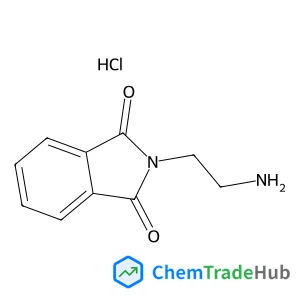
2-(2-Aminoethyl)-1H-isoindole-1,3(2H)-dione hydrochloride (1:1)
CAS Number:
30250-67-0
Molecular Formula:
C10H11ClN2O2
Recommended Suppliers





Disclaimer
This page provides academic journal information for reference and research purposes only. We are not affiliated with any journal publishers and do not handle publication submissions. For publication-related inquiries, please contact the respective journal publishers directly.
If you notice any inaccuracies in the information displayed, please contact us at support@chemtradehub.com. We will promptly review and address your concerns.