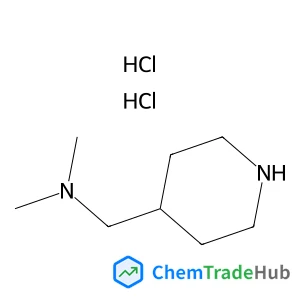
N,N-dimethyl(piperidin-4-yl)methanamine hydrochloride
CAS Number:
172281-72-0
Molecular Formula:
C8H20Cl2N2
Guoyu Qiu
Lilii Bulbus is a notable flower in Chinese cuisine, and has also been used as a Chinese herbal medicine for over 2000 years. This work presents an analytical method for rapidly screening multiple pesticide residues in Lilii Bulbus using ultra-high-performance liquid chromatography-quadrupole time-of-flight mass spectrometry (UPLC-Q-TOF/MS). For sample pre-treatment, the QuEChERS method is employed, and targeted MS/MS is adopted for data acquisition. Moreover, a database containing 515 pesticides with accurate mass database and a high-resolution fragment ion spectrum library is established in this work. In addition, the qualitative and quantitative results of the screening method are validated. The results show that within the linear concentration range of 2 to 200 μg L−1, for each pesticide, 89.3% of the pesticides exhibit linear correlation coefficients R2 equal to or exceeding 0.990. The limit of quantification for all pesticides is below 50 μg kg−1. With a recovery of 70% to 120% and RSD ≤ 20% as the satisfactory standards, 387 (75.0%), 411 (79.7%) and 420 (81.4%) pesticides meet the standards at the three addition levels of 10 μg kg−1, 20 μg kg−1, and 100 μg kg−1, respectively. By utilizing the proposed method, pesticide residues in 100 samples are investigated, providing scientific data to ensure the safety of pesticide residues and demonstrating the general applicability of the method for routine monitoring of pesticide residues in Lilii Bulbus.
Michael Maes, Stijn Schouteden, Luc Alaerts, Diederik Depla, Dirk E. De Vos
DOI: 10.1039/C0CP01703E
William C. Chueh, Chih-Kai Yang, Carol M. Garland, Wei Lai, Sossina M. Haile
DOI: 10.1039/C0CP02198A
Alberto Lesarri, Alicia Vega-Toribio, Richard D. Suenram, Dale J. Brugh, Davood Nori-Shargh, James E. Boggs, Jens-Uwe Grabow
DOI: 10.1039/C0CP02465A
Olga B. Morozova, Konstantin L. Ivanov, Alexey S. Kiryutin, Renad Z. Sagdeev, Talea Köchling, Hans-Martin Vieth, Alexandra V. Yurkovskaya
DOI: 10.1039/C0CP02449J
Yang Chen, Zhou Yang, Xin-Yi Wu, Chun-Yan Ni, Zhi-Gang Ren, Hui-Fang Wang
DOI: 10.1039/C0CP02431G
Xingyu Lu, Olivier Lafon, Julien Trébosc, Feng Deng, Bingwen Hu, Qun Chen, Jean-Paul Amoureux
DOI: 10.1039/C0CP01907K
Meng-Hsuan Chao, Po-Yu Tsai, King-Chuen Lin
DOI: 10.1039/C0CP02710C
Ren-hui Zheng, Qiang Shi
DOI: 10.1039/C0CP01016B
Zhiying Ma, Weihua Wang, Rui Song, Yazhou Zhai, Siwei Bi, Haitao Sun, Yuxiang Bu
DOI: 10.1039/C0CP02298E
K. Vasanth Kumar, M. Monteiro de Castro, M. Martinez-Escandell, M. Molina-Sabio, F. Rodriguez-Reinoso
DOI: 10.1039/C0CP00902D
Ethyl 4-chlorothieno[2,3-b]pyridine-5-carboxylate (CAS: 59713-58-5) can be synth...
5-Methyl-1H-indole-3-carbaldehyde (CAS: 52562-50-2) is subject to various regula...
(1,3-Dimethyl-2,4-dioxo-1,2,3,4-tetrahydro-5-pyrimidinyl)boronic acid is a white...
Waste containing Sulfocostunolide A (CAS: 1016983-51-9) should be handled with c...
When handling Murraxocin (CAS: 88478-44-8), ensure proper personal protective eq...
Formvar (CAS: 63148-64-1) is an alkyd resin characterized by a high molecular we...
(S)-4-benzyl-2-((benzyloxy)methyl)morpholine is generally safe when handled with...
Methyl 1-(5-bromo-2-pyrimidinyl)cyclopropanecarboxylate (CAS: 1447607-69-3) is p...
2-Methyl-1-phenyl-1-propanamine hydrochloride (CAS: 24290-47-9) is generally con...
3-(4-Bromophenyl)-2-methylpropanoic acid is synthesized through a multi-step pro...
Analytical Methods welcomes early applications of new analytical and bioanalytical methods and technology demonstrating the potential for societal impact. We require that methods and technology reported in the journal are sufficiently innovative, robust, accurate, and compared to other available methods for the intended application. Developments with interdisciplinary approaches are particularly welcome. Systems should be proven with suitably complex and analytically challenging samples. We encourage developments within, but not limited to, the following technologies and applications: global health, point-of-care and molecular diagnostics biosensors and bioengineering drug development and pharmaceutical analysis applied microfluidics and nanotechnology omics studies, such as proteomics, metabolomics or glycomics environmental, agricultural and food science neuroscience biochemical and clinical analysis forensic analysis industrial process and method development