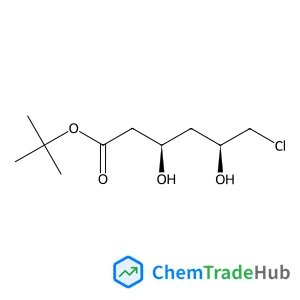
2-Methyl-2-propanyl (3R,5S)-6-chloro-3,5-dihydroxyhexanoate
CAS Number:
154026-93-4
Molecular Formula:
C10H19ClO4
Philipp Schwiderowski, Sascha Stürmer
Using high-pressure methanol and methyl formate pulses as a surface-sensitive operando method for high-pressure methanol synthesis over Cu/ZnO/Al2O3, the recently found autocatalytic pathway was confirmed. The autocatalytic effect is assumed to result from the faster hydrogenation of the formed methyl formate ester at high methoxy coverages compared with the rate-determining hydrogenation of formate to dioxomethylene. When pulsing increasing amounts of methanol at 60 bar and 210 °C under kinetically controlled conditions in 13.5 vol% CO, 3.5 vol% CO2, and 73.5 vol% H2, higher amounts of methanol were observed in response. The surplus of formed methanol was found to increase exponentially as a function of the dosed amount of methanol and the applied residence time. To further investigate the methanol-assisted autocatalytic pathway, methyl formate as the predicted intermediate was pulsed, which was rapidly converted into methanol. Instead of the expected 2 : 1 stoichiometry of methanol : methyl formate, only one methanol molecule was produced per dosed methyl formate molecule. It is concluded that methyl formate is split into methoxy and formate species by dissociative adsorption, but only methoxy species are rapidly further hydrogenated to desorbing methanol, whereas formate hydrogenation to methanol is too slow on the time scale of the pulse experiments.
Chaoqun Zhang, Hannah Korslund, Lan Cheng
DOI: 10.1039/D0CP04608F
Sushil Sharma, Zimu Wei, Ferdinand C. Grozema, Sanchita Sengupta
DOI: 10.1039/D0CP04579A
Hassan Ghermezcheshme, Hesam Makki, Mohsen Mohseni, Morteza Ebrahimi
DOI: 10.1039/D0CP04244G
Fuping Wang, Lang Chen, Deshen Geng, Jianying Lu, Junying Wu
DOI: 10.1039/D0CP02796K
Aniket A. Hande, Clovis Darrigan, Paulina Bartos, Patrick Baylère, Anna Chrostowska
DOI: 10.1039/D0CP03896B
Xingbin Zhao, Li Li, Kuo Bao, Pinwen Zhu, Qiang Tao, Shuailing Ma, Bo Liu, Yufei Ge, Da Li
DOI: 10.1039/D0CP03380D
Isabel Peña, Carlos Cabezas
DOI: 10.1039/D0CP04580B
A. J. Barclay, A. Pietropolli Charmet, K. H. Michaelian, A. R. W. McKellar, N. Moazzen-Ahmadi
DOI: 10.1039/C9CP05480D
Xiaohui Song, Donghai Mei
DOI: 10.1039/D0CP04444J
Waste containing 2-Ethyl-4-Methyl-1H-Imidazole-5-Carbaldehyde (CAS: 88634-80-4) ...
Triethoxy(octyl)silane (CAS: 1385031-14-0) is widely used in the pharmaceuticals...
Several alternatives to 3-iodo-7-nitro-1H-indazole (CAS: 864724-64-1) exist in t...
Yes, there are alternatives to Benzene, bis[(trimethoxysilyl)ethyl] (CAS: 266317...
Isothiazole-3-carbonitrile (CAS: 1452-17-1) is generally considered safe when us...
(3-Chlorophenyl)methanol (CAS: 873-63-2) is considered low to moderately toxic. ...
(2S,3S)-2-Hydroxy-3-({[(2-methyl-2-propanyl)oxy]carbonyl}amino)-3-(2-naphthyl)pr...
Proper handling of methyl 2-(bromomethyl)-5-methoxybenzoate requires the use of ...
6,8-Dibromoimidazo[1,2-a]pyridine-2-carboxylic acid (CAS: 904805-36-3) is an aro...
3-Amino-5-bromo-2-pyridinecarbonitrile is considered safe when handled under pro...

Reaction Chemistry & Engineering is an interdisciplinary journal reporting cutting-edge research focused on enhancing the understanding and efficiency of reactions. Reaction engineering leverages the interface where fundamental molecular chemistry meets chemical engineering and technology. Challenges in chemistry can be overcome by the application of new technologies, while engineers may find improved solutions for process development from the latest developments in reaction chemistry. Reaction Chemistry & Engineering is a unique forum for researchers whose interests span the broad areas of chemical engineering and chemical sciences to come together in solving problems of importance to wider society. All papers should be written to be approachable by readers across the engineering and chemical sciences. Papers that consider multiple scales, from the laboratory up to and including plant scale, are particularly encouraged.

![N-[(1S,2R,4S)-2-Amino-4-(dimethylcarbamoyl)cyclohexyl]-N'-(5-chloro-2-pyridinyl)ethanediamide structure](https://static.chemtradehub.com/structs/480/480452-37-7-0898.webp "N-[(1S,2R,4S)-2-Amino-4-(dimethylcarbamoyl)cyclohexyl]-N'-(5-chloro-2-pyridinyl)ethanediamide structure")