












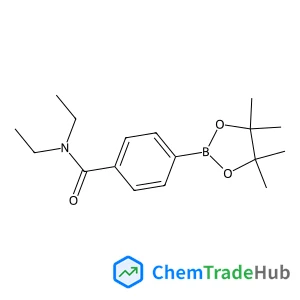
N,N-Diethyl-4-(4,4,5,5-tetramethyl-1,3,2-dioxaborolan-2-yl)benzamide
CAS Number:
325142-99-2
Molecular Formula:
C17H26BNO3
Shibin Chen, Linlin Zhu
A highly facile catalyst-free synthetic methodology for optically active polysulfonamide derivatives with controlled linear architecture has been established based on chiral bis(2-substituted N-sulfonyl aziridine)s. Novel poly(sulfonamide amine)s are prepared in good yields (65–99%) by the step-growth polymerization of bis(aziridine) and diamine. A one-pot, two-step protocol for the synthesis of poly(sulfonamide dithiocarbamate)s has been developed by using the in situ generated bis(dialkyldithiocarbamate), from diamine and carbon disulfide, as the nucleophile to react with bis(aziridine). With appropriate solvents used in this approach, the branches or cross-linkages derived from the homo-polymerization of aziridines are avoided. The synthesized polysulfonamides exhibit excellent thermal properties with decomposition temperature at 5% weight loss (Td,5%) up to 314 °C, and glass transition temperature (Tg) ranging from 49.9 to 137.5 °C. The poly(sulfonamide amine)s bearing tertiary amino groups demonstrate almost complete killing of Staphylococcus aureus (Gram-positive) and Escherichia coli (Gram-negative). It is anticipated that this aziridine-based step-growth polymerization approach will promote aziridine-related polymer chemistry and benefit the exploration of potential applications of aziridine-derived polymeric materials.
Sawsan J. Freij, Gordon M. Parkinson, Manijeh M. Reyhani
DOI: 10.1039/B312505J
Mark A. Blitz, Terry J. Dillon, Dwayne E. Heard, Michael J. Pilling, Ian D. Trought
DOI: 10.1039/B400283K
DOI: 10.1039/B314610N
M. A. Teruel, T. J. Dillon, A. Horowitz, J. N. Crowley
DOI: 10.1039/B316402K
Wilhelm Klein, Alessandra Sani, Martin Jansen
DOI: 10.1039/B312984E
Christopher E. Anson, Norman Sheppard, Ryan Pearman, Sandra Koch
DOI: 10.1039/B309979B
Charles J. Wurrey, Chao Zheng, Gamil A. Guirgis, James R. Durig
DOI: 10.1039/B400142G
Yun-Hong Zhang, Li-Jun Zhao
DOI: 10.1039/B311768E
Scott M. Woodley, Peter D. Battle, Julian D. Gale, C. Richard A. Catlow
DOI: 10.1039/B315066F
Olivier P. J. Vieuxmaire, Michael G. D. Nix, James A. J. Fitzpatrick, Marco Beckert, Richard N. Dixon, Michael N. R. Ashfold
DOI: 10.1039/B313134C
This compound is mainly used as an intermediate in the synthesis of antipsychoti...
Waste containing 1-(D-Ribofuranosyl)-1,4-dihydro-3-pyridinecarboxamide (CAS: 191...
2-Methyl-2-propanyl 3-bromo-3-(hydroxymethyl)-1-azetidinecarboxylate (CAS: 20079...
N-(4-Chloro-2-pyridinyl)acetamide (CAS: 245056-66-0) is a chemical compound with...
5-Chloro-2-hydroxybenzoic acid, also known as 5-chlorosalicylic acid, is an arom...
When handling 1,1-Dichloro-1-fluoroethane (CAS: 1717-00-6), it is important to u...
Fmoc-(2S,3R)-3-phenylpyrrolidine-2-carboxylic acid is a white crystalline solid ...
4-Amino-5-bromo-2-pyridinecarboxylic acid is primarily used as a precursor in th...
Handling this compound should be done with personal protective equipment (PPE) i...
When handling 8-bromo-2,2-dimethyl-3,4-dihydro-2H-1,4-benzoxazin-3-one, use prop...

Polymer Chemistry welcomes submissions in all areas of polymer science that have a strong focus on macromolecular chemistry. Manuscripts may cover a broad range of fields, yet no direct application focus is required.
![tert-Butyl N-[(2-chloropyridin-4-yl)methyl]carbamate structure](https://static.chemtradehub.com/structs/916/916210-27-0-9f95.webp "tert-Butyl N-[(2-chloropyridin-4-yl)methyl]carbamate structure")
![1-[3-(4-Morpholinylsulfonyl)phenyl]methanamine structure](https://static.chemtradehub.com/structs/933/933989-32-3-51af.webp "1-[3-(4-Morpholinylsulfonyl)phenyl]methanamine structure")
![2,6-Di(thiophen-2-yl)dithieno[3,2-b:2',3'-d]thiophene structure](https://static.chemtradehub.com/structs/910/910788-24-8-5b70.webp "2,6-Di(thiophen-2-yl)dithieno[3,2-b:2',3'-d]thiophene structure")





