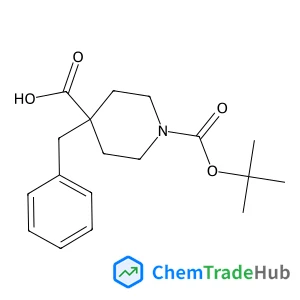
4-Benzyl-1-(tert-butoxycarbonyl)piperidine-4-carboxylic acid
CAS Number:
170838-87-6
Molecular Formula:
C18H25NO4
Scott M. Woodley, Peter D. Battle, Julian D. Gale, C. Richard A. Catlow
A genetic algorithm has been used to generate crystal framework structures from the knowledge of only the unit cell dimensions, constituent atoms and by defining exclusion zones–regions within the unit cell from which the constituent atoms are discouraged. The structures of the better candidates produced are relaxed by minimising the lattice energy, which is based on the Born model of a solid. We present details of the implementation within the computational package GULP. Application to generating various microporous silicate framework structures, without imposing any symmetry relations on the ionic positions, is described. The technique developed can be applied generally in generating new feasible framework structures with defined microporous architectures.
Poomani Ram Kumar, Ebrahim M. Mothi, Mohan Ramesh, Arunkumar Kathiravan
DOI: 10.1039/C7CP07326G
Anders S. Gertsen, Mads Koerstz, Kurt V. Mikkelsen
DOI: 10.1039/C8CP00588E
Fahimeh Akbari, Masumeh Foroutan
DOI: 10.1039/C7CP07932J
Somnath Biswas, Jakub Husek, Stephen Londo, Elizabeth A. Fugate, L. Robert Baker
DOI: 10.1039/C8CP04502J
Hao Chen, Qinghua Lu, Chunhai Yi, Bolun Yang, Suitao Qi
DOI: 10.1039/C7CP08562A
Peter G. Kusalik
DOI: 10.1039/C8CP04466J
Thomas F. Headen, Samantha K. Callear, Matthew Billing, Andrea Sella
DOI: 10.1039/C7CP08220G
Manon Catherin, Elena Zaborova, Anthony D’Aléo, Frédéric Fages, Frédéric Castet, David Casanova
DOI: 10.1039/C8CP05048A
Hajime Torii, Hisako Sato
DOI: 10.1039/C8CP02121J
Cangtao Yin, Mica C. Smith, Maodu Chen, Chunlei Xiao, Dongxu Dai, Kaito Takahashi, Wenrui Dong
DOI: 10.1039/C8CP05920A
This compound is mainly used as an intermediate in the synthesis of antipsychoti...
Waste containing 1-(D-Ribofuranosyl)-1,4-dihydro-3-pyridinecarboxamide (CAS: 191...
2-Methyl-2-propanyl 3-bromo-3-(hydroxymethyl)-1-azetidinecarboxylate (CAS: 20079...
N-(4-Chloro-2-pyridinyl)acetamide (CAS: 245056-66-0) is a chemical compound with...
5-Chloro-2-hydroxybenzoic acid, also known as 5-chlorosalicylic acid, is an arom...
When handling 1,1-Dichloro-1-fluoroethane (CAS: 1717-00-6), it is important to u...
Fmoc-(2S,3R)-3-phenylpyrrolidine-2-carboxylic acid is a white crystalline solid ...
4-Amino-5-bromo-2-pyridinecarboxylic acid is primarily used as a precursor in th...
Handling this compound should be done with personal protective equipment (PPE) i...
When handling 8-bromo-2,2-dimethyl-3,4-dihydro-2H-1,4-benzoxazin-3-one, use prop...

Physical Chemistry Chemical Physics (PCCP) is an international journal co-owned by 19 physical chemistry and physics societies from around the world. This journal publishes original, cutting-edge research in physical chemistry, chemical physics and biophysical chemistry. To be suitable for publication in PCCP, articles must include significant innovation and/or insight into physical chemistry; this is the most important criterion that reviewers and Editors will judge against when evaluating submissions. The journal has a broad scope and welcomes contributions spanning experiment, theory, computation and data science. Topical coverage includes spectroscopy, dynamics, kinetics, statistical mechanics, thermodynamics, electrochemistry, catalysis, surface science, quantum mechanics, quantum computing and machine learning. Interdisciplinary research areas such as polymers and soft matter, materials, nanoscience, energy, surfaces/interfaces, and biophysical chemistry are welcomed if they demonstrate significant innovation and/or insight into physical chemistry. Joined experimental/theoretical studies are particularly appreciated when complementary and based on up-to-date approaches.