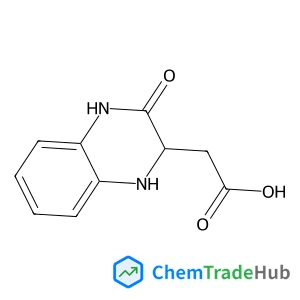
(3-Oxo-1,2,3,4-tetrahydro-2-quinoxalinyl)acetic acid
CAS Number:
136584-14-0
Molecular Formula:
C10H10N2O3
Richard Hoogenboom
The unique material properties of cyclic polymers have made them attractive biomaterials, prompting the need for more efficient cyclization protocols. Due to their chemical versatility, poly(2-alkyl-2-oxazoline)s (PAOx) and poly(2-oxazine)s (POzi) provide potent candidates in this field. However, little to no comprehensive data on the cyclization process of these materials is available, especially not for POzi. In this study, we investigate the impact of a number of reaction parameters (batch volume, catalyst equivalents, molecular weight, and polymer addition method) on the macrocyclization efficiency of PAOx and POzi using copper(I)-catalysed azide–alkyne cycloaddition (CuAAC). It was found that POzi show more efficient conversion to the desired monocyclic species compared to PAOx, possibly due to increased chain flexibility of POzi. Considering macrocyclization efficiency, up to 33× more cyclic POzi could be synthesized per unit volume of solvent, compared to previous protocols for related PAOx, indicating potential for the future scale-up of macrocyclic POzi.

Organic Process Research & Development

Chemistry Education Research and Practice

Saudi Pharmaceutical Journal

Acta Materialia

Russian Journal of Coordination Chemistry

Russian Journal of Bioorganic Chemistry

Chemical Communications

Crystallography Reports

Journal of Peptide Science

Current Opinion in Colloid & Interface Science
Jiahao Chen, Thomas J. Giroux, Yen Nguyen, Atte A. Kadoma, Boyce S. Chang, Brett VanVeller, Martin M. Thuo
DOI: 10.1039/C7CP07531F
Fernan Saiz, David Cubero, Nick Quirke
DOI: 10.1039/C8CP01330F
Hongmei Liu, Xiaolong Li, Changmin Shi, Dongchao Wang, Li Chen, Yuanyuan He, Jianwei Zhao
DOI: 10.1039/C8CP00900G
DOI: 10.1039/C7CP07736J
Francesco Stellato, Matteo Calandra, Francesco D'Acapito, Emiliano De Santis
DOI: 10.1039/C8CP04355H
Taylor A. Barnes, Paul R. C. Kent, David Prendergast
DOI: 10.1039/C8CP05511D
DOI: 10.1039/C8CP03615B
DOI: 10.1039/C7CP07756D
S. Yoshioka, K. Tsuruta, T. Yamamoto, K. Yasuda, S. Matsumura, N. Ishikawa, E. Kobayashi
DOI: 10.1039/C7CP07591J
Denis S. Grebenkov, Ralf Metzler, Gleb Oshanin
DOI: 10.1039/C8CP02043D
This compound is mainly used as an intermediate in the synthesis of antipsychoti...
Waste containing 1-(D-Ribofuranosyl)-1,4-dihydro-3-pyridinecarboxamide (CAS: 191...
2-Methyl-2-propanyl 3-bromo-3-(hydroxymethyl)-1-azetidinecarboxylate (CAS: 20079...
N-(4-Chloro-2-pyridinyl)acetamide (CAS: 245056-66-0) is a chemical compound with...
5-Chloro-2-hydroxybenzoic acid, also known as 5-chlorosalicylic acid, is an arom...
When handling 1,1-Dichloro-1-fluoroethane (CAS: 1717-00-6), it is important to u...
Fmoc-(2S,3R)-3-phenylpyrrolidine-2-carboxylic acid is a white crystalline solid ...
4-Amino-5-bromo-2-pyridinecarboxylic acid is primarily used as a precursor in th...
Handling this compound should be done with personal protective equipment (PPE) i...
When handling 8-bromo-2,2-dimethyl-3,4-dihydro-2H-1,4-benzoxazin-3-one, use prop...

Polymer Chemistry welcomes submissions in all areas of polymer science that have a strong focus on macromolecular chemistry. Manuscripts may cover a broad range of fields, yet no direct application focus is required.
![5-Methyl-4,5,6,7-tetrahydropyrazolo[1,5-a]pyrazin-2-amine structure](https://static.chemtradehub.com/structs/122/1227210-33-4-8d64.webp "5-Methyl-4,5,6,7-tetrahydropyrazolo[1,5-a]pyrazin-2-amine structure")