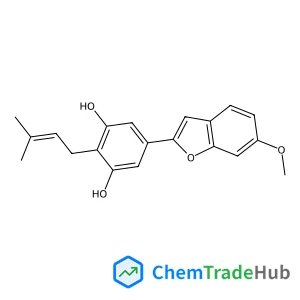
5-(6-Methoxy-1-benzofuran-2-yl)-2-(3-methyl-2-buten-1-yl)-1,3-benzenediol
CAS Number:
1017277-40-5
Molecular Formula:
C20H20O4
Yong-Chol Pak, Chung-Hyok Rim, Suk-Gyong Hwang, Kum-Chol Ri, Chol-Jun Yu
Point defects can be formed readily in layered transition metal oxides used as electrode materials for alkali-ion batteries but their influence on the electrode performance is yet obscure. In this work, we report a systematic first-principles study of intrinsic point defects and defect complexes in sodium titanate Na2Ti3O7, a low-voltage anode material for sodium-ion batteries. Within the density functional theory framework, we calculate the defect formation energies with a set of atomic chemical potentials, which define the synthesis conditions for the stable Na2Ti3O7 compound. Given the atomic chemical potential landscape and defect formation energies, we find that Na interstitials (Nai+), Na antisites (NaTi3−), and Na vacancies (VNa−) are dominant defects depending on the synthesis conditions. Furthermore, our calculations reveal that O vacancies (VO) and Ti antisites (TiNa) lower the electrode potential compared with the perfect system, whereas Ti vacancies (VTi) and NaTi increase the voltage. Finally, we evaluate the activation barriers for vacancy-mediated Na diffusion in the defective systems, finding that the intrinsic point defects improve the Na ion conduction. Our results provide a profound understanding of defect formation and influences on electrode performance, paving a way to designing high-performance anode materials.

Nature Reviews Drug Discovery

Journal of Medical Biochemistry

Environmental Toxicology and Pharmacology

Lab on a Chip

Molecular Diversity

Photochemical & Photobiological Sciences

Contact Lens & Anterior Eye

Mini-Reviews in Medicinal Chemistry

Angewandte Chemie International Edition

Advanced Engineering Materials
Mengyang Li, Zhibin Gao, Yanbo Han, Yaoxiao Zhao, Kun Yuan, Shigeru Nagase, Masahiro Ehara, Xiang Zhao
DOI: 10.1039/D0CP00167H
M. P. Dvores, P. Çarçabal, P. Maître, J. P. Simons
DOI: 10.1039/C9CP06572E
Edoardo Buttarazzi, Francesco Rosi, Gianluca Ciancaleoni
DOI: 10.1039/C9CP03811F
Isaac Benkyi, Enrico Tapavicza, Heike Fliegl, Dage Sundholm
DOI: 10.1039/C9CP04178H
Hongxia Zhu, Xiaolei Zhao, Huanhuan Li
DOI: 10.1039/C9CP06425G
Ting Jia, Zhi Zeng, Xiaoli Zhang, Paul Ohodnicki, Benjamin Chorpening, Gregory Hackett, Jonathan Lekse, Yuhua Duan
DOI: 10.1039/C9CP03883C
Chong-Yuan Zhou, Dong Wang, Xue-Qing Gong
DOI: 10.1039/C9CP03408K
Thomas Niemann
DOI: 10.1039/C9CP04337C
Chunying Rong, Tian Lu, Paul Geerlings, Frank De Proft, Mercedes Alonso, Shubin Liu
DOI: 10.1039/C9CP06120G
When handling 2-Methyl-2-propanyl 5-amino-2-thiophenecarboxylate (CAS: 1498311-5...
5-Bromo-1,2-dichloro-3-fluorobenzene (CAS: 1000572-93-9) is a crystalline solid ...
(2R)-2-Amino-2-(4-bromophenyl)ethanol (CAS: 354153-64-3) should be stored in a c...
Methyl 4-(aminomethyl)tetrahydro-2H-pyran-4-carboxylate hydrochloride (CAS: 3627...
1,4-Dimethyl-1H-pyrazole-5-sulfonyl chloride is primarily used as an intermediat...
Dinaphtho[1,2-b:2',1'-d]furan is generally safe when handled with appropriate pe...
The market for 7-Methyl-7,9-dihydro-1H-purine-2,6,8(3H)-trione (CAS: 612-37-3) i...
2-(4-Chlorophenyl)malonaldehyde (CAS: 205676-17-1) is a colorless or light yello...
2-Methylchrysene (CAS: 3351-32-4) is typically synthesized via the reaction of c...
N-(6-aminopyrimidin-4-yl)acetamide (CAS: 89533-23-3) is generally considered saf...

Physical Chemistry Chemical Physics (PCCP) is an international journal co-owned by 19 physical chemistry and physics societies from around the world. This journal publishes original, cutting-edge research in physical chemistry, chemical physics and biophysical chemistry. To be suitable for publication in PCCP, articles must include significant innovation and/or insight into physical chemistry; this is the most important criterion that reviewers and Editors will judge against when evaluating submissions. The journal has a broad scope and welcomes contributions spanning experiment, theory, computation and data science. Topical coverage includes spectroscopy, dynamics, kinetics, statistical mechanics, thermodynamics, electrochemistry, catalysis, surface science, quantum mechanics, quantum computing and machine learning. Interdisciplinary research areas such as polymers and soft matter, materials, nanoscience, energy, surfaces/interfaces, and biophysical chemistry are welcomed if they demonstrate significant innovation and/or insight into physical chemistry. Joined experimental/theoretical studies are particularly appreciated when complementary and based on up-to-date approaches.
![1-Oxa-8-azaspiro[4.5]decan-3-ol structure](https://static.chemtradehub.com/structs/757/757239-76-2-a0ec.webp "1-Oxa-8-azaspiro[4.5]decan-3-ol structure")