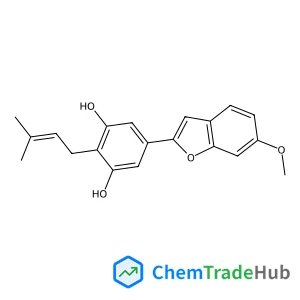
5-(6-Methoxy-1-benzofuran-2-yl)-2-(3-methyl-2-buten-1-yl)-1,3-benzenediol
CAS Number:
1017277-40-5
Molecular Formula:
C20H20O4
Chao Jin, Liang Huang, Yuzhen Niu
A successful drug needs to exhibit both effective pharmacodynamics (PD) and safe pharmacokinetics (PK). However, the coordinated optimization of PD and PK properties in molecule generation tasks remains a great challenge for most existing methods, especially when they focus on the pursuit of affinity and selectivity for the lead compound. Thus, molecular optimization for PK properties is a critical step in the drug discovery pipeline, in which absorption, distribution, metabolism, excretion and toxicity (ADMET) property predictive models play an increasingly important role by providing an effective method to assess multiple PK properties of compounds. Here, we proposed a Graph Bert-based ADMET prediction model that achieves state-of-the-art performance on the public dataset Therapeutics Data Commons (TDC) by combining molecular graph features and descriptor features, with 11 tasks ranked first and 20 tasks ranked in the top 3. Based on this prediction model, we trained a Transformer model with multiple properties as constraints for learning the structural transformations involved in MMP and the accompanying property changes. The experimental results show that the trained Constraints-Transformer can implement targeted modifications to the starting molecule, while preserving the core scaffold. Moreover, molecular docking and binding mode analysis demonstrate that the optimized molecules still retain the activity and selectivity for biological targets. Therefore, the proposed method accounts for biological activity and ADMET properties simultaneously. Finally, a webserver containing ADMET property prediction and molecular optimization functions is provided, enabling chemists to improve the properties of starting molecules individually.
Yaqing Qu, Xueying Chang, Shengli Chen
DOI: 10.1039/C7PY00508C
Jing Zhang, Jiachen Zhu, Chenjie Lu, Zhengye Gu, Tian He, Anle Yang, Huayu Qiu, Mingming Zhang, Shouchun Yin
DOI: 10.1039/C6PY00872K
Friederike Fleischhaker
DOI: 10.1039/C6PY00867D
Xiao-hui Liu, Qiu-yan Zhang, Wen-li Di, Yan-guang Zhang, Chen Ding
DOI: 10.1039/C7PY01040K
Xueyang Liu, Alfred Iing Yoong Tok, Vitali Lipik
DOI: 10.1039/C7PY00786H
Shuai Long, Chunyang Chen, Jun Luo, Haiyan Dong, Limin Wu, Daoyong Chen
DOI: 10.1039/C6PY01816E
When handling 2-Methyl-2-propanyl 5-amino-2-thiophenecarboxylate (CAS: 1498311-5...
5-Bromo-1,2-dichloro-3-fluorobenzene (CAS: 1000572-93-9) is a crystalline solid ...
(2R)-2-Amino-2-(4-bromophenyl)ethanol (CAS: 354153-64-3) should be stored in a c...
Methyl 4-(aminomethyl)tetrahydro-2H-pyran-4-carboxylate hydrochloride (CAS: 3627...
1,4-Dimethyl-1H-pyrazole-5-sulfonyl chloride is primarily used as an intermediat...
Dinaphtho[1,2-b:2',1'-d]furan is generally safe when handled with appropriate pe...
The market for 7-Methyl-7,9-dihydro-1H-purine-2,6,8(3H)-trione (CAS: 612-37-3) i...
2-(4-Chlorophenyl)malonaldehyde (CAS: 205676-17-1) is a colorless or light yello...
2-Methylchrysene (CAS: 3351-32-4) is typically synthesized via the reaction of c...
N-(6-aminopyrimidin-4-yl)acetamide (CAS: 89533-23-3) is generally considered saf...

Physical Chemistry Chemical Physics (PCCP) is an international journal co-owned by 19 physical chemistry and physics societies from around the world. This journal publishes original, cutting-edge research in physical chemistry, chemical physics and biophysical chemistry. To be suitable for publication in PCCP, articles must include significant innovation and/or insight into physical chemistry; this is the most important criterion that reviewers and Editors will judge against when evaluating submissions. The journal has a broad scope and welcomes contributions spanning experiment, theory, computation and data science. Topical coverage includes spectroscopy, dynamics, kinetics, statistical mechanics, thermodynamics, electrochemistry, catalysis, surface science, quantum mechanics, quantum computing and machine learning. Interdisciplinary research areas such as polymers and soft matter, materials, nanoscience, energy, surfaces/interfaces, and biophysical chemistry are welcomed if they demonstrate significant innovation and/or insight into physical chemistry. Joined experimental/theoretical studies are particularly appreciated when complementary and based on up-to-date approaches.
![1-Oxa-8-azaspiro[4.5]decan-3-ol structure](https://static.chemtradehub.com/structs/757/757239-76-2-a0ec.webp "1-Oxa-8-azaspiro[4.5]decan-3-ol structure")