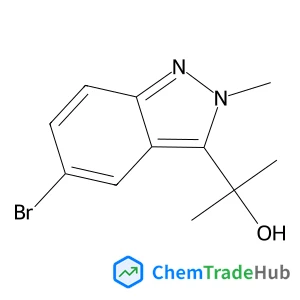
2-(5-Bromo-2-methyl-2H-indazol-3-yl)-2-propanol
CAS Number:
1823787-20-7
Molecular Formula:
C11H13BrN2O
Elena Marzia Sala, Nicola Mazzanti, Francesco M. Chiabrera, Simone Sanna, Mogens B. Mogensen, Peter V. Hendriksen, Zhongtao Ma, Søren B. Simonsen, Christodoulos Chatzichristodoulou
CO2 reduction in Solid Oxide Electrolysis Cells (SOECs) is a key-technology for the transition to a sustainable energy infrastructure and chemical industry. Ceria (CeO2) holds great promise in developing highly efficient, cost-effective and durable fuel electrodes, due to its promising electrocatalytic properties, and proven ability to suppress carbon deposition and to tolerate high concentrations of impurities. In the present work, we investigate the intrinsic electrocatalytic activity of ceria towards CO2 reduction by means of electrochemical impedance spectroscopy (EIS) on model systems with well-defined geometry, composition and surface area. Aiming at the optimization of the intrinsic catalytic properties of the material, we systematically study the effect of different dopants (Zr, Gd, Pr and Bi) on the reaction rate under varying operating conditions (temperature, gas composition and applied polarization) relevant for SOECs. The electrochemical measurements reveal the dominant role of the surface defect chemistry of the material in the reaction rate, with doping having only a mild effect on the rate and activation energy of the reaction. By analyzing the pO2 and overpotential dependence of the reaction rate with a general micro-kinetic model, we are able to identify the second electron transfer as the rate limiting step of the process, highlighting the dominant role of surface polarons in the energy landscape. These insights on the correlation between the surface defects and the electrocatalytic activity of ceria open new directions for the development of highly performing ceria-based technological electrodes.
Sahnawaz Ahmed, Nilotpal Singha, Bapan Pramanik, Julfikar Hassan Mondal, Debapratim Das
DOI: 10.1039/C6PY00809G
Qingshi Wu, Xue Du, Aiping Chang, Xiaomei Jiang, Xiaoyun Yan, Xiaoyu Cao, Zahoor H. Farooqi, Weitai Wu
DOI: 10.1039/C6PY01521B
Mojtaba Enayati, Rauan B. Smail, Silvia Grama, Ryan L. Jezorek, Michael J. Monteiro, Virgil Percec
DOI: 10.1039/C6PY01815G
J. Weißhuhn, T. Mark, M. Martin, P. Müller, A. Seifert, S. Spange
DOI: 10.1039/C6PY00903D
Changyu He, Zhen Zhang, Qinglai Yang, Qing Chang, Zhifeng Shao, Yu-Mei Shen, Bingya Liu, Zhenggang Zhu
DOI: 10.1039/C6PY00651E
P. Bojarová, P. Chytil, B. Mikulová, L. Bumba, R. Konefał, H. Pelantová, J. Krejzová, K. Slámová, L. Petrásková, L. Kotrchová, J. Cvačka, T. Etrych, V. Křen
DOI: 10.1039/C7PY00271H
A. Mero, A. Grigoletto, K. Maso, H. Yoshioka, A. Rosato
DOI: 10.1039/C6PY01616B
When handling 2-Methyl-2-propanyl 5-amino-2-thiophenecarboxylate (CAS: 1498311-5...
5-Bromo-1,2-dichloro-3-fluorobenzene (CAS: 1000572-93-9) is a crystalline solid ...
(2R)-2-Amino-2-(4-bromophenyl)ethanol (CAS: 354153-64-3) should be stored in a c...
Methyl 4-(aminomethyl)tetrahydro-2H-pyran-4-carboxylate hydrochloride (CAS: 3627...
1,4-Dimethyl-1H-pyrazole-5-sulfonyl chloride is primarily used as an intermediat...
Dinaphtho[1,2-b:2',1'-d]furan is generally safe when handled with appropriate pe...
The market for 7-Methyl-7,9-dihydro-1H-purine-2,6,8(3H)-trione (CAS: 612-37-3) i...
2-(4-Chlorophenyl)malonaldehyde (CAS: 205676-17-1) is a colorless or light yello...
2-Methylchrysene (CAS: 3351-32-4) is typically synthesized via the reaction of c...
N-(6-aminopyrimidin-4-yl)acetamide (CAS: 89533-23-3) is generally considered saf...

Physical Chemistry Chemical Physics (PCCP) is an international journal co-owned by 19 physical chemistry and physics societies from around the world. This journal publishes original, cutting-edge research in physical chemistry, chemical physics and biophysical chemistry. To be suitable for publication in PCCP, articles must include significant innovation and/or insight into physical chemistry; this is the most important criterion that reviewers and Editors will judge against when evaluating submissions. The journal has a broad scope and welcomes contributions spanning experiment, theory, computation and data science. Topical coverage includes spectroscopy, dynamics, kinetics, statistical mechanics, thermodynamics, electrochemistry, catalysis, surface science, quantum mechanics, quantum computing and machine learning. Interdisciplinary research areas such as polymers and soft matter, materials, nanoscience, energy, surfaces/interfaces, and biophysical chemistry are welcomed if they demonstrate significant innovation and/or insight into physical chemistry. Joined experimental/theoretical studies are particularly appreciated when complementary and based on up-to-date approaches.