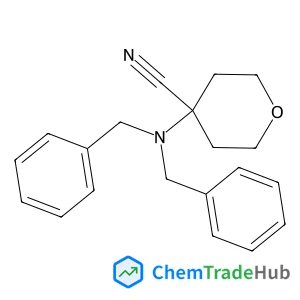
4-(Dibenzylamino)tetrahydro-2H-pyran-4-carbonitrile
CAS Number:
1630906-81-8
Molecular Formula:
C20H22N2O
Oksana I. Grinevich, Victor V. Volkov, Aleksey K. Buryak
We conduct quantum studies of adsorption of diazine heterocycles on graphene to discuss experimental thermodynamics of gas-phase adsorption of pyridazine, pyrimidine and pyrazine on graphitized thermal carbon black, as reported previously. Using Born–Oppenheimer molecular dynamics and density functional studies, we characterize structural and electronic tendencies of the heterocycles on graphene. The theoretical studies predict the adsorption of pyridazine, pyrazine and pyrimidine to cause electronic perturbations of dipole, quadrupole and mixed spatial characters, respectively, resulting in a red shift of the electronic components of the heterocycles to modulate graphene electronics upon admixing of diazine orbital components with the πz states of the substrate. Investigating the thermodynamics of adsorption further involves calculating Henry's constant with the expression of the uniform surface limit: using experimental data, we estimate binding energies and force derivatives with respect to the surface normal. The extracted association energies agree with the results of Lennard-Jones potential calculations. Together, the reported pyridazine anomalous retention required the association force constant to be lower compared with values for the other diazines. Exploring energies of intermolecular relations, we ascribe the pyridazine anomalous retention to possibility of the formation of pyridazine dimers: when on the surface, only for pyridazine, the computed benefit of pairing is larger than the energy of molecular association with graphene.
Monica Bugeanu, Roberto Di Remigio, Krzysztof Mozgawa, Simen Sommerfelt Reine, Helmut Harbrecht, Luca Frediani
DOI: 10.1039/C5CP03410H
Yong Fu Nie, Qian Wang, Xiang Ying Chen, Zhong Jie Zhang
DOI: 10.1039/C5CP06147D
Filipe S. Oliveira, Eurico J. Cabrita, Smilja Todorovic, Carlos E. S. Bernardes, Jennifer L. Hodgson, Douglas R. MacFarlane, Luís P. N. Rebelo, Isabel M. Marrucho
DOI: 10.1039/C5CP06937H
Ludmila B. Boinovich, Alexandre M. Emelyanenko, Kirill A. Emelyanenko, Konstantin I. Maslakov
DOI: 10.1039/C5CP06988B
P. Anees, M. C. Valsakumar, B. K. Panigrahi
DOI: 10.1039/C5CP06111C
Michael Zuzovski, Amir Boag, Amir Natan
DOI: 10.1039/C5CP01090J
Robert Pendrill, Olof Engström, Andrea Volpato, Mirco Zerbetto, Antonino Polimeno, Göran Widmalm
DOI: 10.1039/C5CP06288H
X. Yang, L. Yang, J. Lin, R. Zhou
DOI: 10.1039/C5CP06956D
Markus Martincic, Elzbieta Pach, Belén Ballesteros, Gerard Tobias
DOI: 10.1039/C5CP04664E
When handling 2-Methyl-2-propanyl 5-amino-2-thiophenecarboxylate (CAS: 1498311-5...
5-Bromo-1,2-dichloro-3-fluorobenzene (CAS: 1000572-93-9) is a crystalline solid ...
(2R)-2-Amino-2-(4-bromophenyl)ethanol (CAS: 354153-64-3) should be stored in a c...
Methyl 4-(aminomethyl)tetrahydro-2H-pyran-4-carboxylate hydrochloride (CAS: 3627...
1,4-Dimethyl-1H-pyrazole-5-sulfonyl chloride is primarily used as an intermediat...
Dinaphtho[1,2-b:2',1'-d]furan is generally safe when handled with appropriate pe...
The market for 7-Methyl-7,9-dihydro-1H-purine-2,6,8(3H)-trione (CAS: 612-37-3) i...
2-(4-Chlorophenyl)malonaldehyde (CAS: 205676-17-1) is a colorless or light yello...
2-Methylchrysene (CAS: 3351-32-4) is typically synthesized via the reaction of c...
N-(6-aminopyrimidin-4-yl)acetamide (CAS: 89533-23-3) is generally considered saf...

Physical Chemistry Chemical Physics (PCCP) is an international journal co-owned by 19 physical chemistry and physics societies from around the world. This journal publishes original, cutting-edge research in physical chemistry, chemical physics and biophysical chemistry. To be suitable for publication in PCCP, articles must include significant innovation and/or insight into physical chemistry; this is the most important criterion that reviewers and Editors will judge against when evaluating submissions. The journal has a broad scope and welcomes contributions spanning experiment, theory, computation and data science. Topical coverage includes spectroscopy, dynamics, kinetics, statistical mechanics, thermodynamics, electrochemistry, catalysis, surface science, quantum mechanics, quantum computing and machine learning. Interdisciplinary research areas such as polymers and soft matter, materials, nanoscience, energy, surfaces/interfaces, and biophysical chemistry are welcomed if they demonstrate significant innovation and/or insight into physical chemistry. Joined experimental/theoretical studies are particularly appreciated when complementary and based on up-to-date approaches.
![2-Bromo-7-chloro-4H-pyrrolo[2,3-b]pyrazine structure](https://static.chemtradehub.com/structs/115/1150617-58-5-0b0a.webp "2-Bromo-7-chloro-4H-pyrrolo[2,3-b]pyrazine structure")