












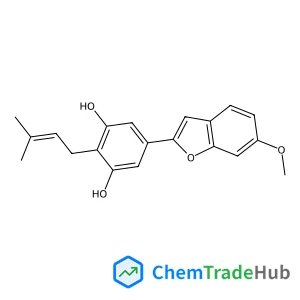
5-(6-Methoxy-1-benzofuran-2-yl)-2-(3-methyl-2-buten-1-yl)-1,3-benzenediol
CAS Number:
1017277-40-5
Molecular Formula:
C20H20O4
Huanling Liu, Kai Zhang, Haipei Zou, Qingfang Mu, Yuzhi Song, Lili Lin, Yuanyuan Xu, Chuan-Kui Wang
Red and near-infrared (NIR) thermally activated delayed fluorescence (TADF) molecules show excellent potential applications in organic light-emitting diodes (OLEDs). Due to the lack of systematic studies on the relationship between molecular structures and luminescence properties, both the species and amounts of red and NIR TADF molecules are far from meeting the requirements for practical applications. Herein, four new efficient molecules (DQCN-2spAs, TPCN-2spAs, DPCN-2spAs and BPCN-2spAs) are proposed and their photophysical properties are theoretically predicted based on first-principles calculations and thermal vibration correlation function (TVCF) theory. The results show that all molecules exhibit red or NIR emissions and they have fast radiative decay rates and reverse intersystem crossing (RISC) rates, and the excellent TADF luminescence properties are predicted. Moreover, based on spiro-acridine (spAs) as the donor unit, the combination with different acceptors can change the dihedral angle between the ground state and the excited state, the bending degree of the donor is positively correlated with the reorganization energy, and this feature can have a great influence on the non-radiative process. Furthermore, based on these theoretical predictions, experimental verifications are performed and the synthesized BPCN-2spAs is confirmed to be an efficient NIR TADF molecule. Thus, the relationships between basic molecular structures and photophysical properties are revealed, a feasible design strategy is applied and four promising red and NIR TADF molecules are proposed. All these results could contribute to the development of red and NIR TADF emitters and OLEDs.
Peng-Fei Wang, Hua Wang, Bao-Hang Han
DOI: 10.1039/C6PY00725B
Peng-Yun Li, Wei-Dong He, Sheng-Qi Chen, Xiao-Xia Lu, Jia-Min Li, Hui-Juan Li
DOI: 10.1039/C6PY00583G
Lucie Seiler, Julien Loiseau, Frédéric Leising, Pascal Boustingorry, Simon Harrisson, Mathias Destarac
DOI: 10.1039/C7PY00747G
Changyu He, Zhen Zhang, Qinglai Yang, Qing Chang, Zhifeng Shao, Yu-Mei Shen, Bingya Liu, Zhenggang Zhu
DOI: 10.1039/C6PY00651E
Zofia Haftek-Terreau, Catherine Ladavière
DOI: 10.1039/C6PY02222G
Boyce S. Chang, Stephanie Oyola-Reynoso, Mingchang Lu
DOI: 10.1039/C7PY00416H
Kun Jiang, Yanan Liu, Yaping Yan, Shengliu Wang, Lianying Liu, Wantai Yang
DOI: 10.1039/C6PY02094A
When handling 2-Methyl-2-propanyl 5-amino-2-thiophenecarboxylate (CAS: 1498311-5...
5-Bromo-1,2-dichloro-3-fluorobenzene (CAS: 1000572-93-9) is a crystalline solid ...
(2R)-2-Amino-2-(4-bromophenyl)ethanol (CAS: 354153-64-3) should be stored in a c...
Methyl 4-(aminomethyl)tetrahydro-2H-pyran-4-carboxylate hydrochloride (CAS: 3627...
1,4-Dimethyl-1H-pyrazole-5-sulfonyl chloride is primarily used as an intermediat...
Dinaphtho[1,2-b:2',1'-d]furan is generally safe when handled with appropriate pe...
The market for 7-Methyl-7,9-dihydro-1H-purine-2,6,8(3H)-trione (CAS: 612-37-3) i...
2-(4-Chlorophenyl)malonaldehyde (CAS: 205676-17-1) is a colorless or light yello...
2-Methylchrysene (CAS: 3351-32-4) is typically synthesized via the reaction of c...
N-(6-aminopyrimidin-4-yl)acetamide (CAS: 89533-23-3) is generally considered saf...

Physical Chemistry Chemical Physics (PCCP) is an international journal co-owned by 19 physical chemistry and physics societies from around the world. This journal publishes original, cutting-edge research in physical chemistry, chemical physics and biophysical chemistry. To be suitable for publication in PCCP, articles must include significant innovation and/or insight into physical chemistry; this is the most important criterion that reviewers and Editors will judge against when evaluating submissions. The journal has a broad scope and welcomes contributions spanning experiment, theory, computation and data science. Topical coverage includes spectroscopy, dynamics, kinetics, statistical mechanics, thermodynamics, electrochemistry, catalysis, surface science, quantum mechanics, quantum computing and machine learning. Interdisciplinary research areas such as polymers and soft matter, materials, nanoscience, energy, surfaces/interfaces, and biophysical chemistry are welcomed if they demonstrate significant innovation and/or insight into physical chemistry. Joined experimental/theoretical studies are particularly appreciated when complementary and based on up-to-date approaches.
![4-Chloro-N-{[4-(dimethylamino)phenyl]carbamoyl}benzenesulfonamide structure](https://static.chemtradehub.com/structs/558/5581-42-0-7dcb.webp "4-Chloro-N-{[4-(dimethylamino)phenyl]carbamoyl}benzenesulfonamide structure")
![L-Lysine,N6-[2-[[(1,1-dimethylethoxy)carbonyl]amino]benzoyl]-N2-[(9H-fluoren-9-ylmethoxy)carbonyl]- structure](https://static.chemtradehub.com/structs/159/159322-59-5-c046.webp "L-Lysine,N6-[2-[[(1,1-dimethylethoxy)carbonyl]amino]benzoyl]-N2-[(9H-fluoren-9-ylmethoxy)carbonyl]- structure")



