












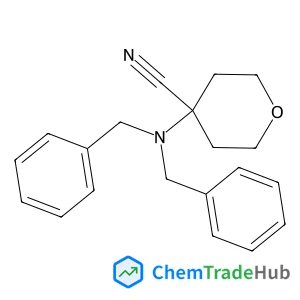
4-(Dibenzylamino)tetrahydro-2H-pyran-4-carbonitrile
CAS Number:
1630906-81-8
Molecular Formula:
C20H22N2O
Fengyuan Lin, Qian Dai, Xiaobing Hou, Bingheng Meng, Dongyue Wang, Le Wang, Zhipeng Wei
Antimonide-based ternary III–V nanowires (NWs) provide a tunable bandgap over a wide range, and the GaAsSb material system has prospective applications in the 1.3–1.55 μm spectral range of optical communications. In this paper, GaAs/Ga(As)Sb/GaAs single quantum well (SQW) NWs were grown on Si(111) substrates by molecular beam epitaxy (MBE). In addition, the morphologies and tunable wavelengths of the GaAs/Ga(As)Sb/GaAs SQWs were adjusted by interrupting the Ga droplets and changing the growth temperatures and V/III ratios. The four morphologies of the GaAs/Ga(As)Sb/GaAs SQW NWs were observed by scanning electron microscopy (SEM). The microscale lattice structure related to the incorporation of Sb in GaAs/Ga(As)Sb/GaAs SQWs was studied by Raman spectroscopy. The crystal quality of the GaAs/Ga(As)Sb/GaAs SQW NWs was researched by X-ray diffraction (XRD) and transmission electron microscopy (TEM). In addition, the optical properties of the GaAs/Ga(As)Sb/GaAs SQWs were investigated by photoluminescence (PL) spectroscopy. The PL spectra showed the peak emission wavelength range of ∼818 nm (GaAs) to ∼1628 nm (GaSb) at 10 K. This study provides an approach to enhance the effective control of the morphology, structure and wavelength of quantum well or core–shell NWs.
Jing Zhang, Jiachen Zhu, Chenjie Lu, Zhengye Gu, Tian He, Anle Yang, Huayu Qiu, Mingming Zhang, Shouchun Yin
DOI: 10.1039/C6PY00872K
Qingshi Wu, Xue Du, Aiping Chang, Xiaomei Jiang, Xiaoyun Yan, Xiaoyu Cao, Zahoor H. Farooqi, Weitai Wu
DOI: 10.1039/C6PY01521B
Katarzyna Kostrzewska, Joanna Ortyl, Robert Dobosz, Janina Kabatc
DOI: 10.1039/C7PY00621G
Qi Liu, Hui Xue, Jinbo Gao, Limin Cao, Hong Chen
DOI: 10.1039/C6PY01788F
Franziska Marx, Karen Strassel, Susanna Kunz, Caroline Lienert, Hartmut Komber, Richard Friend
DOI: 10.1039/C7PY00879A
Boyce S. Chang, Stephanie Oyola-Reynoso, Mingchang Lu
DOI: 10.1039/C7PY00416H
When handling 2-Methyl-2-propanyl 5-amino-2-thiophenecarboxylate (CAS: 1498311-5...
5-Bromo-1,2-dichloro-3-fluorobenzene (CAS: 1000572-93-9) is a crystalline solid ...
(2R)-2-Amino-2-(4-bromophenyl)ethanol (CAS: 354153-64-3) should be stored in a c...
Methyl 4-(aminomethyl)tetrahydro-2H-pyran-4-carboxylate hydrochloride (CAS: 3627...
1,4-Dimethyl-1H-pyrazole-5-sulfonyl chloride is primarily used as an intermediat...
Dinaphtho[1,2-b:2',1'-d]furan is generally safe when handled with appropriate pe...
The market for 7-Methyl-7,9-dihydro-1H-purine-2,6,8(3H)-trione (CAS: 612-37-3) i...
2-(4-Chlorophenyl)malonaldehyde (CAS: 205676-17-1) is a colorless or light yello...
2-Methylchrysene (CAS: 3351-32-4) is typically synthesized via the reaction of c...
N-(6-aminopyrimidin-4-yl)acetamide (CAS: 89533-23-3) is generally considered saf...

Physical Chemistry Chemical Physics (PCCP) is an international journal co-owned by 19 physical chemistry and physics societies from around the world. This journal publishes original, cutting-edge research in physical chemistry, chemical physics and biophysical chemistry. To be suitable for publication in PCCP, articles must include significant innovation and/or insight into physical chemistry; this is the most important criterion that reviewers and Editors will judge against when evaluating submissions. The journal has a broad scope and welcomes contributions spanning experiment, theory, computation and data science. Topical coverage includes spectroscopy, dynamics, kinetics, statistical mechanics, thermodynamics, electrochemistry, catalysis, surface science, quantum mechanics, quantum computing and machine learning. Interdisciplinary research areas such as polymers and soft matter, materials, nanoscience, energy, surfaces/interfaces, and biophysical chemistry are welcomed if they demonstrate significant innovation and/or insight into physical chemistry. Joined experimental/theoretical studies are particularly appreciated when complementary and based on up-to-date approaches.
![N-[(1-Ethyl-2-pyrrolidinyl)methyl]-2-hydroxy-5-sulfamoylbenzamide structure](https://static.chemtradehub.com/structs/673/67381-52-6-877f.webp "N-[(1-Ethyl-2-pyrrolidinyl)methyl]-2-hydroxy-5-sulfamoylbenzamide structure")
![1-{[5-(4,4,5,5-Tetramethyl-1,3,2-dioxaborolan-2-yl)-2-thienyl]methyl}piperidine structure](https://static.chemtradehub.com/structs/121/1218790-44-3-baef.webp "1-{[5-(4,4,5,5-Tetramethyl-1,3,2-dioxaborolan-2-yl)-2-thienyl]methyl}piperidine structure")




