












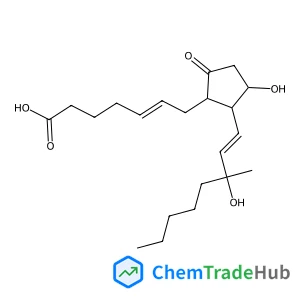
(5Z,11alpha,13E,15R)-11,15-Dihydroxy-15-methyl-9-oxoprosta-5,13-dien-1-oic acid
CAS Number:
55028-70-1
Molecular Formula:
C21H34O5
Rishabh Gupta, Manas Sajjan, Sabre Kais
Quantum state tomography is an integral part of quantum computation and offers the starting point for the validation of various quantum devices. One of the central tasks in the field of state tomography is to reconstruct, with high fidelity, the quantum states of a quantum system. From an experiment on a real quantum device, one can obtain the mean measurement values of different operators. With such data as input, in this report we employ the maximal entropy formalism to construct the least biased mixed quantum state that is consistent with the given set of expectation values. Even though, in principle, the reported formalism is quite general and should work for an arbitrary set of observables, in practice we shall demonstrate the efficacy of the algorithm on an informationally complete (IC) set of Hermitian operators. Such a set possesses the advantage of uniquely specifying a single quantum state from which the experimental measurements have been sampled and hence renders the rare opportunity not only to construct a least-biased quantum state but even replicate the exact state prepared experimentally within a preset tolerance. The primary workhorse of the algorithm is reconstructing an energy function which we designate as the effective Hamiltonian of the system, and parameterizing it with Lagrange multipliers, according to the formalism of maximal entropy. These parameters are thereafter optimized variationally so that the reconstructed quantum state of the system converges to the true quantum state within an error threshold. To this end, we employ a parameterized quantum circuit and a hybrid quantum-classical variational algorithm to obtain such a target state, making our recipe easily implementable on a near-term quantum device.
Giovanni Romanelli, Xuan Zhang, Kian Ping Loh, Carla Andreani
DOI: 10.1039/C5CP05240H
Vinh Van, Wolfgang Stahl, Ha Vinh Lam Nguyen
DOI: 10.1039/C5CP03513A
Nan Chen, Xianke Huang, Liangti Qu
DOI: 10.1039/C5CP04391C
Heinz-Jürgen Flad, Gohar Harutyunyan, Bert-Wolfgang Schulze
DOI: 10.1039/C5CP01183C
Yu Li, Firuz Demir, Satoshi Kaneko, Shintaro Fujii, Tomoaki Nishino, George Kirczenow, Manabu Kiguchi
DOI: 10.1039/C5CP05227K
Felix E. Feiten, Helmut Kuhlenbeck, Hans-Joachim Freund
DOI: 10.1039/C5CP07390A
Yong Fu Nie, Qian Wang, Xiang Ying Chen, Zhong Jie Zhang
DOI: 10.1039/C5CP06147D
Dorian S. N. Parker, Ralf I. Kaiser, Oleg Kostko, Tyler P. Troy, Musahid Ahmed, Bing-Jian Sun, Shih-Hua Chen, A. H. H. Chang
DOI: 10.1039/C5CP02960K
Markus Martincic, Elzbieta Pach, Belén Ballesteros, Gerard Tobias
DOI: 10.1039/C5CP04664E
Thomas Fransson, Iurii Zhovtobriukh, Patrick Norman, Lars G. M. Pettersson
DOI: 10.1039/C5CP03919C
When handling 2-Methyl-2-propanyl 5-amino-2-thiophenecarboxylate (CAS: 1498311-5...
5-Bromo-1,2-dichloro-3-fluorobenzene (CAS: 1000572-93-9) is a crystalline solid ...
(2R)-2-Amino-2-(4-bromophenyl)ethanol (CAS: 354153-64-3) should be stored in a c...
Methyl 4-(aminomethyl)tetrahydro-2H-pyran-4-carboxylate hydrochloride (CAS: 3627...
1,4-Dimethyl-1H-pyrazole-5-sulfonyl chloride is primarily used as an intermediat...
Dinaphtho[1,2-b:2',1'-d]furan is generally safe when handled with appropriate pe...
The market for 7-Methyl-7,9-dihydro-1H-purine-2,6,8(3H)-trione (CAS: 612-37-3) i...
2-(4-Chlorophenyl)malonaldehyde (CAS: 205676-17-1) is a colorless or light yello...
2-Methylchrysene (CAS: 3351-32-4) is typically synthesized via the reaction of c...
N-(6-aminopyrimidin-4-yl)acetamide (CAS: 89533-23-3) is generally considered saf...

Physical Chemistry Chemical Physics (PCCP) is an international journal co-owned by 19 physical chemistry and physics societies from around the world. This journal publishes original, cutting-edge research in physical chemistry, chemical physics and biophysical chemistry. To be suitable for publication in PCCP, articles must include significant innovation and/or insight into physical chemistry; this is the most important criterion that reviewers and Editors will judge against when evaluating submissions. The journal has a broad scope and welcomes contributions spanning experiment, theory, computation and data science. Topical coverage includes spectroscopy, dynamics, kinetics, statistical mechanics, thermodynamics, electrochemistry, catalysis, surface science, quantum mechanics, quantum computing and machine learning. Interdisciplinary research areas such as polymers and soft matter, materials, nanoscience, energy, surfaces/interfaces, and biophysical chemistry are welcomed if they demonstrate significant innovation and/or insight into physical chemistry. Joined experimental/theoretical studies are particularly appreciated when complementary and based on up-to-date approaches.
![L-Lysine,N6-[2-[[(1,1-dimethylethoxy)carbonyl]amino]benzoyl]-N2-[(9H-fluoren-9-ylmethoxy)carbonyl]- structure](https://static.chemtradehub.com/structs/159/159322-59-5-c046.webp "L-Lysine,N6-[2-[[(1,1-dimethylethoxy)carbonyl]amino]benzoyl]-N2-[(9H-fluoren-9-ylmethoxy)carbonyl]- structure")
![2-Bromo-7-chloro-4H-pyrrolo[2,3-b]pyrazine structure](https://static.chemtradehub.com/structs/115/1150617-58-5-0b0a.webp "2-Bromo-7-chloro-4H-pyrrolo[2,3-b]pyrazine structure")





