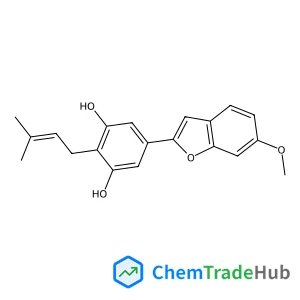
5-(6-Methoxy-1-benzofuran-2-yl)-2-(3-methyl-2-buten-1-yl)-1,3-benzenediol
CAS Number:
1017277-40-5
Molecular Formula:
C20H20O4
Shuai Wang, Lihong Liang
The mechanical response of graphene foams (GrFs) can be enhanced by both short crosslinkers (e.g. C–C bond) and long carbon nanotubes (CNTs) in experiments; however, the underlying mechanism is still unclear. Here, a coarse-grained molecular dynamics method is used to study the mechanical response and microscopic mechanism of GrF interconnected by both short crosslinkers and long CNTs (named CNT bonded GrF, CbGrF) under tension and compression, and the effect of the properties of graphene and CNTs on the mechanical properties of CbGrF is also investigated. Compared with short bonds, long CNTs play a reinforcing role at a larger tensile strain, leading to larger tensile strength and toughness. Under compression, the sliding and rotation of graphene sheets in CbGrF are prevented by long CNTs, resulting in higher compressive stiffness than that of pure GrFs. Furthermore, the tensile and compressive moduli increase by more than 300% with increasing thickness of graphene sheets from 1 to 9 layers; they increase by no more than 50% as the CNT bending stiffness increases and are almost independent of the stretching stiffness of CNTs. These results should be helpful for understanding the tunability of GrFs using both short and long crosslinkers and guiding the preparation of advanced GrF-based composites.
Yesica Di Iorio, Mariana Berruet, Marcela Vazquez, Ricardo E. Marotti
DOI: 10.1039/C9CP04256C
Ting Jia, Zhi Zeng, Xiaoli Zhang, Paul Ohodnicki, Benjamin Chorpening, Gregory Hackett, Jonathan Lekse, Yuhua Duan
DOI: 10.1039/C9CP03883C
M. Jotkar, L. Rongy, A. De Wit
DOI: 10.1039/C9CP03044A
Artur Nowak, Paweł Tecmer, Katharina Boguslawski
DOI: 10.1039/C9CP03678D
Alba Cuadrado, Alejandra Gilabert, Lluís Fajarí, Ignasi Sirés, Enric Brillas, Maria Pilar Almajano, Dolores Velasco, Josep M. Anglada, Luis Juliá
DOI: 10.1039/C9CP02444A
Joel H. Bombile, Shreya Shetty, Michael J. Janik, Scott T. Milner
DOI: 10.1039/C9CP06039A
Hind Benzidi, Marwan Lakhal, Mourad Garara, Mustapha Abdellaoui, Abdelilah Benyoussef, Abdallah El kenz, Omar Mounkachi
DOI: 10.1039/C9CP03230D
Manel Naouai, Faouzi Najar, Kamel Hammami
DOI: 10.1039/C9CP04214H
Yongnan Xiong, Xiaofan Li, Shifang Xiao, Huiqiu Deng, Bowen Huang, Wenjun Zhu, Wangyu Hu
DOI: 10.1039/C9CP02920F
When handling 2-Methyl-2-propanyl 5-amino-2-thiophenecarboxylate (CAS: 1498311-5...
5-Bromo-1,2-dichloro-3-fluorobenzene (CAS: 1000572-93-9) is a crystalline solid ...
(2R)-2-Amino-2-(4-bromophenyl)ethanol (CAS: 354153-64-3) should be stored in a c...
Methyl 4-(aminomethyl)tetrahydro-2H-pyran-4-carboxylate hydrochloride (CAS: 3627...
1,4-Dimethyl-1H-pyrazole-5-sulfonyl chloride is primarily used as an intermediat...
Dinaphtho[1,2-b:2',1'-d]furan is generally safe when handled with appropriate pe...
The market for 7-Methyl-7,9-dihydro-1H-purine-2,6,8(3H)-trione (CAS: 612-37-3) i...
2-(4-Chlorophenyl)malonaldehyde (CAS: 205676-17-1) is a colorless or light yello...
2-Methylchrysene (CAS: 3351-32-4) is typically synthesized via the reaction of c...
N-(6-aminopyrimidin-4-yl)acetamide (CAS: 89533-23-3) is generally considered saf...

Physical Chemistry Chemical Physics (PCCP) is an international journal co-owned by 19 physical chemistry and physics societies from around the world. This journal publishes original, cutting-edge research in physical chemistry, chemical physics and biophysical chemistry. To be suitable for publication in PCCP, articles must include significant innovation and/or insight into physical chemistry; this is the most important criterion that reviewers and Editors will judge against when evaluating submissions. The journal has a broad scope and welcomes contributions spanning experiment, theory, computation and data science. Topical coverage includes spectroscopy, dynamics, kinetics, statistical mechanics, thermodynamics, electrochemistry, catalysis, surface science, quantum mechanics, quantum computing and machine learning. Interdisciplinary research areas such as polymers and soft matter, materials, nanoscience, energy, surfaces/interfaces, and biophysical chemistry are welcomed if they demonstrate significant innovation and/or insight into physical chemistry. Joined experimental/theoretical studies are particularly appreciated when complementary and based on up-to-date approaches.
![methyl 6-amino-1H-pyrrolo[2,3-b]pyridine-4-carboxylate structure](https://static.chemtradehub.com/structs/119/1190315-60-6-9d9a.webp "methyl 6-amino-1H-pyrrolo[2,3-b]pyridine-4-carboxylate structure")